

Which hormone balance supplements may help men over 40
Declining performance isn’t something to ignore, but supplements aren’t a shortcut to a diagnosis. Signs linked with low testosterone can include fatigue, reduced libido, and mood swings. Hormone balance supplements for men over 40 may include nutrients such as vitamin D and zinc, alongside herbs like ashwagandha, tongkat ali, or fenugreek, each with different potential roles.
You’re right to look beyond age alone: symptoms can have more than one cause, and a supplement that suits one man may not suit another. The smart move is to identify the pattern, understand what the evidence says, and avoid stacking ingredients without a clear reason.
This guide covers common signs of hormonal imbalance, what age-related testosterone changes may mean, and how vitamins and herbal supplements can fit into a practical plan. It also explains why professional advice matters before starting a new regimen, so you can make an informed choice based on your health rather than guesswork.
Key Takeaways
- Learn how vitamin D, zinc, and omega-3s fit into nutritional support, and why correcting a deficiency matters more than taking supplements blindly.
- Recognize changes in energy, libido, and mood as signals to investigate, not proof of a hormonal imbalance.
- Understand how testosterone can change with age and why symptoms deserve a closer look rather than assumptions about aging.
- See how healthcare professionals can help assess symptoms, supplement safety, and whether further evaluation is appropriate.
- Compare herbal options such as ashwagandha, tongkat ali, and fenugreek, while keeping the limits of the evidence in view.
1. Can vitamins help hormonal imbalance?
Vitamins can support hormone-related processes, but they don’t diagnose or correct every imbalance. Vitamin D contributes to testosterone production, while zinc plays a role in testosterone production and sperm health. These functions make both nutrients relevant to men over 40. They don’t prove that extra supplements raise testosterone levels when nutrient intake is already adequate.
Vitamin D deserves attention when sun exposure is limited, including during winter. It also identifies a 25-hydroxy vitamin D level of 30-50 ng/mL as an optimal range for men over 40. A blood test can show whether vitamin D status is low; fatigue alone can’t identify the cause.
Zinc supports reproductive health, but more isn’t necessarily better. Low zinc levels may affect reproductive hormones, and zinc also contributes to sperm health. Count zinc from both food and supplements toward your total intake. Check product labels before combining supplements to avoid doubling up on the same vitamin or mineral.
Omega-3 fatty acids have anti-inflammatory properties and a role in hormonal regulation. They also serve as precursors needed to produce estrogen, progesterone, and testosterone. That gives men a practical food-first option.
Vitamin B6 is involved in processes related to sex hormone balance. Don’t add a high-dose vitamin based on a hormone claim alone. Consider your diet, existing supplements, and health needs together.
Evidence supports vitamin D and zinc as nutrients with roles in testosterone biology, not as guaranteed testosterone boosters. The National Center for Complementary and Integrative Health (NCCIH) says limited evidence suggests ashwagandha taken for 2 to 4 months may increase testosterone levels and sperm quality; DHEA evidence isn’t established in the supplied facts.
Supplements can cause side effects or interact with medicines, particularly when products are combined or taken at high doses. Discuss a new regimen with a healthcare professional, especially before using DHEA or high-dose vitamins. Magnesium is part of overall nutrition, but it isn’t a substitute for assessing a suspected hormone problem.
2. What are the Signs and Symptoms of Hormonal Imbalance in Men?
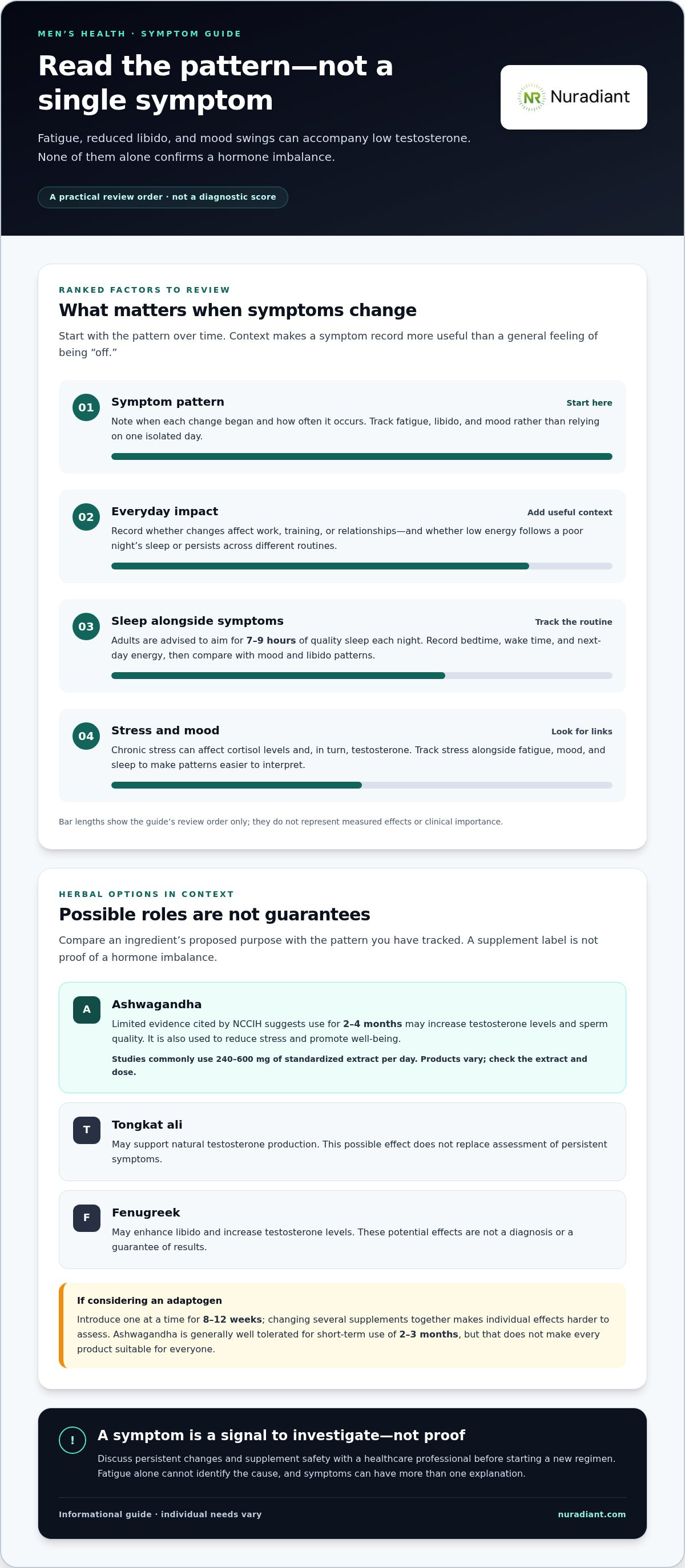
Fatigue, reduced libido, and mood swings can accompany low testosterone, but no single symptom identifies a hormone imbalance. Track when each change began, how often it occurs, and whether it affects work, training, or relationships. For example, note whether low energy follows a poor night’s sleep or persists across different routines. This pattern gives a healthcare professional more useful context than a general sense of feeling off.
Stress is another part of the picture. Chronic stress can contribute to hormonal imbalances affecting cortisol levels and, in turn, testosterone. Ashwagandha is an adaptogenic herb used to reduce stress and promote well-being. It may be worth investigating when stress is part of the pattern, but it isn’t a direct answer to every symptom. Track stress alongside fatigue, mood, and sleep to make changes easier to interpret.
Sleep is useful to track, but it can’t diagnose a hormone problem on its own. Adults are advised to aim for seven to nine hours of quality sleep each night to support hormonal health. Keep a simple record of bedtime, wake time, and next-day energy, then compare it with mood and libido patterns. This can help distinguish a short-lived rough patch from a persistent change to discuss with a professional.
Ashwagandha products vary, so read the label for the extract and dose. Studies commonly use 240 to 600 milligrams of standardized extract per day. Ashwagandha is generally well tolerated for short-term use of 2-3 months, but that doesn’t make every product suitable for every person. If considering an adaptogen, introduce one at a time for 8-12 weeks. Changing several supplements together makes their individual effects harder to assess.
Tongkat ali may support natural testosterone production, while fenugreek may enhance libido and increase testosterone levels. These possible effects don’t replace an assessment of persistent fatigue, reduced libido, or mood changes. Compare each ingredient’s intended purpose with the symptoms you’ve tracked. A supplement label isn’t proof of a hormonal imbalance or that an herb will resolve it.
Start with a focused step: record symptoms, sleep, and stress, then discuss the pattern with a healthcare professional before beginning a new supplement regimen. You can review safety and effectiveness, including whether ashwagandha, tongkat ali, or fenugreek fits your circumstances. Avoid chasing every symptom with another capsule. Identify the pattern first, then make a deliberate choice.
3. Andropause and age-related testosterone decline
Andropause is commonly described as a testosterone-related change that can occur in men over 40. The term doesn’t mean every man experiences the same symptoms or timing. Testosterone levels can change with age, but age alone doesn’t establish that symptoms come from low testosterone. Track what changes and when, rather than treating a birthday as a diagnosis.
The figures show why age deserves attention, not assumptions. Almost 20% of men over age 60 have low testosterone levels. The figure rises to 30% among men in their 70s and 80s. These statistics don’t predict an individual man’s hormone status. They do reinforce a practical distinction: an age-related trend and a confirmed problem aren’t interchangeable.
Common symptoms associated with low testosterone include fatigue, reduced libido, and mood swings. They can affect everyday life, from keeping up with training to feeling engaged at home. Note when symptoms began, whether they persist, and how they affect your regular activities. A brief record is often more useful than relying on memory alone.
Use one simple tracking routine: record energy, sex drive, mood, sleep, and exercise in the same place. Add context, such as a stressful week or disrupted sleep. This won’t identify the cause, but it will show how things change over time. Avoid changing several supplements or lifestyle habits at once, which can make cause and effect harder to assess.
Testosterone replacement therapy is commonly prescribed for men experiencing symptoms of low testosterone, including fatigue, reduced libido, and mood swings. It’s a medical treatment, not a general-purpose supplement for managing age. Decisions about treatment depend on symptoms and testosterone status, not age alone. Keep this distinction in mind when comparing therapy with over-the-counter products.
Lifestyle habits support overall well-being and hormone balance. Regular exercise, stress management, balanced eating, and enough sleep are practical foundations. Adults are advised to aim for seven to nine hours of quality sleep each night to support hormonal health. These habits don’t replace assessment of persistent symptoms, but they offer concrete areas to review while tracking changes.
Don’t use a nutrient or “testosterone support” label to explain away a lasting change in how you feel or function. A focused record of symptoms, sleep, stress, and activity is a useful starting point for discussing next steps. The goal is to identify the pattern, understand whether low testosterone may be involved, and consider an approach suited to the evidence and your health needs.
4. Consulting a healthcare professional
Before starting a supplement, discuss your symptoms, health history, and current medicines with a healthcare professional. Bring a written list of products, including ingredient amounts and how often you take them. Mention changes in energy, strength, libido, mood, or sexual function. This context helps the professional consider possible causes and assess a new regimen for safety and effectiveness.
If you suspect low testosterone, describe your symptoms and how they affect daily life. A healthcare professional can consider your history and decide whether hormone testing fits the situation. Ask what a proposed test measures and how the result relates to your symptoms. Fatigue or reduced libido alone doesn’t prove low testosterone, and a supplement label isn’t a basis for starting testosterone treatment.
Supplements can raise questions about medicines and testing. Give a healthcare professional a complete list of vitamins, herbs, and other products before making changes. Ask whether an ingredient could interact with a medicine or affect a planned blood test, and follow the test instructions. Make the conversation specific by naming each ingredient, its amount, and when you take it, rather than calling it only a “testosterone booster.”
In the United States, supplement cost depends on factors such as ingredients, formulation, serving size, and supply duration. Compare the full label and serving information, not just front-of-package claims. For quality and safety, look for clearly identified ingredients and amounts, along with accessible independent testing documentation. Check what testing covers, such as identity and purity; a testing claim isn’t proof of effectiveness.
Mental health is part of the assessment, too. Persistent mood changes, stress, or low motivation can affect daily life and overlap with hormone concerns. Share these symptoms directly rather than trying to manage them only with supplements. A professional can consider mental health, sleep, medicines, and physical symptoms together to help identify a suitable next step.
Food choices matter alongside supplement decisions. Adults are advised to consume 25 to 35 grams of fiber per day; increase fiber gradually to help prevent gastrointestinal discomfort. Beans, oats, and vegetables are practical examples to discuss when improving meals. Probiotics are aimed at gut health, so define that goal separately from suspected low testosterone. Don’t assume a gut-health product treats a hormone problem. A focused conversation keeps each choice tied to its purpose, safety, and your symptoms.
5. Herbal supplements for hormone balance
Herbal products have different intended purposes, so compare ingredients rather than relying on a broad label. Ashwagandha is an adaptogenic herb used to reduce stress and promote well-being. Tongkat ali may support natural testosterone production, while fenugreek may enhance libido and increase testosterone levels. These possible roles aren’t interchangeable. Match an herb to a specific goal, such as stress management or sexual health, rather than buying into a general “hormone balance” promise.
Evidence also has limits. The National Center for Complementary and Integrative Health (NCCIH) says limited evidence suggests that taking ashwagandha for 2 to 4 months may increase testosterone levels and sperm quality. That finding doesn’t establish an effect for every man or every product. It’s a reason to assess the evidence carefully, not to assume an herb will correct a diagnosed hormone problem.
Formulation matters. Studies of ashwagandha commonly use 240 to 600 milligrams of standardized extract per day. Check whether a label identifies the extract and amount, rather than relying on a proprietary blend’s broad claims. Ashwagandha is generally well tolerated for short-term use of 2-3 months. That short-term description doesn’t mean longer use is automatically suitable.
Keep the trial focused. Introduce one adaptogen at a time for 8-12 weeks to assess your response. Before starting, write down the goal, such as tracking stress or energy levels. Note the dose and use the same simple record throughout. If several herbs begin together, you can’t tell which ingredient relates to a change in symptoms or hormone levels.
Track outcomes separately. Record libido, mood, sleep, and energy alongside your supplement routine. If weight is a concern, track it on its own rather than treating a change as proof of a hormone effect. A clear record can help distinguish your intended goal from ordinary day-to-day variation. Discuss persistent symptoms with a healthcare professional rather than attributing them to an herb.
Build safety into your decision. Before adding ashwagandha, tongkat ali, or fenugreek, review the product label and your current medicines with a healthcare professional. Bring the ingredient list and serving directions. Herbs may have a supporting role, but their evidence and intended uses differ. Choose one clear goal, assess one product at a time, and keep expectations in line with what the evidence supports.
Nuradiant: Men's Health Supplements
Nuradiant offers Men's Health Supplements for men looking to make informed supplement choices as they age. Its range also includes CBD Products, Nootropics, and Joint Health Supplements, each serving a different wellness focus. Use the guidance in this article to clarify your priorities, such as supporting general nutrition or addressing a specific health goal. Supplements can complement a considered routine, but persistent symptoms or suspected low testosterone call for a conversation with a healthcare professional, not guesswork or self-treatment. Explore Nuradiant’s offerings and choose your next step with your goals in mind. Visit nuradiant.com to learn more.
Make Your Next Move Deliberate
The strongest next move isn’t adding another capsule. Define the outcome you want to support, note the products you already use, and make choices that fit your broader health priorities. That approach keeps hormone balance supplements for men over 40 in perspective: they’re one part of a considered routine, not a substitute for understanding persistent symptoms or protecting long-term health.
For men exploring supplement options, Nuradiant offers Men’s Health Supplements, CBD Products, and Nootropics. These categories suit different wellness interests, so focus on your goal and review ingredients carefully. For ongoing symptoms or concerns about a possible hormonal issue, discuss your next steps with a healthcare professional before changing your regimen.
Take ownership of your next step with a clear goal and informed decisions. Contact Nuradiant about its supplement range, and keep moving forward with purpose.
Frequently Asked Questions
What are the Signs and Symptoms of Hormonal Imbalance in Men?
Possible signs include persistent fatigue, reduced libido, and mood changes, but they don’t reveal the cause on their own. Notice whether they affect daily life, such as concentration at work, motivation to exercise, or sexual relationships. Track when they started and whether they’re changing. A clear timeline helps distinguish an ongoing concern from a difficult day and gives a healthcare professional useful context.
Can vitamins help hormonal imbalance?
Vitamins can support processes involved in hormone production, especially when a nutrient is lacking. Vitamin D and zinc have roles related to testosterone, while omega-3 fatty acids support hormonal regulation. That doesn’t mean taking more will automatically improve hormone levels. Consider your diet, current supplements, and health needs together. If you suspect a deficiency, discuss whether an assessment is appropriate before adding a high-dose product.
Understanding Andropause: What Do Men Need to Know?
Andropause is a term for age-related changes involving testosterone, commonly discussed in men over 40. It isn’t a fixed event that happens to every man at the same age. Changes vary, and symptoms such as lower energy or libido can have different causes. Treat the term as a prompt to assess a persistent change, not a diagnosis or proof that testosterone treatment is needed.
What hormone changes are common in men over 40?
Testosterone may decline with age, but the timing and degree vary between individuals. Age alone can’t show whether your hormone levels are low or explain a change in performance. Pay attention to persistent symptoms and their effect on daily life. Consider the wider context, including sleep, stress, diet, activity, and any medicines or supplements you use, rather than assuming every change is hormonal.
What symptoms may indicate low testosterone in men over 40?
Fatigue, reduced libido, and mood swings may occur with low testosterone, but none confirms it alone. Look for a persistent pattern instead of relying on one difficult day or a single change in sexual interest. Note how symptoms affect your routine, relationships, and usual activities. Share those details with a healthcare professional, who can consider them alongside an appropriate evaluation.
Which supplements are marketed for hormone balance in men, and what ingredients do they contain?
Options among hormone balance supplements for men over 40 may include vitamin D, zinc, omega-3 fatty acids, ashwagandha, tongkat ali, or fenugreek. Ingredients and amounts vary, so compare the label with your intended goal rather than relying on front-of-package claims. Evidence also varies by ingredient. The National Center for Complementary and Integrative Health (NCCIH) describes limited evidence for ashwagandha’s effects on testosterone and sperm quality.
When should men see a doctor about hormone symptoms?
Talk with a healthcare professional if fatigue, reduced libido, or mood changes persist, worsen, or interfere with daily life. Bring a symptom timeline and a complete list of medicines and supplements. Note, for example, whether a change began after starting a product or coincided with disrupted sleep. This record helps focus the discussion on your specific pattern and possible next steps.
How do supplements compare with medically supervised testosterone replacement therapy?
Supplements provide nutrients or herbal ingredients; testosterone replacement therapy is a medical treatment commonly prescribed for men with symptoms of low testosterone. They aren’t interchangeable. A supplement label doesn’t establish low testosterone or replace medical assessment. Discuss persistent symptoms and current products with a healthcare professional, who can consider your history and hormone status when evaluating treatment. Don’t start, stop, or substitute therapy based only on supplement marketing.