How to Choose the Best Multivitamin for Men Over 40 and 50
Turning 40 does not flip a switch. But something does shift. Workouts that used to energize you leave you flat. Recovery takes longer. Motivation shows up late, if it shows up at all. And no matter how "healthy" you eat, it can feel like your body is quietly running on less than it used to.
If that sounds familiar, the problem is probably not your discipline. It is the gap between what your body needs at 40 and 50 and what a standard multivitamin actually delivers. This guide walks you through how to choose the best multivitamin for men over 40, step by step, so you can stop guessing and start supporting your strength, energy, and vitality with something built for your body.
Why "a multivitamin is a multivitamin" is the wrong starting point for men over 40 and 50
Walk into any store or scroll any supplement aisle and you will see dozens of bottles that all make the same vague promise: daily support for men. Look closer and most of them are built for a generic adult, often a younger one, with the same formula poured into a different label.
That approach falls apart after 40 for three reasons.
First, your requirements change. Age-specific needs for nutrients like vitamin D, B12, and calcium are rarely met through food alone, even when your diet looks reasonably balanced.
Second, your absorption changes. Metabolism slows, digestion shifts, and the margin between what you eat and what your cells actually use gets tighter every year.
Third, your hormones change. After 40, testosterone levels decline naturally, and that decline reaches further than muscle. It touches energy, sleep quality, mental clarity, and mood stability. Training and sleep help, but they cannot fully offset the hormonal shifts happening underneath.
Put those together and the real question stops being "is this a good multivitamin?" and becomes "is this multivitamin built for a man over 40?" That distinction is the foundation of everything below.
Step 1: Match the Multivitamin formula to your age, not just your gender
A men's multivitamin is a better start than a unisex one, but "men's" alone is not enough. A 25-year-old man and a 50-year-old man have meaningfully different nutritional priorities.
When you are evaluating the best multivitamin for men over 40, check whether the formula speaks directly to age-related change. It should acknowledge that bone density declines, that energy production gets less efficient, and that hormonal support matters more than it did a decade ago. A formula that addresses those realities is aimed at you. A formula that lists a wall of ingredients with no age-specific logic behind it is aimed at everyone, which usually means no one.
Step 2: Prioritize the nutrients that matter most for men over 40 and 50
Ingredient count is a vanity metric. What matters is whether the right nutrients are present at meaningful levels. For men in their 40s and 50s, a handful of nutrients consistently earn their place.
Vitamin D and calcium for bone strength
Men over 40 and 50 experience declining bone density, and that decline is easy to ignore until it is not. Vitamin D and calcium work together to support bone mineralization and structural integrity. Vitamin D also supports exercise performance, immune health, muscle growth, cardiovascular health, glucose tolerance, strength, and positive mood. For a nutrient, that is an unusually broad job description, and it is one of the first things to look for on a label.
B12 and the B complex for consistent energy
If your energy dips in the afternoon or your focus fades by mid-morning, B vitamins deserve attention. Vitamin B12 supports proper DNA synthesis, folate cycle function, energy production, cognitive function, and immune health. The B complex supports red blood cell formation and helps your body convert food into fuel. The goal is steady energy through the day, not a spike and a crash.
Vitamins A, C, and E for cellular defense
Aging is partly accumulation - the slow build-up of oxidative stress and inflammation that chips away at recovery and performance. Vitamins A, C, and E work as an antioxidant trio. Vitamin A supports antioxidant function through decreased inflammatory cytokines and increased glutathione production, the body's master antioxidant. Vitamin C supports immune health through free radical scavenging and fueling immune cell activity. Vitamin E supports immune function, cognitive health, cardiovascular health, and bone health. Together they help defend your cells while training and daily stress keep testing them.
Minerals and hormonal support
Beyond bone and energy, look at whether the formula supports healthy testosterone levels and hormonal balance. That is where a generic multivitamin usually gives up, and it is exactly where targeted nutrition for older men should do its most useful work.
Step 3: Learn to read the label like a skeptic
The supplement aisle rewards confidence, not accuracy. A polished bottle with 60 ingredients and a bold promise can still be underdosed, generic, or designed for a younger body. Here is a simple filter.
Check whether the formula explains what each nutrient does. Transparency is a signal. A brand that tells you vitamin D supports immune function and muscle growth, and that B12 supports energy and cognitive function, is showing its work. A brand that hides behind a proprietary blend and a vague "supports overall wellness" is asking you to take a lot on faith.
Check whether the nutrient list is targeted or padded. A focused formula built around the vitamins and minerals that genuinely matter for men over 40 is more trustworthy than a scattergun list of fillers that exists to look impressive on the front of the bottle.
Check whether the formula is realistic about the problem. Aging men are not dealing with a single deficiency. They are dealing with widening gaps caused by slowdowns in metabolism, absorption, and hormonal balance. A formula that recognizes those root causes is more likely to address them.
If you want a faster version of this test: ignore the marketing for a moment and ask whether the bottle sounds like it was written for a man in his 40s or 50s, or for an anonymous "adult." The answer tells you a lot.
Step 4: Watch for the red flags that quietly waste your money in multivitamins
Most men do not fail to find a good multivitamin because the options are hidden. They fail because the bad options look identical to the good ones. Here are the patterns worth walking past.
Underdosed formulas. If the amounts are too low to matter, the label is decoration. Cheap multivitamins tend to cut potency before they cut packaging.
Generic, one-size-fits-all blends. A formula made for a 22-year-old will not match the needs of a 52-year-old. If the label makes no distinction, the formula probably does not either.
Hype over substance. Words like "extreme," "ultra," and "revolutionary" are not nutrients. Judge the formula, not the font.
No age logic, no transparency. If the brand cannot explain why a nutrient is in the bottle, it is not really explaining anything.
The pattern behind all four is the same. What feels like aging is often just accumulation - of nutrient neglect, not years. A multivitamin that ignores that mechanism cannot fix it.
Step 5: Choose a multivitamin format you will actually take every day
The best multivitamin for men over 40 is the one you take consistently. Elegance means nothing if the bottle sits untouched on the counter.
That makes ease a real criterion, not a nice-to-have. Look for a simple, easy-to-take daily formula with no elaborate protocol, no shaker, no complicated timing. An easy daily habit beats an ambitious routine you abandon in two weeks. Consistency is what turns nutrition into a compounding advantage over the years, and the low-friction option is the one that survives a busy Tuesday.
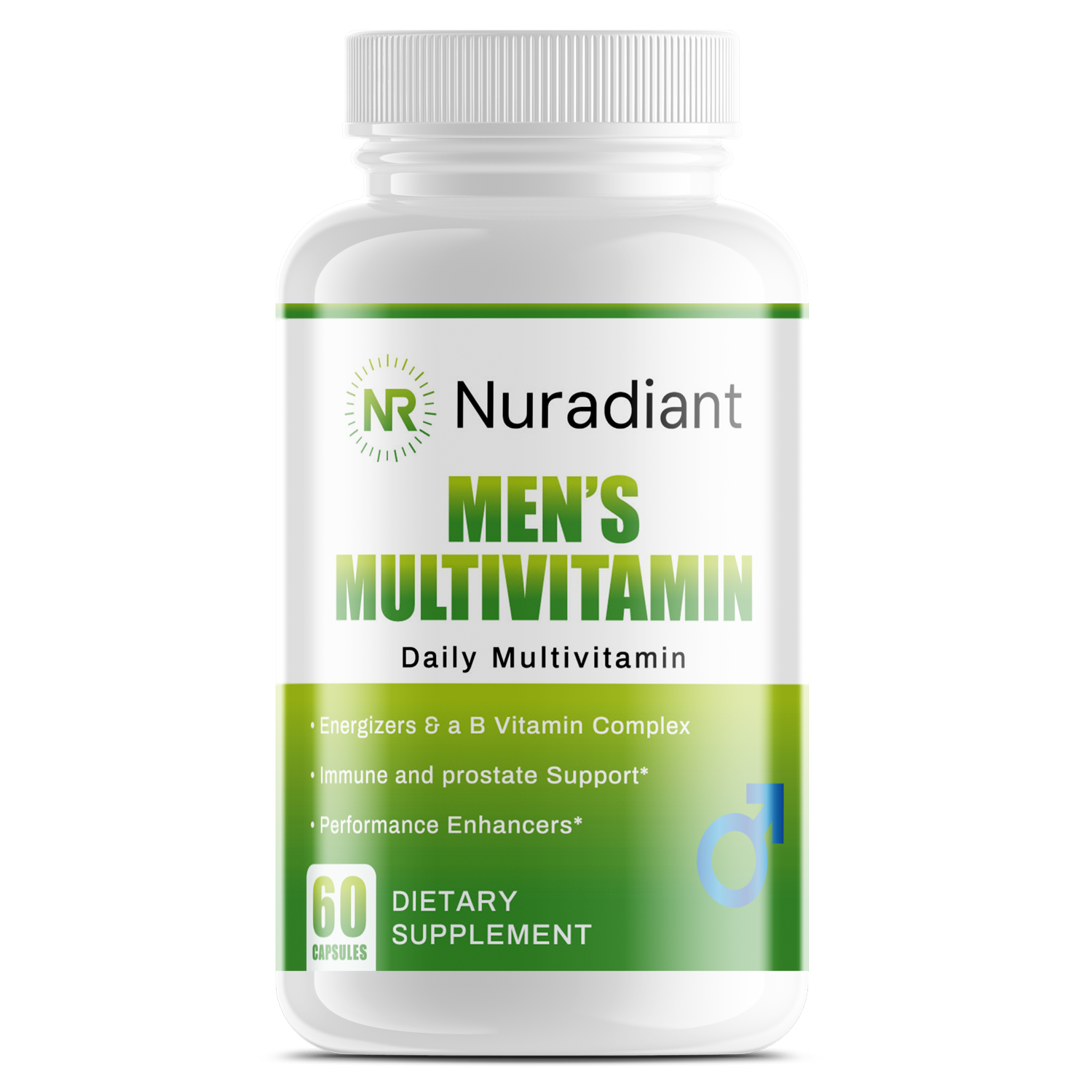
Why Nuradiant Men's Multivitamin is built for this exact job. Men over 40 and 50 love it.
Everything above pointed toward a formula designed specifically for men over 40 and 50, with targeted nutrients at honest levels and a format you can stick with. That is precisely what Nuradiant Men's Multivitamin is.
Nuradiant was built for men who want to defy the slow fade of aging and stay in peak shape beyond 40 and 50. The premise is simple: aging is inevitable, but decline does not have to be. The mission behind the formula is high-quality, science-backed nutrition for men who demand more from life, their bodies, and themselves - no gimmicks, no fluff, just real results.
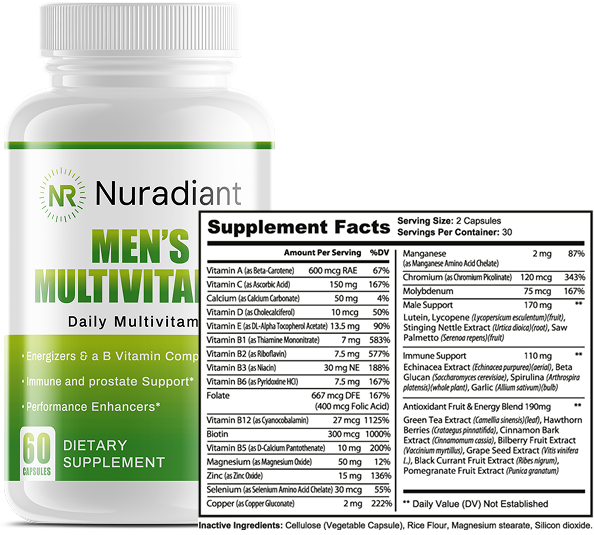
The formula is targeted rather than generic, filling the nutritional gaps that widen after 40 while supporting healthy testosterone levels and helping you reclaim strength, energy, and vitality without guesswork. It delivers essential vitamins including A, C, D, E, and B12, with each one chosen for a specific reason.
Vitamin A supports antioxidant function, helping manage inflammation and support your body's master antioxidant, glutathione. Vitamin C supports immune health and free radical scavenging. Calcium carbonate supports bone mineralization and repair. Vitamin D supports exercise performance, immune health, muscle growth, bone health, hormonal health, cardiovascular health, glucose tolerance, strength, and positive mood. Vitamin E supports immune, cognitive, cardiovascular, and bone health. Vitamin B12 supports DNA synthesis, folate cycle function, energy production, cognitive function, and immune health.
Those ingredients map directly onto the steps above. The vitamin D and calcium address bone strength. B12 and the B complex address energy and focus. The antioxidant trio addresses cellular defense. And the overall formula is explicitly formulated for men 40 and older rather than a younger body - which is the single most important box to tick.
It is also built to be effortless: an easy-to-take daily formula that removes the guesswork and fits into a normal routine, so consistency stops being a test of willpower.
How it stacks up against the checklist in Men's multivitamins
Run Nuradiant Men's Multivitamin through the five steps and the fit is straightforward.
Age-matched formula: yes. It is formulated specifically for men over 40 and 50, not a generic adult.
Nutrients that matter: yes. Vitamin D, calcium, the B vitamins, and the A, C, E antioxidant trio are all present and accounted for, each with a stated purpose.
Transparent, targeted label: yes. The brand explains what each nutrient does and why it is included.
No hype: yes. The positioning is deliberate - science-backed nutrition without gimmicks or fluff.
Easy daily format: yes. A simple daily formula designed to be taken without ceremony.
Men who have made the switch describe it in exactly those terms. Daniel, 55, noticed better sleep, clearer focus, and more energy for his morning runs after a month. Rob, 59, called it a clean formula that does what it says. Alex, 50, felt like he was constantly running on empty after turning 50 and said it helped turn things around - sharper, better sleep, and workouts he can finish without crashing. Steve, 47, who had tried a dozen multivitamins over the years, said this one was different: more energy, better digestion, and gains in the gym again. Kyle, 51, said his doctor recommended it and he felt a huge difference in his energy levels.
That is the outcome the selection framework is aiming at: not a dramatic overnight change, but the slow return of the energy, recovery, and sharpness you used to take for granted.
The bottom line
Choosing the best multivitamin for men over 40 comes down to five moves. Match the formula to your age, not just your gender. Prioritize the nutrients that matter most - vitamin D and calcium, B12 and the B complex, and the A, C, and E antioxidants. Read the label like a skeptic. Walk past the red flags of underdosing and hype. And pick a format you will actually take every day.
If you want to skip the trial and error, Nuradiant Men's Multivitamin was designed around those exact requirements: targeted, science-backed, transparent, and built for men over 40 and 50 who want to stay strong, sharp, and energized. Reclaim your edge, daily.
These statements have not been evaluated by the Food and Drug Administration. This product is not intended to diagnose, treat, cure, or prevent any disease.