

Thyroid support supplements for women: Should you take them
More thyroid support isn’t automatically better. Thyroid support supplements for women may be appropriate when they address a nutrient deficiency, but they don’t cure thyroid disorders or replace treatment. Supplements that contain thyroid hormones or excessive iodine can pose real risks, so start with a clear reason, not a bottle.
If you’re looking for more energy or trying to understand thyroid symptoms, it’s natural to consider vitamins and herbs. A better first step is to identify what your body actually needs. Testing can reveal nutrient deficiencies, while a healthcare provider can assess your results, symptoms, and medications before you add a supplement.
This guide explains when targeted nutrients may help, why testing matters, and what to check on thyroid supplement labels. It also covers herbal formulas and concerns about hidden hormone content and iodine. You’ll have a clearer framework for deciding whether a supplement fits your plan or whether diagnosis and treatment should come first.
Key Takeaways
- Use symptoms as a reason to investigate, not as proof that you need a thyroid supplement.
- Review nutrient test results before choosing vitamins, since taking large doses without a known need can cause harm.
- Read supplement labels closely for iodine, glandular ingredients, and possible thyroid hormone content.
- Herbal formulas can affect thyroid hormone levels, so their ingredients deserve the same scrutiny as vitamins and minerals.
- Bring your supplement list and test results into a healthcare discussion to weigh them alongside your thyroid treatment and medications.
Should you take thyroid-specific supplements?
Thyroid-specific supplements don’t replace diagnosis or treatment for hypothyroidism. Consider them only for a defined nutritional need, not as a shortcut to producing thyroid hormones.
Risks of Supplement Blends and Excess Vitamins
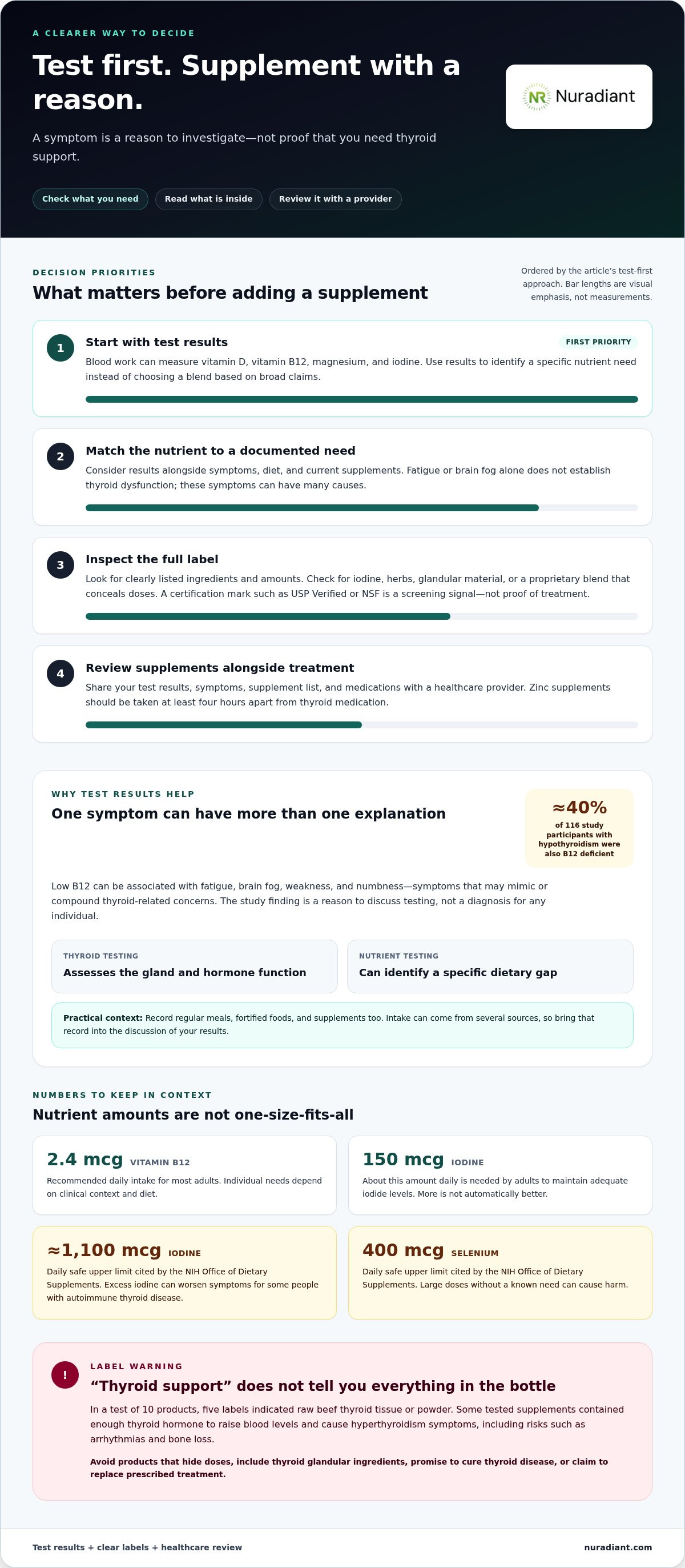
A thyroid supplement blend combines nutrients or herbs marketed for thyroid function, but its ingredients can carry risks. The dose and formula matter: according to the National Institutes of Health Office of Dietary Supplements, the safe upper limit of daily iodine intake is approximately 1,100 mcg. The safe upper limit of daily selenium intake is 400 mcg, according to the National Institutes of Health Office of Dietary Supplements.
Excess iodine can worsen symptoms for some people with autoimmune thyroid disease. Vitamins A and E are fat-soluble and can build up in the body; excessive vitamin A, particularly from supplements, can be harmful. A high-potency label doesn’t mean that more nutrients will improve thyroid function.
Thyrotoxicosis is excess thyroid hormone in the body. Some tested thyroid support supplements contained enough hormone to raise blood levels and cause symptoms of hyperthyroidism, including risks such as arrhythmias and bone loss. In a test of 10 products, five labels indicated raw beef thyroid tissue or powder. These findings make undisclosed hormone content a serious label concern.
Choosing a Quality Supplement
Look for a transparent label that lists ingredients and amounts, rather than a proprietary blend that conceals doses. Products with similar front-label promises can contain very different ingredients, including iodine, herbs, or glandular material. Check the full label and look for independent third-party certification marks, such as USP Verified or NSF.
Certification is a screening signal, not proof that a supplement treats hypothyroidism. The American Thyroid Association notes that dietary supplements have little or no regulation by the U.S. Food and Drug Administration by law. Compare the label with your medication list and test results, and avoid products that promise to cure thyroid disease or replace prescribed treatment.
Yes, supplements can interact with thyroid medication. Take zinc supplements at least four hours apart from thyroid medication. Share your full supplement and medication list with your healthcare provider to identify other possible interactions.
Choose a product with clearly listed ingredients, amounts, and third-party certification, then match its contents to a documented need. If a blend hides doses or includes thyroid glandular ingredients, skip it and seek a clearer option.
Testing nutrient levels before supplementation
Test first, then choose nutrients based on evidence. Blood work can measure vitamin D, vitamin B12, magnesium, and iodine levels, helping connect a potential deficiency with a targeted supplement instead of adding nutrients without a clear reason.
Nutrients support thyroid function in different ways. A deficiency can impair function, interfere with hormone production, or worsen existing symptoms, but that doesn’t mean every woman with fatigue or brain fog needs a thyroid supplement. These symptoms can have many causes, so consider symptom patterns alongside test results rather than treating one symptom as proof of thyroid dysfunction.
Vitamin B12 is one example worth discussing. In a study of 116 participants with hypothyroidism, approximately 40 percent were also deficient in vitamin B12. Low B12 can occur alongside an underactive thyroid and may be associated with malabsorption or autoimmune gastritis. A B12 deficiency can cause fatigue, brain fog, weakness, and numbness, symptoms that can mimic or compound thyroid-related concerns.
Use a focused testing discussion to separate thyroid status from nutrient status. Thyroid testing evaluates the gland and its hormone function; nutrient testing can identify whether a specific dietary gap needs attention. Blood work can measure vitamin D, B12, magnesium, and iodine. The results give a more useful starting point than choosing a multi-ingredient formula based only on broad claims.
Match each result to a concrete decision. If testing identifies low B12, discuss that finding and its possible causes, rather than assuming a general thyroid blend will address it. If vitamin D or magnesium levels are low, consider the result alongside your diet, symptoms, and current supplements. A normal result also matters: it can help avoid taking large doses without a demonstrated need.
Dietary intake belongs in the same review. Record supplements, fortified foods, and regular meals before interpreting a result, because total intake can come from several sources. Bring that record to a healthcare discussion along with test results and symptoms. The recommended daily intake of vitamin B12 for most adults is 2.4 micrograms, while the amount that suits an individual depends on their clinical context and diet.
Testing turns “maybe I need support” into a clearer question: which nutrient, what evidence, and what purpose? For broader nutritional routines beyond thyroid-specific decisions, women’s health supplements are one category to explore after identifying your needs.
Thyroid hormone content in thyroid support supplements
A label promising thyroid support doesn’t reveal everything inside the bottle. Adults need about 150 mcg of iodine daily to maintain adequate iodide levels, according to the National Institutes of Health Office of Dietary Supplements. That nutrient supports thyroid hormone production, but more iodine isn’t automatically better, especially for someone with autoimmune thyroid disease.
Product testing shows why ingredient scrutiny matters. In a study of 10 commercially available thyroid health supplements, researchers found triiodothyronine (T3) in nine products and thyroxine (T4) in five. One product contained neither hormone. Five were herbal products whose labels didn’t disclose thyroid hormone content, making the front label an incomplete guide to what a formula may contain.
Thyroid hormones can affect the body directly. A supplement containing T3 or T4 may raise blood hormone levels, potentially causing symptoms of hyperthyroidism. Among five supplements containing beef extract, four contained T3 and two contained T4. These results don’t establish the contents of every product, but they show why glandular ingredients deserve close attention.
Evaluate iodine by its amount and context. The body uses iodine to produce thyroid hormone, and both inadequate and excessive intake can matter. Extra iodine may worsen symptoms for women with autoimmune thyroid disease. Check whether a product lists iodine and its quantity, then consider that amount alongside dietary sources and other supplements.
Vitamin A and selenium play different roles. Vitamin A helps convert thyroxine (T4) into triiodothyronine (T3), the active form of thyroid hormone. Selenium supports thyroid-related processes, but a formula’s presence of selenium alone doesn’t show that it matches your needs. Compare each ingredient and dose with your test results and overall intake, rather than stacking overlapping products.
There’s no single U.S. price or insurance rule for thyroid supplements. Whether you pay out of pocket depends on the product’s ingredients and your insurance plan’s benefit terms. Review those terms before budgeting.
During pregnancy or breastfeeding, don’t assume a thyroid supplement is safe because its label says “herbal” or “natural.” Ingredient amounts, iodine, and possible thyroid hormone content all matter. Have the formula reviewed as part of your prenatal or breastfeeding care before using it.
These findings distinguish product testing from personal guidance. Across the tested supplements, 9/10 contained T3 and 5 contained T4; among the five supplements containing beef extract, 4/5 contained T3 and 2 contained T4. These figures describe the products tested and do not establish the contents of every supplement. A clinician quoted on the page says she generally uses selenium doses of 90 to 200 micrograms daily with her patients. That describes her general practice with patients, not a dose that can be assumed to suit everyone. Before choosing a product, review its full ingredient list and selenium amount with a clinician who can consider your individual circumstances.
Working with a qualified healthcare provider
A qualified healthcare provider can assess thyroid disease, symptoms, test results, medications, and supplements together. That context matters because fatigue and mood changes can have many causes, and thyroid treatment depends on the underlying condition. Medication is often the foundation of treatment for thyroid disorders; supplements may address a documented nutrient need, but they don’t replace prescribed care.
Bring a concise record to your appointment: current medicines, supplement labels, dietary habits, symptoms, and relevant test results. Ask what each result means for your plan and whether you have a nutrient deficiency. This keeps the discussion focused, especially if hypothyroidism, autoimmune thyroid disease, or hyperthyroidism is involved.
Start with food. A balanced diet rich in fruits, vegetables, lean proteins, and healthy fats supplies a range of nutrients. For example, discuss regular meals and food sources of iron before adding an iron supplement. A food-first approach can also reveal whether a supplement duplicates nutrients in fortified foods or multivitamins.
Vitamin D deserves attention in thyroid care. Low vitamin D levels are frequently observed in people with hypothyroidism and autoimmune thyroid diseases. Vitamin D supplementation may help reduce thyroid-specific antibody production, though research is ongoing. The recommended dietary allowance of vitamin D is 600 IU per day, according to the National Institutes of Health Office of Dietary Supplements. A result, diet, and existing supplement routine help frame whether additional intake is appropriate.
Selenium also requires context, not guesswork. The recommended dietary allowance of selenium for adult men and women is 55 micrograms, according to the National Institutes of Health Office of Dietary Supplements. For people with Hashimoto’s disease, daily selenium supplementation of 200 mcg may help decrease thyroid antibodies and improve mood. These findings don’t mean every patient needs selenium; total intake and diagnosis matter.
Iron supports essential body functions, but supplementation should respond to need. Women generally need 18 mg of iron per day, according to the National Institutes of Health Office of Dietary Supplements. Iron can be low in people with hypothyroidism, and vitamin C can aid iron absorption. Discuss iron results, dietary intake, and stomach tolerance before choosing a supplement or changing its timing.
Use the appointment to set a specific plan: which nutrient needs attention, what the evidence shows, and how a supplement fits with treatment. A clear plan can prevent unnecessary overlap and keep thyroid care focused on the factors that affect your health.
Herbal thyroid support supplements
Herbal formulas often promise thyroid support through plant extracts, but their ingredients and evidence vary. Ashwagandha, Coleus forskohlii, and Bacopa are discussed in relation to thyroid function, but none should replace thyroid disease diagnosis or medication.
One study administered 600 mg of ashwagandha root daily for eight weeks. That detail describes the study regimen, not a universal dose or proof that the herb treats Hashimoto’s disease. Before interpreting a study, separate what researchers tested from what a product label promises. The difference matters when fatigue or other symptoms prompt a search for an alternative to prescribed treatment.
Coleus forskohlii is another herb marketed for low-thyroid symptoms. Naturopathic doctors generally recommend 100-200 mg a day in that context, but this recommendation alone doesn’t establish effectiveness or suitability for an individual. A formula may combine Coleus with other herbs, making it harder to identify which ingredient accounts for an effect or unwanted symptom.
Bacopa evidence requires the same careful reading. In an animal study, mice received a 200 mg dose, and Bacopa increased thyroid hormone production by as much as 41 percent when taken daily. Animal findings do not establish the same result in people. For a reader considering a human supplement, this distinction is essential: an animal result is not a treatment plan for hypothyroidism.
There’s another issue beyond the advertised herbs. In testing of herbal thyroid capsules, all tested capsules contained T3, and two contained T4. These are thyroid hormones, not simply plant ingredients. A product marketed as herbal can therefore raise concerns about undisclosed hormone content. Review the complete label, including glandular ingredients, and don’t assume “herbal” means hormone-free.
Assess herbal formulas carefully. Identify each herb and its dose, distinguish human studies from animal studies, and compare the label with your medications and treatment plan. If you have Hashimoto’s or another thyroid disease, discuss the exact product label with a healthcare provider before adding it. “Natural” doesn’t mean evidence-based, and fatigue alone can’t establish that an herb addresses the cause.
Want to explore broader wellness options while keeping thyroid decisions evidence-led? Explore women’s health supplements as part of a plan focused on your overall health, not as a substitute for thyroid treatment.
Nuradiant: CBD Products
Nuradiant offers CBD products as a separate wellness option, not as a treatment for thyroid disease or a replacement for thyroid medication. Once testing and provider guidance have clarified your thyroid plan, you can explore other wellness categories without confusing them with thyroid care. Nuradiant also offers nootropics, joint health supplements, and premium gummies. A product’s category doesn’t establish that it supports thyroid hormone levels or treats symptoms. Review supplement ingredients alongside your current plan, especially if you take medication or manage a diagnosed condition. For thyroid-specific decisions, rely on test results and qualified healthcare guidance. Explore Nuradiant’s offerings at Nuradiant.
Make your next move evidence-led
Let your next decision match your actual goal. If you’re considering thyroid support supplements for women, keep thyroid treatment decisions separate from general wellness shopping. Use test results and qualified healthcare guidance to shape your thyroid care, then assess other products for distinct needs without expecting them to treat thyroid disease.
Nuradiant offers men’s health supplements, CBD products, and nootropics. These are wellness categories, not substitutes for thyroid medication or personalized medical care. Choose products that fit your broader routine, and keep your healthcare provider informed about the supplements you use.
For questions about Nuradiant’s wellness products, contact Nuradiant to discuss your options. Take the next step with a clear purpose, informed choices, and confidence in the plan you build.
Frequently Asked Questions
Which supplements have evidence for supporting thyroid function or treating hypothyroidism?
Supplements may support thyroid function by correcting a confirmed nutrient deficiency, but they don’t treat or cure hypothyroidism. The evidence for thyroid support supplements for women is most relevant when testing identifies a specific need, such as low vitamin B12 or vitamin D. A broad “thyroid booster” can’t identify the cause of symptoms. If hypothyroidism is diagnosed, supplements should complement, not replace, prescribed treatment.
Can iodine supplements help thyroid health, and how much iodine do women need daily?
Iodine supports thyroid hormone production, so correcting inadequate intake may matter, but extra iodine isn’t automatically beneficial. Adults need about 150 mcg of iodine daily to maintain adequate iodide levels, according to the National Institutes of Health Office of Dietary Supplements. Count iodine from multivitamins and other supplements, too. Women with autoimmune thyroid disease should be especially cautious, since excess iodine can sometimes worsen symptoms.
Do selenium, zinc, iron, or vitamin D supplements affect thyroid function?
These nutrients can matter when a deficiency exists, but they aren’t universal thyroid treatments. For people with Hashimoto’s disease, 30 mg of zinc per day may help enhance thyroid function when used alone or with selenium. Iron is commonly low in people with hypothyroidism, and vitamin C can aid its absorption. Low vitamin D is frequently observed with hypothyroidism and autoimmune thyroid disease, though supplementation research continues.
What are the risks of taking too much iodine or selenium?
Excess intake can exceed safe limits, and those limits aren’t supplement targets. According to the National Institutes of Health Office of Dietary Supplements, the safe upper limit of daily iodine intake is approximately 1,100 mcg, and the safe upper limit of daily selenium intake is 400 mcg. Excess iodine can sometimes worsen symptoms in people with autoimmune thyroid disease. Add up intake from all supplements before taking extra.
Do thyroid support supplements contain undisclosed thyroid hormones or other risky ingredients?
Some formulas may contain thyroid hormones or ingredients that aren’t obvious from front-label claims. Check the full ingredient list for glandular or raw thyroid material, and look for clearly stated iodine amounts rather than hidden blends. The American Thyroid Association notes that dietary supplements have little or no regulation by the U.S. Food and Drug Administration by law. Don’t assume an “herbal” label means a product is hormone-free.
When should women see a doctor for thyroid symptoms instead of trying supplements?
Seek an evaluation if symptoms persist or worsen, especially fatigue, brain fog, weakness, or numbness. These symptoms can overlap with nutrient deficiencies and thyroid concerns, so they can’t identify the cause on their own. Arrange testing before adding high-dose nutrients, and discuss new supplements if you take thyroid medication or have a thyroid diagnosis. A clear diagnosis can distinguish a nutrient issue from thyroid dysfunction and guide the next step.