

Supplements to Keep Up With Grandkids: What May Help
A multivitamin may help fill nutrient gaps, but it won’t replace a balanced diet or guarantee you can keep pace with your grandkids. The right supplements to keep up with grandkids depend on your diet, health, and medications. Review any supplement with your primary care provider before adding it, because supplements can cause side effects or interact with prescription drugs.
Want more energy for walks, games, and full days together? It’s understandable to look for support, but taking more supplements isn’t automatically the answer. The key is matching a supplement to a genuine need and using it safely.
Here’s what to know: how multivitamins fit into a routine, why vitamin D and calcium matter for bones, how shared activities engage the mind, and what to discuss with your provider before taking a supplement. These points can help you make informed choices without treating a pill as a shortcut to staying strong.
Key Takeaways
- Keep your mind engaged with activities such as reading, puzzles, and time spent playing with your grandkids.
- Learn how vitamin D and calcium support bone health, and how recommended intake changes with age.
- Use multivitamins to address potential nutrient gaps, not as a replacement for a balanced diet.
- Review supplements alongside your medications with your primary care provider, and store vitamins securely away from children.
Mental engagement and cognitive health
Keeping up with grandkids takes more than physical stamina. Reading together, building a puzzle, or planning a simple game engages your mind as well as bringing you together. Choose an activity, focus on it together, and keep the conversation moving. Supplements to keep up with grandkids may be part of a broader health discussion, but they can’t replace meaningful mental activity.
Active time with grandchildren is associated with less stress, greater mental engagement, better physical health, and longevity. That association doesn’t guarantee a particular outcome. It highlights how time together can combine connection, movement, and mental stimulation.
Nutrition supports the body, but supplements don’t replace activities that challenge the mind. Calcium and vitamin D help maintain strong bones, and bone loss can lead to fractures in older adults. These nutrients relate to physical capability; reading or puzzles offer a different kind of engagement. Neither takes the place of the other.
There’s no single U.S. price for supplements marketed for strength or bone health. Cost varies with the nutrient, formulation, serving size, and quantity. Compare product labels and serving details rather than assuming products provide the same amount. Choosing supplements to keep up with grandkids should begin with a clear purpose, not a general promise of better performance.
For omega-3 supplements, don’t assume they improve joint pain or mobility. People who already eat fish twice a week may not need a fish oil supplement. A provider can weigh diet, symptoms, medicines, and health history before discussing whether one fits.
Make health checkups useful by bringing a list of supplements and medicines. Mention fatigue, memory changes, persistent stress, or difficulty with usual activities. If low mood or stress affects daily life, discuss it with your doctor and ask whether counseling could help. For example, losing interest in a regular puzzle night gives you a specific starting point.
Vitamin D, calcium absorption, and muscle strength
Bone strength depends on more than one nutrient. Calcium is a building block for bones, while vitamin D helps the body absorb calcium. Bone loss can increase fracture risk in older adults, making adequate intake relevant to everyday movement, from climbing stairs to playing on the floor with grandkids.
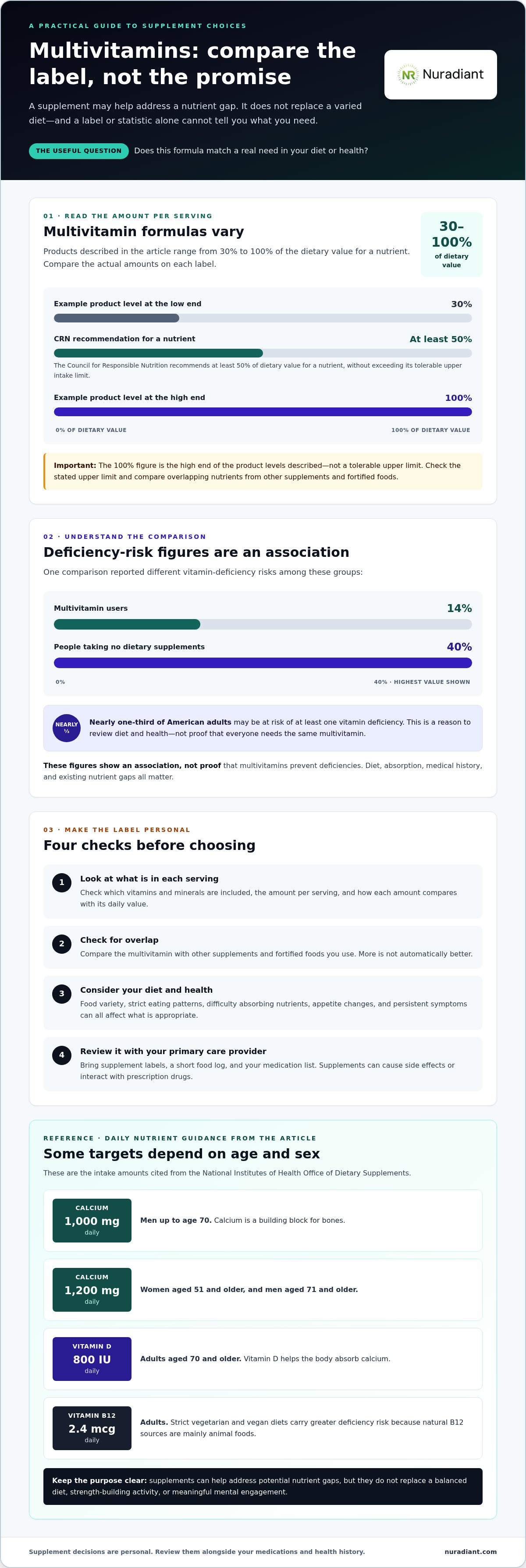
Age and sex shape calcium recommendations. The National Institutes of Health Office of Dietary Supplements advises men up to age 70 to get 1,000 milligrams of calcium daily. It advises women aged 51 and older and men aged 71 and older to get 1,200 milligrams of calcium daily. For adults aged 70 and older, the same organization advises 800 international units of vitamin D daily.
Many people in the United States consume less than the recommended amount of vitamin D, and older adults have a greater deficiency risk than younger people. Fatigue can have many causes. If it persists, ask your doctor whether checking vitamin D levels is appropriate. Calcium and vitamin D support bone health, but they don’t replace strength-building activity.
Vitamin B6 and B12 are distinct nutrients, so review them separately in foods and supplement labels. Adults are advised by the National Institutes of Health Office of Dietary Supplements to get 2.4 micrograms of vitamin B12 daily. Low B12 can cause tingling, trouble walking, memory changes, or difficulty thinking clearly. Strict vegetarian and vegan diets carry greater deficiency risk because natural B12 sources are mainly animal foods.
Creatine may be considered alongside resistance training, but it isn’t a stand-alone way to maintain everyday strength. Protein needs vary with body size, activity, diet, and health conditions. Discuss an appropriate intake with a clinician rather than relying on a one-size-fits-all target.
Blood pressure medicines and diabetes care can affect supplement decisions. Bring your medication list and supplement labels to a health visit. For readers exploring targeted support, joint health supplements may be relevant to a broader routine, alongside nutrition and movement.
Multivitamin use and nutrient deficiencies
After age 50, adults may need more of some vitamins and minerals than younger adults. A multivitamin doesn’t replace nutrition from food, and taking one doesn’t prove a deficiency exists. Nearly one-third of American adults may be at risk of at least one vitamin deficiency. Treat that figure as a prompt to review your diet and health, not proof that every active grandparent needs the same formula.
One comparison found a vitamin deficiency risk of 14% among multivitamin users, versus 40% among people taking no dietary supplements. Those figures show an association, not proof that multivitamins prevent deficiencies. Your diet, absorption, medical history, and existing nutrient gaps all matter. A person eating a varied diet may have different needs from someone with restricted food choices or difficulty absorbing nutrients.
Read the label before choosing a formula. Check which vitamins and minerals it contains, the amount per serving, and how that amount compares with the daily value. The Council for Responsible Nutrition recommends that multivitamin formulas provide at least 50% of the dietary value for a nutrient without exceeding its tolerable upper intake limit. Products vary: manufacturers offer multivitamins with nutrient levels ranging from 30% to 100% of the dietary value.
More isn’t automatically better. Compare the multivitamin label with other supplements and fortified foods you use, so you can spot overlapping nutrients. Then bring the labels and a short food log to a medical appointment. Mention a strict eating pattern, changes in appetite, or persistent symptoms that could point to a deficiency. For example, someone avoiding animal foods can ask about vitamin B12, while someone with limited food variety can review overall intake. This makes the conversation specific: the goal is to address a real gap, not to take a multivitamin by default.
Checking supplement safety with a primary care provider
A supplement label can’t replace a medication review. In the United States, the Food and Drug Administration doesn’t require dietary supplements to be approved for safety or efficacy before they’re sold. Supplements can cause side effects and interact with prescription drugs. A doctor’s review is a practical safety step, especially if you take several products or medicines.
Bring each supplement container or a clear photo of its label to your appointment. Include multivitamins, powders, gummies, and products you take only occasionally. Add prescription medicines and over-the-counter drugs to the same list. Mention medicines for high blood pressure and antihistamines, which can cause daytime drowsiness. This review helps your doctor assess potential interactions and whether another factor could explain fatigue.
To choose a product with third-party testing, look for the United States Pharmacopeia or NSF International name on its label. Check that the mark appears on the specific product, then compare the ingredient list and serving directions with your medication list. A certification mark can help identify products evaluated by those organizations, but it doesn’t mean the FDA approved the supplement or that it suits every person.
Make the conversation specific. Tell your doctor why you’re considering a supplement, what you hope it will support, and whether you’ve noticed a reaction. If a product causes a new symptom, note the product, serving, and timing, then share those details. Older adults may respond differently from younger adults because their medication lists and health needs can differ. Keep the active ingredient and serving information handy for follow-up.
Before choosing support for an active routine, use the same label-first approach with every product. Explore supplement options and bring the product details to your next medication review.
Nuradiant: CBD Products
Nuradiant offers CBD products, nootropics, joint health supplements, and premium gummies for adults choosing supplements to match their goals. These categories aren’t interchangeable, and a product shouldn’t replace a nutrient your provider has identified as necessary or treatment for a health condition.
Before adding a supplement, review its label, consider your current medications, and discuss potential interactions with your primary care provider. This is especially important if you take prescription drugs or manage an ongoing health concern. Choose a product based on what you’re looking to support, not on the assumption that one supplement can provide every benefit needed to stay active with grandkids.
Visit Nuradiant to explore its supplement options.
Choose support that fits your next step
Staying active with your grandkids is a reason to make thoughtful choices, not to pile on products without a plan. Before adding supplements to keep up with grandkids, decide what you want to support, note what you already take, and bring those details to your next healthcare appointment. A routine based on your actual needs is easier to understand and maintain.
Nuradiant offers men’s health supplements, CBD products, and nootropics for adults exploring supplement options. These products serve different purposes, so consider each individually rather than treating them as interchangeable or as a replacement for medical care. Your provider can help assess how a supplement fits with your medications and health needs.
Take the next step with a clear question and the relevant product details in hand. Contact Nuradiant about your supplement questions, then keep building an active routine around the moments you want to share. Make informed choices. Stay engaged. Show up ready for the next adventure.
Frequently Asked Questions
What about multivitamins?
A multivitamin may fill a dietary gap, but it isn’t a universal requirement or a substitute for meals. Before adding one, compare its label with fortified foods and any separate vitamins you already take. For example, fortified breakfast cereal and a multivitamin may contain some of the same nutrients. Bring both labels to a medical review, especially if your diet is restricted or your appetite has changed.
Which supplements support muscle strength and mobility in older adults?
Calcium and vitamin D support bone health, while vitamin B12 deficiency can contribute to trouble walking. Those roles don’t make supplements a complete muscle or mobility plan. If stairs feel harder, discuss diet, medications, pain, balance, and activity changes with your doctor instead of adding several products at once. The right supplement depends on the nutrient gap and your health context.
Can vitamin D supplements help prevent falls or improve muscle function in older adults?
Vitamin D helps the body absorb calcium and supports bone strength, but that role alone doesn’t show that it prevents falls or improves muscle function. Don’t use a supplement instead of fall-safety measures. Keep toys and other obstacles out of walkways, and discuss recurring falls or changes in balance with a doctor. Review medicines that may cause drowsiness, too.
When should an older adult ask a doctor before starting supplements?
Ask a doctor before starting a supplement if you take prescription or over-the-counter medicines, manage a chronic condition, or plan to combine products. Some medicines for high blood pressure and antihistamines can cause daytime drowsiness, which matters if you drive or supervise children. Bring the product label and a complete medication list to your appointment, and report any new symptoms after starting a supplement.