

Signs Your Multivitamin Is Effective and When You May Notice Them
A multivitamin rarely produces an overnight signal. The clearest signs your multivitamin is effective may be gradual changes in energy or general well-being, which some people notice after consistent use. Others may need longer, especially if the supplement is addressing a deficiency.
It’s understandable to expect a quick boost, but the timeline depends on what your body needs and whether the formula provides it. This guide explains why changes may take time, what could suggest a supplement is helping, and how to assess progress without guesswork. It also covers why consistency matters and when a lack of improvement may mean the vitamin isn’t addressing the underlying concern.
Key Takeaways
- Results can take weeks or months, depending on your nutrient status, the supplement, and the concern you’re addressing.
- Track changes that match your goal, such as shifts in energy or general well-being, rather than expecting an instant boost.
- Consistency gives you a clearer picture of whether a supplement may be helping; look for gradual patterns over time.
- If you see no improvement after several months, consider whether the supplement fits your needs or whether a deficiency was present.
- Use nutrient testing when appropriate to get a more objective view of changes than symptoms alone can provide.
How long does it take for vitamins to work?
Some supplements take weeks or months to produce noticeable results. The timeline depends on your nutrient status, the ingredients, and the concern you’re addressing.
Individual Nutrient Status and Lifestyle
Nutrient status refers to how much of a nutrient is available in your body before supplementation begins. It matters because addressing a deficiency can follow a different timeline than adding nutrients you already get from food.
Consistency matters: missed doses make intake less regular, while a limited diet may leave the original shortfall in place. Food choices, absorption, health conditions, and medications can all affect how your body uses nutrients. A multivitamin cannot replace a varied diet or address every cause of fatigue or other symptoms.
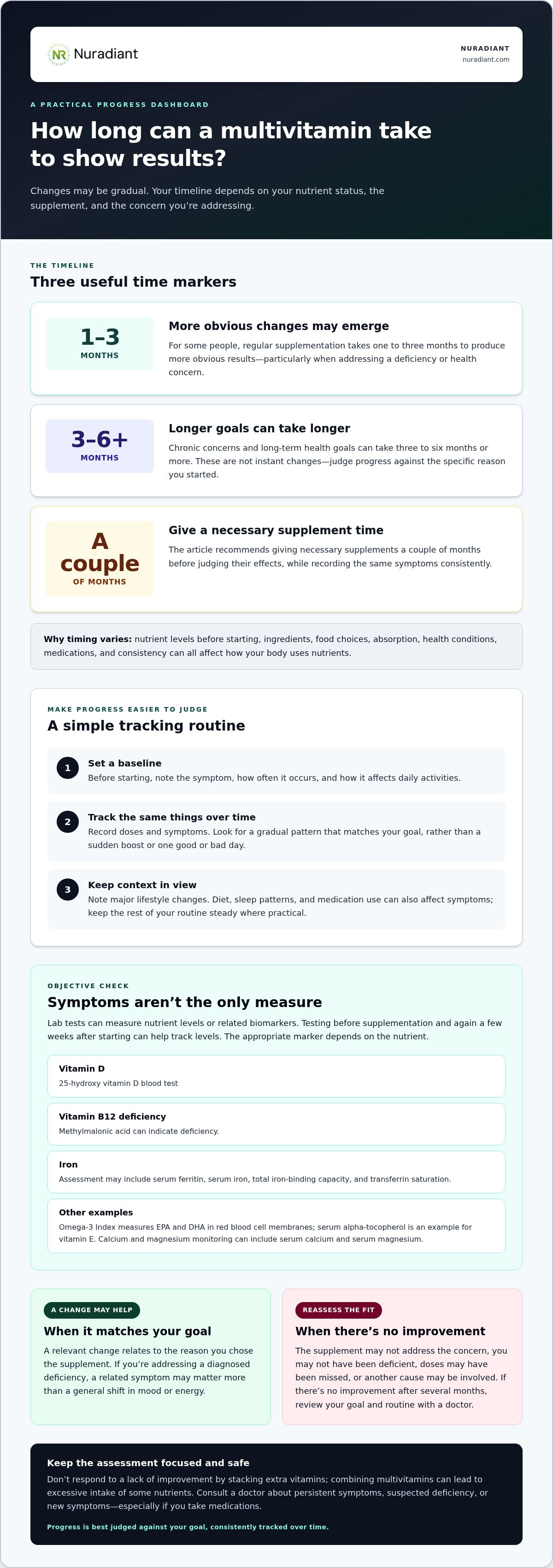
For some people, regular supplementation takes one to three months to produce more obvious results, particularly when addressing a deficiency or health concern. Chronic concerns and long-term health goals can take three to six months or more. These are not instant changes, so judge progress against the specific reason you started taking a supplement.
Many nutrient deficiencies develop over weeks or months, and addressing them can follow a similar timeline. If the supplement provides a nutrient you lack, gradual change may matter more than a sudden sensation. If your diet already provides enough, you may notice little or no difference in how you feel.
Tracking Nutrient Levels With Tests
Lab tests measure nutrient levels or related biomarkers in blood or other samples. They’re useful because symptoms alone can’t show whether a nutrient level has changed.
Testing before supplementation and again a few weeks after starting can help track levels. A 25-hydroxy vitamin D blood test monitors vitamin D, while methylmalonic acid can indicate vitamin B12 deficiency. Iron assessment may include serum ferritin, serum iron, total iron-binding capacity, and transferrin saturation.
Other examples include the Omega-3 Index, which measures EPA and DHA in red blood cell membranes, and serum alpha-tocopherol for vitamin E. Calcium and magnesium monitoring can include serum calcium, including total and ionized calcium, and serum magnesium. The appropriate marker depends on the nutrient being assessed.
Supplements are only one route to nutrients. The 2020-2025 Dietary Guidelines for Americans identify calcium, vitamin D, potassium, and fiber as nutrients that American diets often lack. Foods can provide these alongside other nutrients, so consider your usual meals when assessing whether a multivitamin addresses a dietary gap.
Persistent brittle hair or nails, mouth ulcers, bleeding gums, brain fog, impaired eyesight, or scaly or discoloured skin can signal a nutritional issue, but they can also have other causes. Consult a doctor if these symptoms appear, especially if you take medications or suspect a deficiency. Considering symptoms alongside testing gives you a clearer basis for evaluating whether supplementation is helping.
How do you know when vitamins are working?
Measure progress against the benefit you’re targeting, not a sudden boost. Talk with a doctor about persistent symptoms, suspected deficiency, or new symptoms after starting a vitamin, especially if you take medications.
Changes That Match Intended Benefits
A relevant change matches the reason you chose the supplement. If your goal is to address a diagnosed deficiency, a change in a related symptom may matter more than a general shift in mood or energy.
Set a clear baseline before starting: note the symptom, how often it occurs, and how it affects daily activities. For example, track whether a specific concern changes over time. A simple record makes it easier to distinguish a lasting pattern from an ordinary good or bad day.
Lack of Improvement During Supplementation
No improvement may mean the vitamin doesn’t address your concern, or that you weren’t deficient in the nutrient it supplies. Other possibilities include missed doses, a product that doesn’t match your dietary needs, or another cause that supplementation won’t resolve.
Give necessary supplements a couple of months before judging their effects, while recording the same symptoms consistently. If there’s no improvement after several months, review the goal and your routine with a doctor. Don’t respond by stacking extra vitamins; combining multivitamins can lead to excessive intake of some nutrients.
Consistency During a Supplement Trial
A consistent routine makes progress easier to assess by reducing missed doses and changes in habits. Take the supplement as directed, record doses and symptoms, and note major lifestyle changes that could affect how you feel.
Keep the rest of your routine steady where practical. Changes to your diet, sleep pattern, or medication use can also affect symptoms. Share all supplements with your doctor, particularly if medications are part of your daily routine.
Product quality matters, too. The U.S. Pharmacopeial Convention says its verification checks whether dietary supplements are pure and contain the ingredients listed on their labels. NSF, USP, and ConsumerLab are examples of independent verification seals. Look for brands that follow Good Manufacturing Practices, and be cautious of vague health claims or proprietary blends that omit ingredient amounts.
Folate is a clear example of a nutrient with a specific timing goal. The Centers for Disease Control and Prevention recommends that women of reproductive age get 400 micrograms daily. The recommended approach in this article is to take folate for three months before conception and during the first 12 weeks of pregnancy. Discuss this plan with a doctor as part of pregnancy care.
For a more structured approach, keep your supplement routine focused on a clear goal and consistent tracking.
Do vitamins take effect immediately?
A vitamin can begin interacting with your body before you feel anything. A quick sensation alone doesn’t prove the supplement is working; the nutrient, your starting status, and the change you’re tracking all matter.
Energy Changes as a Possible Sign
An energy change is a shift in fatigue or alertness that might align with a nutrient need. It matters because fatigue has many possible causes, so timing alone doesn’t establish that a multivitamin helped.
Some people notice a change in fatigue after days or weeks of supplementation. Water-soluble vitamins may begin working within days, but feeling more alert isn’t a reliable measure of nutrient levels. Record when fatigue appears, such as after lunch, and whether that pattern changes over time.
Vitamins support normal body function, but a multivitamin isn’t an instant energy product. If fatigue is your concern, first review your eating patterns, sleep, activity, and dietary intake of vitamins and minerals. A food log may reveal habits such as routinely skipping breakfast or rarely eating nutrient-rich foods.
Dietary supplements may be more relevant when they address a nutrient gap. A noticeable change is more plausible when someone has a deficiency and the supplement provides what’s missing. Without a deficiency, taking extra amounts may not translate into more energy. Persistent fatigue also deserves attention because supplements don’t address every possible cause.
Possible Placebo Effects
A placebo effect is a perceived change associated with expectations rather than a direct nutrient effect. It matters because starting a new routine can make you pay closer attention to energy, focus, or motivation.
For example, expecting a morning vitamin to improve alertness can affect how you interpret an ordinary productive morning. The experience feels real, but it doesn’t confirm that the vitamin changed your nutrient status. Compare similar days and look for a consistent pattern rather than treating one unusually energetic afternoon as proof.
Separate the supplement from other changes. If you start exercising, improve your sleep, and change your diet in the same week, any energy shift could relate to one or more factors. Note changes in eating, sleep, activity, and supplement use together. This gives you a better view of what changed without assuming the vitamin caused every improvement.
Water-soluble vitamins may begin working within days, while fat-soluble vitamins can take weeks or months. Neither timeline guarantees an immediate sensation. Feeling different a few hours after taking a tablet isn’t a dependable test of effectiveness.
Don’t increase doses to chase a fast boost. Vitamins A, D, E, and K can build up in the body, and excessive intake can cause health problems. Judge effects by the intended goal and your pattern over time, not by a single burst of energy.
Vitamin effects and how quickly they may be noticed
Some nutrients may produce noticeable changes within a few weeks, while others take longer. Your starting nutrient levels and the vitamin’s role affect the timeline.
Deficiencies and Response Time
A deficiency is a shortage of a nutrient the body needs, and it can shape how quickly supplementation makes a difference. When someone lacks a nutrient, supplying it may address the gap; without a deficiency, the same supplement may not produce a noticeable change.
Many deficiencies develop over weeks or months, so addressing them can be gradual. For example, changes related to low vitamin levels may not show up as an immediate shift in energy or mental focus.
Vitamin Absorption and Processing
Absorption is the movement of vitamins from food or supplements into the body, where they can be used or stored. It matters because a nutrient must be absorbed and processed before it can support bodily functions.
Water-soluble vitamins generally work within days, while fat-soluble vitamins may take weeks or months. Vitamins A, D, E, and K are fat-soluble. Their absorption and storage differ from those of water-soluble nutrients, so one timeline cannot predict the effect of every ingredient.
Water-soluble vitamins may begin working soon, but their effects may not be physically noticeable for hours or longer. That distinction matters: a vitamin can enter the body before you feel a change. Feeling different shortly after taking a tablet doesn’t demonstrate that a deficiency has been addressed.
Some people notice minor health changes within a few weeks. The effect depends on the nutrient, the amount taken, and whether your body needs it. A multivitamin can contain many vitamins and minerals, but that doesn’t mean every ingredient will produce a sensation. Track the goal you chose rather than expecting every vitamin to feel active.
More isn’t a shortcut. Vitamins A, D, E, and K can build up in the body, and excessive intake can cause health problems. Avoid high doses, particularly of vitamins A and E. High-dose, prolonged supplement use can potentially damage the liver and kidneys. Check the amounts from all supplements together, since overlapping products may contain the same nutrients.
Don’t treat a multivitamin as a shield against disease. The U.S. Preventive Services Task Force states there’s no evidence to support or discourage multivitamins for preventing cardiovascular disease or cancer. That finding concerns prevention, not whether a supplement addresses a specific nutrient deficiency.
Use the intended outcome as your benchmark. If a product contains several ingredients, identify the nutrient linked to your goal and consider its expected timeline. A noticeable sensation is only one clue; your nutrient status and reason for taking the vitamin matter more.
Gradual symptom changes and consistent use
Many vitamin deficiencies develop over weeks or months, and addressing them follows a similar timeline. Progress often appears as a pattern, not a dramatic overnight shift. If you began supplementation for a particular concern, compare how it changes across ordinary days. One better morning alone says little; a steady change in the same symptom offers a more useful signal.
Track one or two symptoms tied to your goal. Note their frequency, intensity, and effect on daily activities, then review the pattern after a while. For example, someone monitoring fatigue could record whether it interrupts work or exercise less often. Keep the measure consistent. Switching from fatigue notes to unrelated measures such as mood makes comparisons less useful.
Consistency helps you interpret your record. Take the supplement as directed and note missed doses, changes in eating, and shifts in sleep or activity. If several habits change at once, it’s difficult to tell which one influenced a symptom. Research on long-term multivitamin use also assesses outcomes over sustained periods, rather than treating a single day’s experience as proof of an effect.
The nutrient matters, too. A supplement designed to address one particular gap won’t necessarily change symptoms linked to another cause. Calcium and magnesium levels, for example, can be monitored using serum tests. A symptom diary shows how you feel, while a relevant test provides information about nutrient status. Don’t confuse one measure with the other.
Use consistent timing when reviewing tests. The research guidance recommends checking nutrient levels before supplementation and again after starting. The appropriate marker depends on the nutrient: serum calcium, including total and ionized calcium, and serum magnesium are examples. Comparing results from the same type of test gives a clearer view than switching measures midway through a trial.
If symptoms remain unchanged after several months, reconsider whether the supplement matches your concern or whether you had a deficiency. Don’t respond by adding another multivitamin or taking higher amounts. Taking multiple multivitamins at once can lead to excessive intake of certain nutrients. Share your supplement routine with a doctor, especially if symptoms persist or you take medications.
Keep the trial practical. Record your dose, missed days, relevant symptoms, and major lifestyle changes in one place. Review that record after a couple of months, then use symptom patterns and appropriate test results to guide your next step. For a consistent starting point, explore supplement options.
Nuradiant: CBD Products
Nuradiant offers CBD products for readers exploring supplement options beyond multivitamins. CBD products are distinct from multivitamins, so they aren’t a substitute for nutrients or a way to assess whether a vitamin is effective. If your goal is to address a specific nutrient gap, focus on the supplement’s ingredients and your reason for taking it. Nuradiant also offers nootropics, joint health supplements, and premium gummies for other interests. Choose a category that fits your needs, rather than expecting every supplement to serve the same purpose. Explore Nuradiant’s offerings at nuradiant.com.
Make Your Next Supplement Choice Deliberate
Treat signs your multivitamin is effective as evidence to guide your next decision, not as a reason to keep adding products. Set a clear goal before changing your routine. Decide what change would matter in daily life, then use that measure to guide your next step. A focused plan beats chasing every new supplement trend.
If your needs shift, match the product category to your priorities. Nuradiant offers men’s health supplements, CBD products, and nootropics. These are distinct offerings, so choose based on the support you’re seeking rather than expecting one product to do everything. Keep your decisions grounded in your goals and the ingredients that fit them.
Have questions about Nuradiant’s offerings? Contact Nuradiant with your questions. Stay consistent, stay informed, and keep making deliberate choices for your health.
Frequently Asked Questions
Do multivitamins make you healthier?
Not automatically. A multivitamin can help fill a nutrient gap, but it doesn’t replace a balanced dietary pattern or guarantee better health. The U.S. Preventive Services Task Force states there’s no evidence to support or discourage multivitamins for preventing cardiovascular disease or cancer. Consider why you’re taking one: addressing a documented shortfall differs from expecting a multivitamin to prevent disease in an otherwise healthy adult.
What signs indicate a multivitamin is working?
Look for a sustained change that matches your reason for taking a multivitamin, such as less frequent fatigue if that was your specific concern. One of the signs your multivitamin is effective may be a meaningful improvement in that targeted issue, but a good day alone isn’t proof. Record the symptom and its effect on your daily routine. That gives you a more useful comparison than relying on memory.
How long does it take to notice effects from a multivitamin?
Noticeable changes may take weeks or months, and some people need longer with consistent use. The nutrient, your starting status, and the outcome you’re tracking all affect the timeline. Set a review point and compare it with your starting notes, rather than judging the supplement after a single dose. If your goal is a measured nutrient change, use an appropriate test rather than waiting for a particular sensation.
Can you tell if a multivitamin is effective without a blood test?
You can track symptoms and daily function without testing, but those observations can’t confirm your nutrient levels. For example, a log may show that fatigue disrupts fewer afternoons, while a blood test can assess a specific nutrient marker. Symptoms can have causes unrelated to nutrition, so use a diary to spot patterns, not to diagnose a deficiency or prove that a multivitamin changed your levels.
What symptoms suggest a multivitamin is not working or a deficiency persists?
Persistent symptoms such as brittle hair or nails, mouth ulcers, bleeding gums, brain fog, impaired eyesight, or scaly or discoloured skin can signal a nutritional issue. They don’t identify a specific deficiency on their own. If symptoms continue, worsen, or appear after starting a supplement, discuss them with a doctor. Bring the product label and a list of your medications and other supplements to help assess possible causes.
How do multivitamin benefits differ for people with nutrient deficiencies versus healthy adults?
For someone with a deficiency, a multivitamin may supply a nutrient missing from their diet. For an adult already meeting nutrient needs, extra vitamins may not produce a noticeable benefit. The key distinction is the starting gap, not simply taking a supplement. A multivitamin also isn’t a substitute for addressing the cause of a deficiency or getting care for an ongoing health concern.
How can you check whether a multivitamin contains effective doses of nutrients?
Compare each ingredient and its amount on the label with its Daily Value. A general selection guideline is 100% of the Daily Value for most ingredients, while avoiding excessive intake from multiple products. Look for independent verification seals such as NSF, USP, or ConsumerLab. Be cautious of proprietary blends that hide individual amounts, since you can’t readily assess how much of each ingredient the product contains.
What factors affect multivitamin absorption, such as food, medications, or timing?
Taking a multivitamin with food may reduce stomach discomfort and aid absorption. Timing also matters with some medications: take Synthroid four hours before or after a multivitamin or calcium supplement. For optimal calcium absorption, avoid taking a calcium supplement with a multivitamin. Tell your healthcare provider about all supplements you use, since ingredients and medication schedules can affect how you plan your routine.