

Non-Drowsy CBD for Daytime Anxiety: What to Expect and When
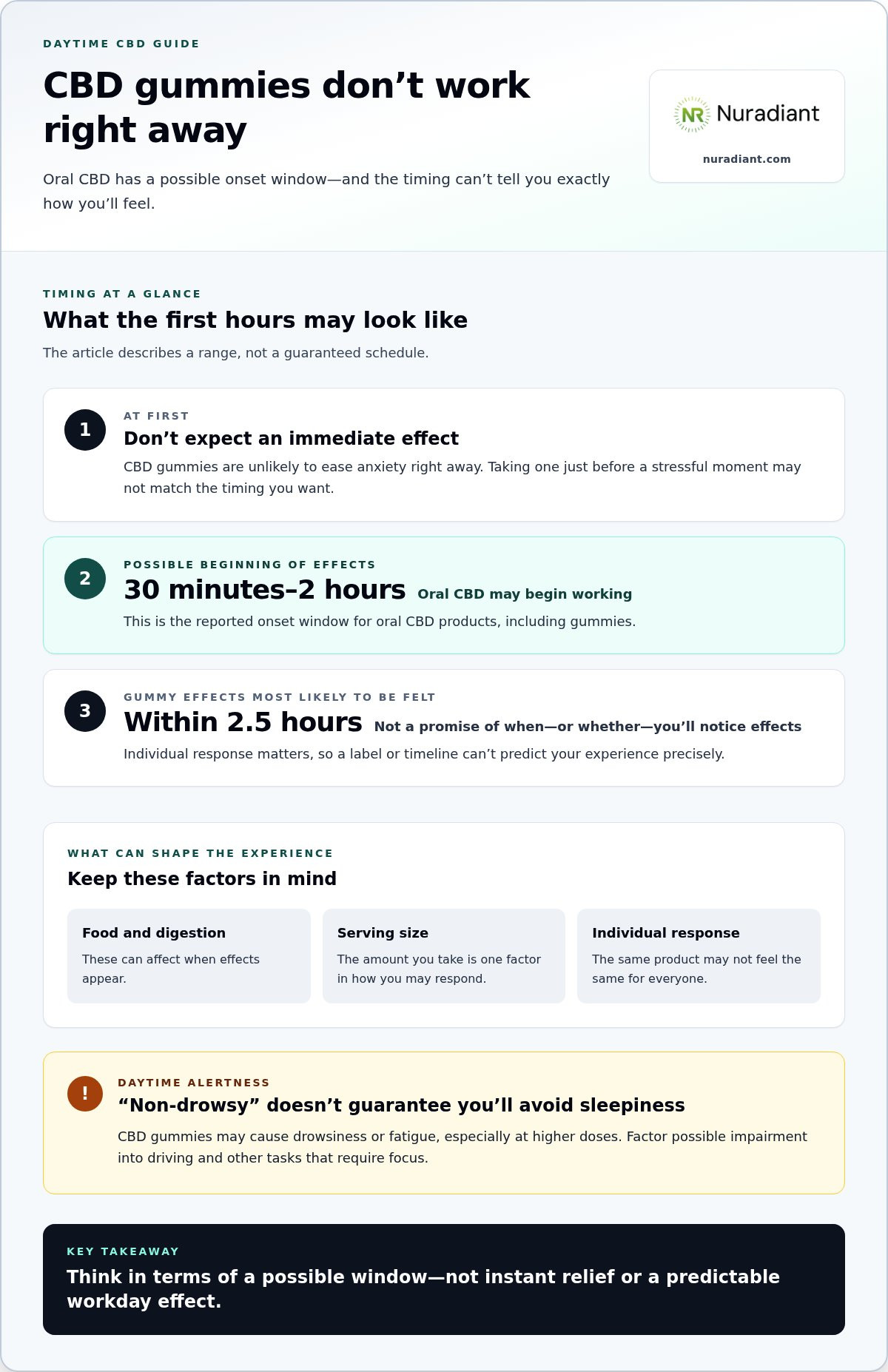
CBD gummies are unlikely to ease anxiety right away: oral CBD may take 30 minutes to 2 hours to begin working, and gummy effects are most likely to be felt within 2.5 hours. Choosing non-drowsy CBD for daytime anxiety doesn’t guarantee you’ll avoid sleepiness, since gummies may cause drowsiness or fatigue, especially at higher doses.
You want to feel calm without losing focus, so a gummy marketed for daytime use may sound like a simple solution. But timing, serving size, and your individual response all matter. The label alone can’t predict how you’ll feel during the workday.
This guide compares CBD gummies with other oral formats, explains factors that can affect when effects appear, and outlines what to do if CBD seems to increase anxiety. It also offers a practical way to weigh daytime use, possible drowsiness, and the limits of current evidence. Use these points to make an informed decision, not a guess.
Key Takeaways
- CBD can worsen anxiety for some people: one study reported worse symptoms in 19.5% of participants. Pay attention to changes in anxiety after use.
- Compare THC-free, broad-spectrum, and full-spectrum products by their cannabinoid and THC profiles; full-spectrum CBD contains up to 0.3% THC.
- Studies have used widely varying CBD doses, from 0.5 to 800 mg per day. Don’t assume a dose used in research is a personal dosing recommendation.
- CBD gummies may affect appetite or digestion, and CBD may interact with certain medications. Review these considerations before adding a product to your routine.
- Daytime use demands alertness. CBD gummies may cause drowsiness or fatigue, so factor possible impairment into driving and other tasks requiring focus.
Can CBD cause more anxiety and panic attacks?
Yes. CBD can coincide with worse anxiety, including a more intense response after treatment. In one study, 19.5% of participants reported worse symptoms. In a New Zealand study, 0.8% reported worsening symptoms. Those results show why a calming effect isn’t guaranteed. Track your response instead of assuming a gummy will help.
Side effects can also affect daytime function. In the New Zealand study, 9.9% of participants experienced adverse effects such as sedation and vivid dreams. CBD gummies can also change appetite or digestion. A strong flavor tells you nothing about how your body will respond. Record the product, amount, timing, and any changes in anxiety or physical symptoms.
Interactions matter, too. CBD may interact with certain medications, so review your medication list with a healthcare provider before combining them. Don’t stop or change prescribed medication to try CBD. A systematic review can help put the evidence in context, but individual studies and products may differ. Look for the specific outcome measured, such as anxiety symptoms or adverse effects, rather than relying on broad claims.
In the United States, some hemp-derived CBD products containing less than 0.3% THC became federally legal under the 2018 Farm Bill, according to U.S. Congress. That does not mean every CBD product is federally legal or approved: the FDA has not approved nonprescription CBD products. State rules also differ; purchasers of consumable hemp products in Alabama, Minnesota, and Tennessee must be at least 21 years old.
| Option | Possible concern | Practical step |
|---|---|---|
| CBD gummies | Worsening anxiety, digestion changes, or sedation | Track timing and symptoms; stop if anxiety worsens |
| CBD with medications | Potential interaction | Review the combination with a healthcare provider |
| Continuing anxiety | Symptoms remain severe or disruptive | Seek professional care instead of relying on CBD |
Choose based on your symptoms, medication use, and need to stay alert, not on flavor or “calm” marketing. If CBD seems to trigger anxiety or panic, stop taking it and note what changed, including the timing and amount used and any other substances.
Seek professional care if anxiety is severe, worsening, or interfering with daily life. Get urgent help for thoughts of self-harm or an immediate safety concern. A healthcare professional can assess your symptoms and medication interactions; CBD is not a substitute for that evaluation.
Can hemp products help relieve stress naturally?
Product labels can make CBD options seem interchangeable, but they aren’t. Before considering a product for daytime stress, compare its THC content, spectrum, serving information, and testing details.
CBD Spectrum and Lab Testing
THC-free products are labeled to contain no THC; broad-spectrum products generally retain other hemp compounds while removing THC. Full-spectrum CBD can contain up to 0.3% THC, so it differs on an important workplace and personal preference criterion. Check the certificate of analysis for cannabinoid results. Forbes Health evaluated over 20 CBD gummy products with certificates of analysis and third-party testing by ISO 17025-compliant laboratories.
Product Types, Potencies, and Serving Sizes
CBD oils, edibles, and capsules differ in format, ingredients, and how precisely you can measure a serving. Gummies provide a labeled amount per piece, while oils require measuring a portion with a dropper. Compare CBD per serving, not just the total amount on the package. Check the ingredient list for added compounds and allergens, too. Flavor doesn’t indicate potency or expected effects.
CBD Options for Workday Stress
Products promoted for workday use often emphasize calm, focus, or convenience, but those labels don’t establish that CBD relieves stress or preserves alertness. A gummy may be easier to carry than oil, while oil can allow more flexible portioning. Compare the THC profile and serving information first, then consider whether the format suits your routine and tolerance for possible effects.
In the United States, CBD gummy prices vary with the labeled CBD amount per serving, package count, ingredients, and testing. Compare cost per labeled serving rather than jar size alone.
Yes. A “THC-free” label doesn’t guarantee a negative workplace drug test. Test results depend on actual product contents and exposure, so don’t treat that label as proof of an outcome.
Use this comparison before choosing:
- THC profile: Match the label to your preference for THC exposure.
- Serving information: Compare the CBD amount per gummy, capsule, or measured oil portion.
- Testing: Look for a product-specific certificate of analysis with cannabinoid results.
- Ingredients: Review the full list, especially if you avoid particular ingredients.
CBD research doesn’t establish that every format or spectrum delivers stress relief. Start with the product details that matter most to your workday: predictable serving information, a clear THC profile, and accessible testing results. If you’re comparing CBD product options, use those same criteria rather than relying on calm-focused marketing.
Do CBD gummies work right away for anxiety?
Usually, no. Oral cannabidiol products, including gummies, typically begin taking effect within 30 minutes to 2 hours. Gummy effects are most likely to be felt within 2.5 hours, so taking one immediately before a stressful meeting may not match the timing you want. Food, digestion, and the individual product can affect how quickly an edible takes effect.
Clinical research has tested a wide range of amounts, not one settled dosage for anxiety disorders. Studies referenced in the article used 0.5 to 800 mg per day, while studies of anxiety used 6 to 400 mg per dose. Those ranges reflect different research designs and participants. They aren’t a personal dosing plan, and a higher amount doesn’t automatically mean better results.
A 2023 research review reported decreased social anxiety in studies using 300 to 600 mg of CBD. But a small 2023 trial found that 300 mg did not alleviate mental symptoms of anxiety. The different findings show why a single study can’t determine how an individual will respond. Read the study outcome and dose together, not as a promise attached to every gummy.
Other research used substantially different amounts. In a 2019 study of 72 adults with anxiety or sleep problems, most participants received 25 mg per day. A pharmacist cited in the page suggests a typical starting dosage of 20 to 50 mg per day. Experts commonly recommend starting at 5 mg twice a day and gradually increasing. Another recommendation is 5 to 10 mg, increased slowly every few days.
- Read the label: Identify CBD milligrams per gummy, not just per package.
- Start low: The cited guidance includes 5 mg twice a day or 5 to 10 mg initially.
- Allow time: Oral products may take 30 minutes to 2 hours to begin working.
- Track your response: Record dosage, timing, anxiety symptoms, and side effects.
Don’t stack gummies because relief hasn’t arrived quickly. Wait for the expected oral onset before considering another serving, and keep the product’s labeled amount clear. CBD doses above 600 mg daily may be less effective for anxiety, which further challenges the assumption that more is always better. The best next step is careful reading and consistent tracking, not copying a clinical dose from a different study.
CBD gummies marketed for daytime calm
“Daytime calm” is a marketing position, not proof of an effect or a guarantee of alertness. Evaluate each gummy by its labeled CBD amount, cannabinoid profile, ingredient list, and testing information. If you’re looking for non-drowsy CBD for daytime anxiety, compare those details with the demands of your day, such as driving, focused work, or a meeting.
Look closely at what the gummies contain. Full-spectrum CBD can contain up to 0.3% THC; that profile differs from a product labeled THC-free. Product contents matter because CBD may interact with certain medications, and THC exposure may matter for workplace testing. Don’t treat words like “calm,” “focus,” or “daytime” as evidence of a specific effect.
Research also needs careful reading. A New Zealand study followed 397 adults receiving medical CBD treatment for 3 weeks, and 70% reported some level of satisfaction. That finding doesn’t show that a particular gummy reduces anxiety during a workday. It describes satisfaction with medical CBD treatment, not a direct comparison of gummies marketed for daytime use.
Other findings use different timelines and outcomes. After 2 months of CBD treatment, 78.1% of participants in a study reported improved anxiety symptoms. That result doesn’t establish how quickly a gummy works, whether it prevents fatigue, or whether the same response applies to people with anxiety disorders. Check the population, product, treatment period, and measured outcome before applying a study to a product label.
Use a practical label review before choosing:
- Amount: Find CBD milligrams per gummy, not only the total amount in the container.
- Ingredients: Read the full list, including added ingredients that may not fit your preferences.
- Profile: Distinguish THC-free, broad-spectrum, and full-spectrum CBD descriptions.
- Testing: Look for a product-specific certificate of analysis and cannabinoid results.
- Medication use: Review potential interactions with a healthcare provider before combining CBD and medications.
For an evidence-based comparison, Forbes Health’s CBD gummy evaluation assigned 35% of its ranking weight to independent laboratory testing results, 20% to ingredient quality, and 40% to price. Those are ranking criteria, not proof that any gummy treats anxiety. Use lab results to understand what a product contains, then judge daytime claims against the evidence and your priorities.
To choose non-drowsy CBD for daytime anxiety, weigh product details against your need to stay alert. A “daytime” label alone can’t predict your response, so base your decision on the cannabinoid profile, serving information, and testing results.
Can CBD cause drowsiness or impair driving during the day
Yes. CBD gummies may cause drowsiness or fatigue, especially at higher doses. Drowsiness is also a common side effect reported in clinical studies of Epidiolex, a prescription CBD medicine. That finding doesn’t establish the effects of every gummy, but it makes alertness an important consideration before daytime use.
Driving requires sustained attention, quick decisions, and coordination. If a CBD product makes you sleepy, foggy, or less alert, don’t drive or operate equipment. Avoid trying a first dose before a commute, work shift, or other task requiring full concentration. A “daytime” label can’t predict how your body will respond.
Timing matters because oral CBD products can take 30 minutes to 2 hours to begin working. Gummy effects are most likely to be felt within 2.5 hours after consumption. A person who feels normal shortly after eating a gummy could notice effects later, during a drive or meeting. Plan around the possible delay, not just the moment you take it.
Dose is another variable. The research references CBD doses ranging from 0.5 to 800 mg per day, and gummies may cause drowsiness or fatigue especially at higher doses. Those study amounts aren’t a personal dosing guide. Follow the product’s serving label, avoid taking extra because you feel nothing immediately, and record the time and amount if you’re assessing your response.
Use a simple alertness check before any driving:
- Before use: Avoid trying a new CBD gummy before driving or safety-sensitive work.
- After use: Watch for sleepiness, fatigue, slowed thinking, or difficulty focusing.
- If symptoms appear: Don’t drive; arrange another way to travel and wait until fully alert.
- For future use: Note the gummy amount, timing, and effects to spot patterns.
CBD may interact with certain medications, so include medication use in your safety assessment. A healthcare provider can review possible interactions. Don’t treat a “non-drowsy” claim as proof that a product won’t affect your alertness, especially if you take medication or are trying a different serving.
Make alertness the deciding factor, not the marketing. If you’re comparing CBD products, explore CBD product options and weigh serving details against your need to drive or stay focused.
Nuradiant: CBD Products
Nuradiant offers CBD products and premium gummies for readers comparing formats after considering timing, serving information, and possible side effects. If you’re considering a gummy for daytime use, apply the same criteria: read the product information, account for possible drowsiness, and consider medication interactions. “Daytime” positioning doesn’t guarantee alertness or anxiety relief. If CBD seems to worsen your anxiety, stop using it and seek appropriate professional care rather than switching products to chase a different effect. Nuradiant also offers nootropics and joint health supplements for readers exploring other supplement options. Visit nuradiant.com to explore the products.
Choose Your Next Step With Intent
Make your next move deliberately. Before adding a CBD gummy to your routine, define what you need: a format that fits your day, clear product information, and a plan for noticing how you respond. Choosing non-drowsy CBD for daytime anxiety still means weighing your need for alertness against possible unwanted effects. If anxiety is disrupting daily life, prioritize appropriate professional care instead of expecting a supplement to do every job.
Nuradiant offers CBD products, nootropics, and men’s health supplements for people exploring supplement options. Compare the products with your goals, read the details carefully, and keep your decision grounded in what matters to your day. Take an informed next step, without rushing.
Contact Nuradiant for support as you explore its offerings. Keep asking precise questions, stay attentive to your response, and move forward with a clear plan.
Frequently Asked Questions
Can CBD effectively treat anxiety?
CBD is not an established treatment for anxiety, and the FDA hasn’t approved nonprescription CBD products. Some studies report improvements in anxiety symptoms, but findings vary by dose, product, and study design. For example, results from a controlled study may not predict how a retail gummy affects you. If anxiety disrupts work, sleep, or relationships, discuss established care options with a qualified health professional rather than replacing them with CBD.
What are the risks and side effects of CBD?
CBD can cause side effects, including drowsiness, fatigue, appetite or digestion changes, and vivid dreams. It may also interact with certain medications. Note any new sleepiness or stomach changes after starting a product, and share that information with a healthcare provider who knows your medication list. Stop using CBD if anxiety worsens, and seek urgent help for a serious reaction or immediate safety concern.
Does CBD calm the nervous system?
CBD may affect processes involved in mood and stress, but that doesn’t prove it reliably calms the nervous system for everyone. A noticeable change may also reflect the amount used, timing, expectations, or other substances. Treat “calming” language on a label as marketing, not as a measurement of nervous-system activity. Track specific outcomes, such as tension, concentration, and sleep, rather than relying on a general sense of calm.
How Quickly Do I Feel the Effects of Mood CBD Gummies?
Gummy effects may take time because the CBD must pass through digestion before entering circulation. Oral CBD products typically begin taking effect within 30 minutes to 2 hours, while gummy effects are most likely to be felt within 2.5 hours. A practical approach is to avoid taking another serving just because you feel nothing immediately. Record when you take the gummy and when any changes begin.
How does CBD help with relaxation?
CBD may influence signaling involved in mood and stress responses, but the precise pathway behind relaxation isn’t settled. A gummy also won’t remove the trigger behind a demanding presentation, conflict, or deadline. Pair any supplement decision with a practical stress-management tool, such as taking a brief break or using a planned breathing exercise. Judge the result by a specific change, such as reduced tension, rather than a broad promise of relaxation.
How should I use CBD oil?
Start by reading the oil’s serving directions and checking how much CBD each measured serving contains. Use the provided dropper to measure rather than estimating by eye, and record the time and amount. Don’t combine it with a new gummy during your first trial, because that makes your response harder to interpret. If you take medication, ask a healthcare provider about possible interactions before adding CBD oil.
Does CBD help with daytime anxiety, and what does the clinical evidence show?
Clinical evidence is mixed, so it doesn’t establish CBD as a dependable daytime anxiety treatment. In a New Zealand study of medical CBD treatment, some participants reported improvement, while others reported worsening symptoms or side effects. That matters for daytime use: symptom change and alertness are separate outcomes. Consider both, and don’t assume feeling calmer means your attention or driving ability is unaffected.
What CBD dose has been studied for anxiety, and how should someone start low?
Anxiety studies have used doses from 6 to 400 mg per dose, while broader research references doses from 0.5 to 800 mg per day. Those ranges describe study protocols, not a recommended personal dose. Guidance cited in the article includes starting with 5 to 10 mg and increasing slowly every few days. Check the product’s CBD amount per serving, keep a response log, and review medication interactions with a healthcare provider.