

Medical Grade vs Store Bought Vitamins: How Quality and Absorption Compare
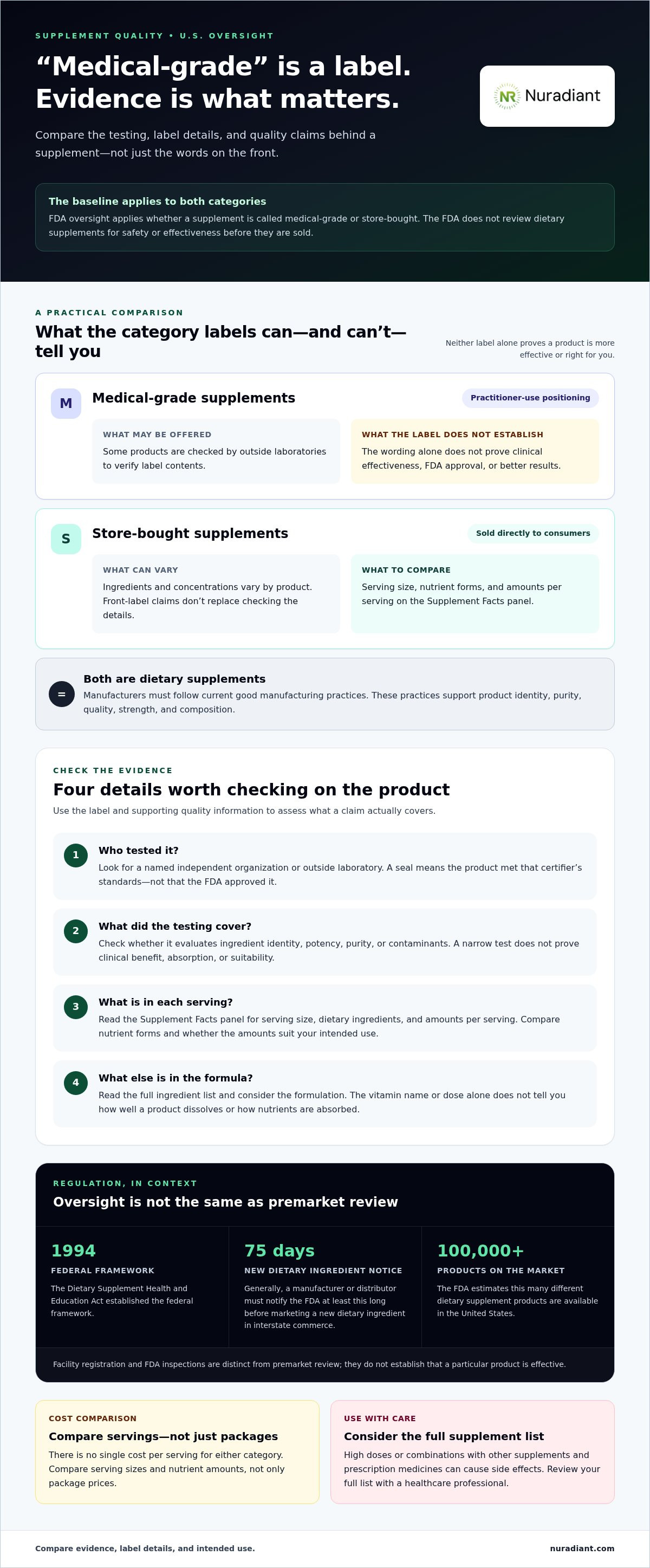
In the United States, medical-grade vs. store-bought vitamins isn’t a simple FDA-approved-versus-unapproved choice: the FDA doesn’t review dietary supplements for safety or effectiveness before they’re sold. Manufacturers must follow current good manufacturing practices, but independent testing, ingredient forms, doses, and label transparency can vary by product.
It’s smart to look beyond the front label. A premium-sounding claim doesn’t tell you how a supplement was tested, which nutrient forms it contains, or how its formulation dissolves. The details matter.
This guide compares quality testing, manufacturing standards, absorption, and additional ingredients. Learn what to check on a Supplement Facts panel, what third-party testing can tell you, and why it’s worth reading the full ingredient list. Then compare products against your goals rather than relying on marketing claims.
Key Takeaways
- The FDA regulates dietary supplements but doesn’t review them for safety or effectiveness before they’re sold. Manufacturers must follow current good manufacturing practices.
- Independent testing and certification can offer extra evidence about a supplement’s quality. Learn what a seal covers before treating it as a guarantee of every product claim.
- Absorption depends on the formulation, not just the vitamin name or dose. A product’s ability to dissolve can affect how its nutrients are absorbed.
- Read the Supplement Facts panel and full ingredient list to assess serving amounts, nutrient forms, and other ingredients.
- “Medical grade” alone doesn’t tell you how a supplement was tested or made. Look for clear, specific evidence behind quality claims.
What’s the Difference Between Medical-Grade and Store-Bought Supplements?
Both are dietary supplements, but their testing, formulation, and marketing can differ. In the United States, FDA oversight applies to both, not just vitamins sold in stores.
Medical-Grade Supplements
“Medical-grade” generally describes a product positioned for practitioner use and associated with additional quality controls. Some products in this category are tested by outside laboratories to verify label contents. That may provide evidence about identity and purity, but the label alone doesn’t establish clinical effectiveness or guarantee better results than an over-the-counter supplement.
Store-Bought Supplements
Store-bought supplements include vitamins, minerals, and botanicals sold directly to consumers. Ingredients and concentrations vary, so compare the Supplement Facts panel rather than relying on the front label. It lists serving size, dietary ingredients, and amounts per serving, subject to stated exceptions. Check the nutrient forms and whether the amounts suit your intended use.
FDA Oversight and Supplement Regulation
The Dietary Supplement Health and Education Act established the federal framework in 1994. According to the FDA, supplements aren’t reviewed for safety or effectiveness before sale, and manufacturers, packers, and holders must follow current good manufacturing practices. Those practices support product identity, purity, quality, strength, and composition. FDA oversight applies whether a supplement is labeled medical-grade, sold over the counter, or marketed for a specific function.
| Option | Testing and oversight | What to compare |
|---|---|---|
| Medical-grade supplement | Often outside-lab checked | Testing details and label amounts |
| Store-bought supplement | FDA-regulated; no premarket review | Ingredients, forms, and serving size |
| Both categories | Subject to manufacturing requirements | Quality evidence and intended use |
Evidence, Cost, and Supplement Risks
A “medical-grade” label alone doesn’t show that vitamins work better. Clinical evidence needs to match the ingredient, dose, formulation, and outcome. There’s no single cost per serving for either category, so compare serving sizes and nutrient amounts, not just package prices. High doses or combinations with other supplements and prescription medicines can cause side effects. Review your full supplement list with a healthcare professional before choosing or combining products.
The assertion that over-the-counter supplements are not regulated by the government conflicts with the FDA oversight described above. Dietary supplement manufacturing, processing, packing, and holding facilities in the United States must register with FDA before beginning those operations under the Public Health Security and Bioterrorism Preparedness and Response Act of 2002. FDA periodically inspects facilities that manufacture dietary supplements. Registration and inspection are distinct from premarket review and do not establish that a particular product is effective.
A new dietary ingredient is one that was not marketed in the United States before October 15, 1994. In the United States, a manufacturer or distributor generally must submit a new dietary ingredient notification to FDA at least 75 days before marketing the supplement in interstate commerce. The FDA estimates that more than 100,000 different dietary supplement products are on the market in the United States, making it useful to compare the ingredients and amounts in each specific product.
Independent quality testing and seals
A seal can provide evidence about quality, but only within its stated scope. Distinguish product testing from blood testing: one examines a supplement, while the other assesses markers in your body.
No. The FDA doesn’t approve dietary supplements before sale, and “medical-grade” doesn’t mean FDA-approved. Independent certification is separate: a seal indicates that the product met the certifier’s standards.
Ingredient and Toxin Testing
Ingredient testing checks whether a product’s contents match its label and whether contaminants are present. Some pharmaceutical supplement programs test raw ingredients before production for toxins. Don’t assume every supplement labeled medical-grade follows that process. Look for specifics about what was tested, such as ingredient identity, purity, or contaminants.
Third-Party Testing and Certification
Third-party testing means an independent organization evaluates a product against its criteria. ConsumerLab.com, NSF International, and U.S. Pharmacopeia offer dietary supplement quality testing. A certification seal indicates that the product met that company’s standards, not that the FDA approved it or confirmed every wellness claim. The difference between medical-grade wording and independent certification is the evidence supporting the claim.
Review the label systematically. Identify the certifier, then find out what its seal covers. Check whether it evaluates ingredient identity, potency, or contaminants. A seal with a narrow scope isn’t proof of clinical benefit, absorption, or suitability for your needs. For example, a quality test of listed ingredients can’t show that a supplement corrects a personal nutrient deficiency.
Blood and micronutrient tests answer a different question. They assess markers in your body, not the manufacturing quality of a supplement. Doctors may consider lab results, diet, medications, and symptoms when discussing nutrition. A blood test also can’t verify that a product contains its labeled ingredients. Keep the tools distinct: product testing evaluates what you take; clinical testing evaluates relevant markers in you.
Before choosing, compare the testing claim with the actual seal or report. Note the tested product, ingredients, and scope. Then bring relevant results and your current supplement list to a healthcare professional, especially when combining products. For a practical next step, compare supplement options against the same ingredient and quality criteria.
Absorption of over-the-counter vitamins
A supplement label shows what a serving contains, not how much your body absorbs. Formulation, nutrient type, and how well a tablet dissolves can all affect how much is available for use.
Some studies show people may absorb about 10% of some over-the-counter vitamins. That figure applies to some vitamins in some studies, not every product or person. It doesn’t establish that all store-bought supplements absorb poorly, or that medical-grade formulas consistently perform better. The difference between products depends on the specific ingredient and formulation.
Tablet design can matter. Some compacted daily multivitamins may pass through the stool undigested and unabsorbed if they don’t dissolve well. A tablet that remains intact has less opportunity to release its vitamins and minerals during digestion. That’s one reason to consider the format, not just the dose printed on the front label.
Absorption varies by nutrient. Vitamins and minerals don’t all behave alike, and a result for one nutrient can’t automatically be applied to another. For example, how well a mineral is absorbed from a tablet doesn’t predict how well a vitamin in the same product dissolves. Both the ingredient form and the product matrix matter.
Use this quick review before selecting a supplement:
- Read the serving details. Compare the Supplement Facts panel with the front-label claim.
- Check the format. Note whether the product is a tablet, capsule, liquid, or gummy.
- Look for a specific claim. “Medical-grade” alone doesn’t explain dissolution or absorption.
Food can affect how you take a supplement, so follow the product’s directions rather than assuming every vitamin belongs with a meal. If the label gives timing instructions, follow them consistently. The FDA regulates dietary supplements, but it doesn’t review them for effectiveness before sale.
A higher dose isn’t proof of better absorption. The amount listed describes the serving, not the fraction your body takes up. Compare nutrient form, dose, delivery format, and intended use together. A healthcare professional can also consider your diet, medications, and relevant health information when discussing supplements.
For a fair comparison, assess each product rather than assuming every over-the-counter formula is poorly absorbed or every medical-grade supplement is superior. A tightly compacted daily tablet may differ from a product that dissolves well, but the label category alone can’t settle the comparison. Match the specific formula to the nutrient and directions that matter.
Fillers and other ingredients in store-bought vitamins
“Filler” can refer to an ingredient that serves a practical role in a tablet, capsule, or gummy. The label, not the marketing, shows what a supplement contains and how its ingredients are presented.
Start with the Supplement Facts panel. It generally lists serving size, servings per container, dietary ingredients, and amounts per serving, subject to stated exceptions. Then read the other ingredients section for components beyond the named vitamins and minerals. A tablet may include ingredients that help hold its shape; a gummy may list ingredients that give it texture. Their presence alone doesn’t show whether a product is better or worse.
Distinguish dietary ingredients from other components. Vitamins, minerals, botanicals, probiotics, and amino acids may be listed as dietary ingredients, while other components can support the product’s form. Don’t just ask whether a formula has additional ingredients. Ask what each one does, whether it’s clearly listed, and whether the serving amounts fit the product’s intended use.
- Compare the full ingredient list. Don’t stop at the front label’s highlighted nutrients.
- Check serving details. Match each listed amount to the serving size.
- Look at product format. Compare a tablet’s other ingredients with those in a gummy or capsule.
Marketing claims need a separate check. A phrase such as “clean” or “premium” doesn’t identify an ingredient or prove a quality advantage. FDA doesn’t evaluate dietary supplement structure/function claims before they appear on labels. Under 21 U.S.C. 343(r)(6)(C), labels making certain structure/function or related claims must include a disclaimer that FDA hasn’t evaluated the claim and the product isn’t intended to diagnose, treat, cure, or prevent disease.
The difference between medical-grade wording and store-bought labeling isn’t that one automatically has fillers and the other doesn’t. Composition varies by product. Good manufacturing practices support identity, purity, quality, strength, and composition, but don’t mean every product uses the same ingredients. For a practical comparison, place two labels side by side and compare dietary ingredients, serving amounts, and other ingredients.
Use the label to decide whether each component makes sense for your needs. If a product includes probiotics or amino acids, assess them as listed ingredients, not proof of an overall benefit. If an ingredient’s purpose or amount is unclear, discuss the label with a healthcare professional. This gives you a concrete starting point: the formula, its claims, and the serving you plan to take.
What does “medical grade” mean for vitamins, and is it a regulated term in the U.S?
In the United States, “medical grade” describes how a supplement is marketed, not a separate FDA approval category. The FDA regulates dietary supplements as food, not medication, so the phrase doesn’t make a vitamin an FDA-approved drug or prove it works better.
The label may still point to quality practices, such as outside laboratory testing or manufacturing controls. Those details matter more than the phrase itself. Judge a product claiming medical-grade status by the evidence for its ingredients, manufacturing, and testing, not its name alone.
Use this distinction when comparing products:
- Regulatory status: FDA rules for supplements differ from rules for prescription and over-the-counter medicines.
- Manufacturing: Dietary supplement manufacturers, packers, and holders must follow current good manufacturing practices.
- Product evidence: Outside testing may help verify product contents, but it doesn’t establish that a supplement treats a disease.
The Dietary Supplement Health and Education Act established the federal framework for supplements in 1994. Under that framework, manufacturers and distributors are responsible for ensuring products aren’t adulterated, misbranded, or otherwise in violation of federal law. FDA doesn’t evaluate structure/function claims before they appear on supplement labels. Certain claims must carry a disclaimer stating FDA hasn’t evaluated them and the product isn’t intended to diagnose, treat, cure, or prevent disease.
That’s why “medical grade” shouldn’t be read as “prescription strength,” “clinically proven,” or “approved by the FDA.” Those descriptions refer to different kinds of evidence or regulatory status. An independent certification seal also differs from FDA approval: it indicates that a product met the certifier’s standards, not that the agency endorsed its benefits.
Let the label guide your comparison. Read the Supplement Facts panel for serving size, dietary ingredients, and amounts per serving. Then look for specific testing details, not just broad quality language. A claim of independent testing is more informative when it says what was tested, such as ingredient identity or purity. Match the product’s stated purpose to your needs and discuss supplement choices with a healthcare professional, especially if you take medicines or combine products.
For a more evidence-led comparison, review supplement quality criteria alongside the product label and testing information.
Nuradiant: CBD Products
Nuradiant offers CBD products for readers comparing supplement options and looking beyond conventional vitamins. A CBD product isn’t a substitute for a vitamin or mineral, so choose based on the type of product you’re considering and its listed ingredients. Nuradiant also offers nootropics, joint health supplements, and premium gummies, giving you several categories to explore while keeping your decision grounded in labels and quality information. Compare each product’s ingredients, serving directions, and intended use rather than assuming “medical grade” means the same thing across categories. If you’re assessing whether an option fits alongside medicines or other supplements, discuss the combination with a healthcare professional. Ready to explore? Visit Nuradiant.
Make Your Next Supplement Choice Deliberate
Choosing between medical-grade and store-bought vitamins is just one part of building a supplement routine. Start with a clear priority, such as supporting a particular area of health, then compare products with that goal and your current routine in mind. A focused choice is easier to assess than adding several new supplements at once.
Nuradiant offers men’s health supplements, CBD products, and nootropics for people exploring different supplement categories. Be intentional: identify what you want to add, consider how it fits with what you already take, and discuss potential combinations with a healthcare professional.
Ready to consider your options? Contact Nuradiant to discuss your options. Take the next step with a clear goal and an informed decision.
Frequently Asked Questions
How are medical-grade vitamins different from store-bought vitamins in ingredients, potency, and quality testing?
There’s no fixed formula that separates these categories. Compare each product’s ingredient forms, serving amounts, and testing evidence instead of assuming “medical-grade” means stronger. For example, two multivitamins may list the same nutrient in different forms or amounts. A quality seal or test report can provide product-specific evidence, while a category label alone can’t establish potency, purity, or suitability for your needs.
What do USP, NSF, and ConsumerLab certifications verify for supplements?
These organizations offer independent supplement quality testing, but their programs and standards differ. A seal means a product met the certifier’s stated criteria; it doesn’t mean the FDA approved the supplement or endorsed its health claims. ConsumerLab.com also provides testing rather than universal certification for every product. Look for the specific product and certification scope, and distinguish quality checks from evidence that an ingredient delivers a particular health outcome.
Are medical-grade vitamins more bioavailable than store-bought vitamins?
Not automatically. “Medical-grade” alone doesn’t demonstrate that a nutrient reaches the bloodstream more effectively. Bioavailability depends on the nutrient form, formulation, digestion, and individual factors. Compare the actual forms listed on two labels rather than judging by category or dose alone. Evidence for one ingredient or formulation shouldn’t be generalized to every vitamin, mineral, tablet, or capsule in either category.
How can consumers check vitamin labels, third-party testing, and expiration dates?
Read the Supplement Facts panel for serving size, nutrient forms, and amounts, then scan the other ingredients and expiration date. Check that any testing or seal applies to the specific product, not just a general company quality statement. Choose a package with readable labeling and intact seals. Follow its storage directions, and don’t use it past the printed expiration date.
When should someone choose a clinician-recommended vitamin instead of an over-the-counter product?
A clinician’s recommendation is especially useful when a lab result, health condition, medication, or altered absorption affects your choice. For example, people who have had metabolic or bariatric surgery are commonly advised to take lifelong supplements because nutrient absorption can change. Pregnancy is another distinct case: folate supplements help prevent neural tube defects. Bring your current supplement and medication list to the discussion.
How much do medical-grade and store-bought vitamins cost per serving?
There’s no single cost per serving for either category. Compare serving size and the amount of each nutrient, not just the package price.