

Glucosamine Chondroitin MSM Supplements and Joint Health
Choosing glucosamine chondroitin MSM supplements starts with understanding the ingredients. They’re associated with cartilage and joint health, but their presence in a formula doesn’t prove it will ease pain or protect cartilage.
It’s sensible to look beyond the label. Research on glucosamine and chondroitin for osteoarthritis has produced mixed findings, and evidence for MSM remains limited. These supplements may also interact with blood-thinning medication, so speak with your doctor before using glucosamine and chondroitin.
This guide explains the ingredients, what research says about osteoarthritis, and how to interpret the evidence. It also covers medication interactions and other safety considerations, helping you assess supplement claims without mistaking them for proven results.
Key Takeaways
- Understand how glucosamine, chondroitin, and MSM relate to cartilage and joint support.
- Weigh the conflicting osteoarthritis findings before deciding what the evidence means for you.
- If you take blood-thinning medication, discuss potential supplement interactions with your doctor before use.
- Learn what to consider when evaluating glucosamine’s role in joint health and whether a trial is worth discussing with a healthcare professional.
What Are Glucosamine and Chondroitin?
Glucosamine, chondroitin sulfate, and MSM are ingredients in some joint-health supplements. Their connection to cartilage helps explain why they’re combined, but it doesn’t prove a supplement can rebuild or protect a joint.
Cartilage and Supplement Ingredients
Cartilage is the cushioning tissue between bones, and glucosamine and chondroitin sulfate are components of normal cartilage. They’re building blocks that may stimulate the body to make more cartilage. MSM, or methylsulfonylmethane, is a sulfur-containing compound with the chemical formula (CH3)2SO2. A formula combining all three ingredients brings together cartilage components and a sulfur compound, but the ingredients have distinct roles.
Chondroitin’s Role in Cartilage Cushioning
Chondroitin is a major component of cartilage, which cushions joints and helps prevent bones from rubbing against each other. It absorbs water and other fluids, helping cartilage stay hydrated. This cushioning supports smooth joint movement. In a supplement, chondroitin is included because of its relationship to cartilage, not as a direct replacement for worn tissue.
Glucosamine Sulfate and Hydrochloride Forms
Glucosamine sulfate and glucosamine hydrochloride are two forms listed on supplement labels. The names identify different forms, but don’t show on their own which product is more effective. Compare the ingredients and serving directions instead of assuming the forms are interchangeable or that one guarantees better joint support. These supplements are used to support joint health, including in people interested in osteoarthritis symptoms.
There’s no single typical price for these supplements in the United States. Cost varies with the formula, ingredient amounts, number of servings, and product format.
There’s no standard dosage across all formulas. Follow the specific product’s directions. If you take medication or manage a medical condition, discuss supplement use with a healthcare professional.
Evidence for glucosamine and chondroitin in osteoarthritis
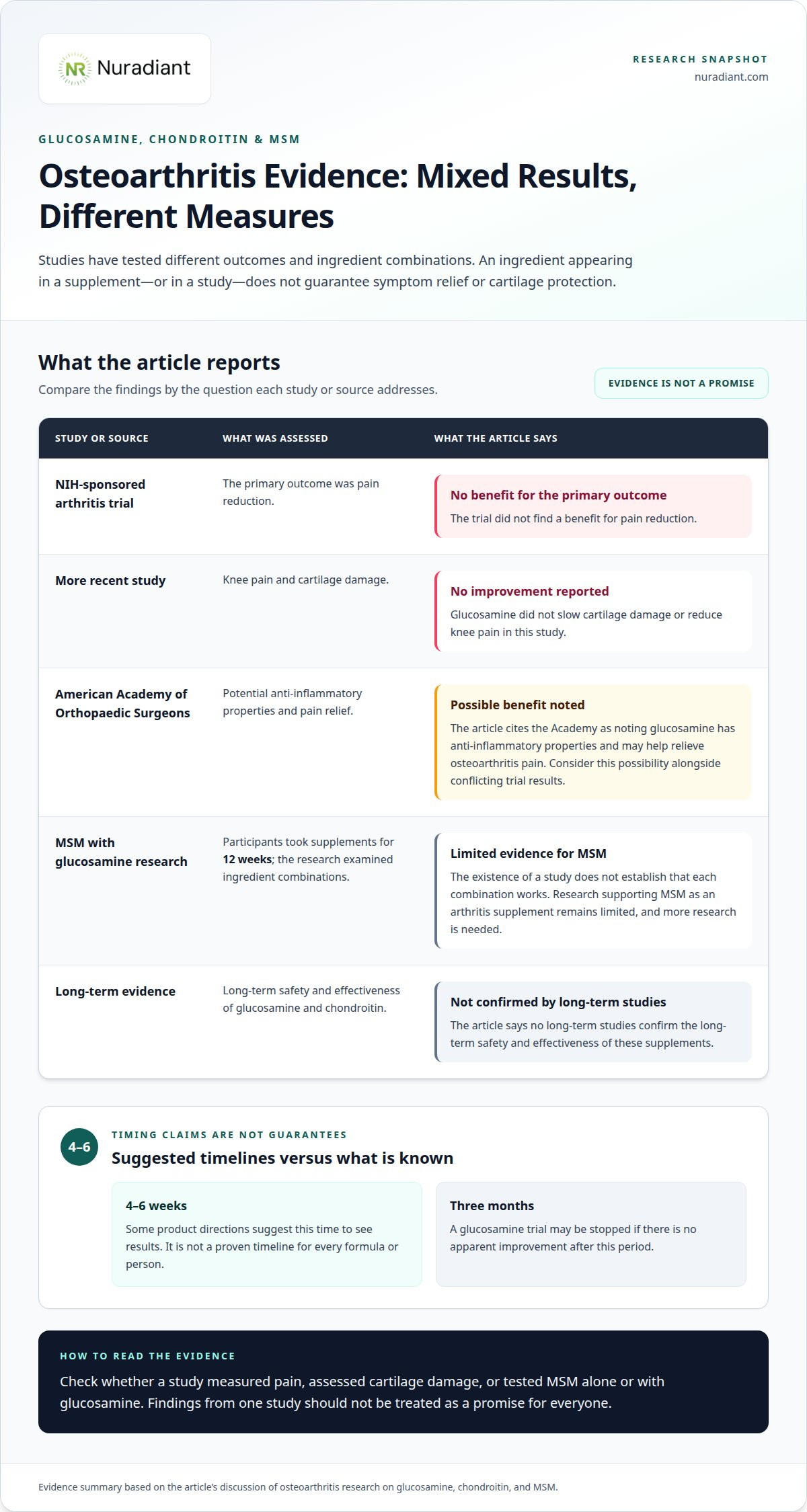
Evidence for glucosamine and chondroitin in osteoarthritis is mixed. Studies have reported conflicting results, so an ingredient list alone can’t establish whether a supplement will ease knee pain or affect cartilage damage.
The NIH-sponsored Glucosamine/Chondroitin Arthritis Intervention Trial did not find a benefit for its primary outcome, pain reduction. A more recent study found that glucosamine did not slow cartilage damage or reduce knee pain. These findings challenge confident claims that glucosamine consistently relieves osteoarthritis symptoms. They also show why results from one study can’t be treated as a promise for everyone.
Research has also examined MSM with glucosamine. Participants took the supplements for 12 weeks. That study design compares different ingredient combinations, but the existence of a study does not establish that each combination works. Research supporting MSM as an arthritis supplement remains limited, and more research is needed.
The American Academy of Orthopaedic Surgeons is cited as noting that glucosamine has anti-inflammatory properties and may help relieve osteoarthritis pain. That possibility should be considered alongside conflicting trial results. To assess the evidence, distinguish whether a study measured pain, assessed cartilage damage, or tested MSM alone or alongside glucosamine.
How long do glucosamine, chondroitin, and MSM supplements take to work? Some product directions suggest 4-6 weeks to see results, but that is not a proven timeline for every formula or person. A glucosamine trial may be stopped if there’s no apparent improvement after three months. No long-term studies confirm the long-term safety and effectiveness of glucosamine and chondroitin supplements.
Blood-thinning medication interactions
Glucosamine and chondroitin can interact with medication, so consider this before use. If you take blood-thinning medication, speak with your doctor before starting these supplements. Review the full ingredient list and your current medicines with a healthcare professional before adding them to your routine.
Reviewing possible interactions matters because supplements and prescription medications can affect side effects and may require monitoring. Take extra care if you manage multiple health conditions or use more than one prescription. Share the supplement’s ingredients and serving directions, along with your medication list, so a healthcare professional can assess possible interactions. Don’t stop or change prescribed medication to make room for a supplement.
Shellfish allergy calls for particular care. Glucosamine is extracted from a substance in shellfish, so people with shellfish allergies should consult their doctor before using glucosamine and chondroitin. A product label may identify shellfish as an allergen. Read it carefully and discuss the ingredient source with a healthcare professional rather than assuming every formula has the same contents.
Other groups need caution, too. Glucosamine and chondroitin aren’t recommended for children, pregnant people, nursing people, or those who could become pregnant, because effects on children and developing babies aren’t known. Product directions also advise people under 18, pregnant or nursing people, those taking medication, and people with medical conditions to consult a healthcare professional before use. If you have diabetes, use caution with glucosamine because it may raise blood sugar.
Be aware of reported side effects. Glucosamine and chondroitin may cause nausea, diarrhea or constipation, heartburn, and increased intestinal gas. MSM has been associated with diarrhea, skin rash, headache, and fatigue. If symptoms appear after you start a product, note when they began and which ingredients it contains, then discuss them with a healthcare professional. This record can help assess the supplement alongside blood-thinning medication and other treatments.
Glucosamine and joint health
Glucosamine plays a role in building and repairing cartilage that connects joints. That helps explain its appeal for joint support, but it doesn’t mean a capsule replaces damaged cartilage. Keep the distinction clear: a biological role describes what glucosamine does in the body, while a supplement’s effect on pain or joint function is a separate question. For osteoarthritis, those outcomes matter more than a proposed mechanism.
Joint health involves function as well as tissue. Cartilage cushions the ends of bones, helping joints move without direct bone-on-bone contact. Glucosamine’s connection to cartilage gives researchers a reason to study it, particularly for knee osteoarthritis. However, the evidence reviewed earlier is mixed, including studies that found no reduction in knee pain or slowing of cartilage damage. That makes “supports cartilage” an incomplete basis for deciding whether a supplement may be useful.
Before assessing a trial, choose a specific measure, such as knee discomfort during a walk. A glucosamine trial may be stopped if there’s no apparent improvement after three months. This gives the decision a practical boundary, but doesn’t mean everyone will respond or that continued use protects cartilage. Track a specific outcome, and don’t treat a change in one symptom as proof of structural repair.
For a sound joint-health decision, separate three things: glucosamine’s role in cartilage, research findings for osteoarthritis, and your own observable function. The first explains the biological rationale; the second sets limits on what the evidence supports; the third helps you judge whether a trial seems useful in daily life. Combining ingredients doesn’t remove uncertainty about results.
If you’re exploring targeted support, explore joint health supplements as one part of an informed approach to joint function.
Nuradiant: Men's Health Supplements
Nuradiant offers joint health supplements for men looking to explore targeted support after weighing the evidence. Its supplement range is formulated for men and women over the ages of 40 and 50, with options that include men’s health supplements, CBD products, nootropics, and premium gummies.
When exploring supplement options as part of your broader approach to health, remember that supplements don’t replace prescribed medication or medical care. If you take blood-thinning medication, discuss glucosamine and chondroitin with your doctor before use.
Contact Nuradiant to learn more about its supplement offerings.
Make Your Next Joint-Health Decision Deliberate
Make your decision around your priorities. Before choosing glucosamine, chondroitin, and MSM supplements, define what you want to support and what change you’d notice in daily life. Keep expectations grounded in the evidence, and treat ingredient claims as a starting point for evaluation, not a substitute for sound judgment.
Account for your current health routine, too. If you take medication, especially a blood thinner, discuss the supplement with your doctor before adding it. This conversation puts the formula, your medications, and your health needs in context. An informed choice is better than a rushed one.
Nuradiant offers options for people exploring supplement support as part of their health routine. Contact Nuradiant with your questions and take your next step with a clearer plan.
Frequently Asked Questions
What Are the Side Effects of MSM?
Reported MSM side effects include diarrhea, skin rash, headache, and fatigue. If symptoms begin after you start an MSM product, note when they occur and list other supplements or medicines you take. This information can help a healthcare professional assess a possible reaction. Combination formulas contain multiple ingredients, so keep the full label handy when discussing symptoms or deciding whether to continue.
What Is MSM and Can It Help My Arthritis?
MSM is a sulfur-containing compound used in some joint-health supplements. It’s sometimes taken for arthritis support, but research on MSM for arthritis remains limited. Its presence on a label isn’t proof of pain relief. Consider the outcome that matters to you, such as comfort during a walk, and discuss supplement use with a healthcare professional if you take medication.
Which Brand of Arthritis Supplement Should I Use?
Compare glucosamine chondroitin MSM supplements by reviewing the full ingredient list, serving directions, allergen information, and quality-testing details. Don’t choose based only on broad promises or a long ingredient list. If you take medication or have a medical condition, discuss the formula with a healthcare professional before use. A clear label helps you understand what you’re considering, but can’t guarantee a particular result.
Do glucosamine, chondroitin, and MSM relieve osteoarthritis or joint pain?
These supplements don’t reliably relieve osteoarthritis or joint pain for everyone. Research on glucosamine and chondroitin has mixed results, while evidence for MSM remains limited. Set a specific goal, such as noting whether knee discomfort changes during a usual walk. This gives you a practical point of comparison without assuming that a change in how you feel means your cartilage has changed.
What Does Research Say About Supplement Effectiveness?
Research doesn’t establish a consistent benefit of glucosamine chondroitin MSM supplements for osteoarthritis. Findings can vary according to the ingredients tested and the outcome measured, such as pain or cartilage damage. Read claims with these distinctions in mind. Results for one formula or study outcome don’t automatically show that another combination will have the same effect.
What are the side effects and health risks of glucosamine chondroitin MSM?
Glucosamine chondroitin MSM supplements may cause digestive symptoms, while MSM has been associated with diarrhea, rash, headache, or fatigue. Shellfish allergies, diabetes, pregnancy, nursing, and medication use also warrant caution. If you take blood-thinning medication, discuss glucosamine and chondroitin with your doctor before use. Review the full label, as combination products can contain several active ingredients.