

Supplements Without Fillers and Binders: How to Choose With Confidence
A “filler-free” label doesn’t automatically make a supplement the better choice. If you’re looking for supplements without fillers and binders, start with the ingredient list, but don’t let a bold front-label claim make the decision for you. Terms like “clean” and “filler-free” have no official U.S. definition, so their meaning can vary from brand to brand.
It makes sense to want every ingredient to serve a purpose. The catch is that fillers, binders, and other excipients can help a supplement hold its shape, stay consistent, or work in its chosen format. Their presence alone doesn’t prove a formula is low quality. What matters is what each ingredient does, how clearly the label identifies it, and whether the product fits your needs.
This guide explains what excipients do, where to find them on a label, and how to assess them without getting distracted by vague marketing. You’ll also learn which quality signals deserve attention beyond a “free-from” claim, so you can compare formulas based on purpose, transparency, and your specific goal.
Key Takeaways
- Learn how fillers, binders, and other excipients support different supplement formats, and why “inactive” doesn’t automatically mean harmful.
- Compare the Supplement Facts panel and “Other ingredients” list to see the full formula.
- Use consistent criteria, including active ingredients, serving size, dosage form, and quality information, to compare products.
- Choose supplements without fillers and binders by starting with your health goal, then assessing whether each ingredient and serving direction fits.
- Explore targeted supplement categories by health goal, while judging each formula on fit, transparency, and ingredient purpose.
Supplements Without Fillers and Binders: What Those Claims Actually Mean
“Filler-free” sounds like a quality standard, but it isn’t one by itself. Fillers, binders, and other excipients are non-active ingredients included for a formulation or manufacturing purpose. A filler may add volume when the active ingredient alone doesn’t make a practical dose. A binder helps hold certain tablet formulations together. Neither term describes every supplement, and not every formula needs either ingredient.
“Inactive” refers to an ingredient’s role in the formula, not an automatic verdict on its safety or value. An excipient isn’t the primary ingredient intended to deliver the supplement’s benefit, but it may help with manufacturing, stability, texture, or consistent dosing. The Excipient overview describes the wider category, including ingredients such as binders, fillers, lubricants, and disintegrants.
What are fillers, binders, and excipients?
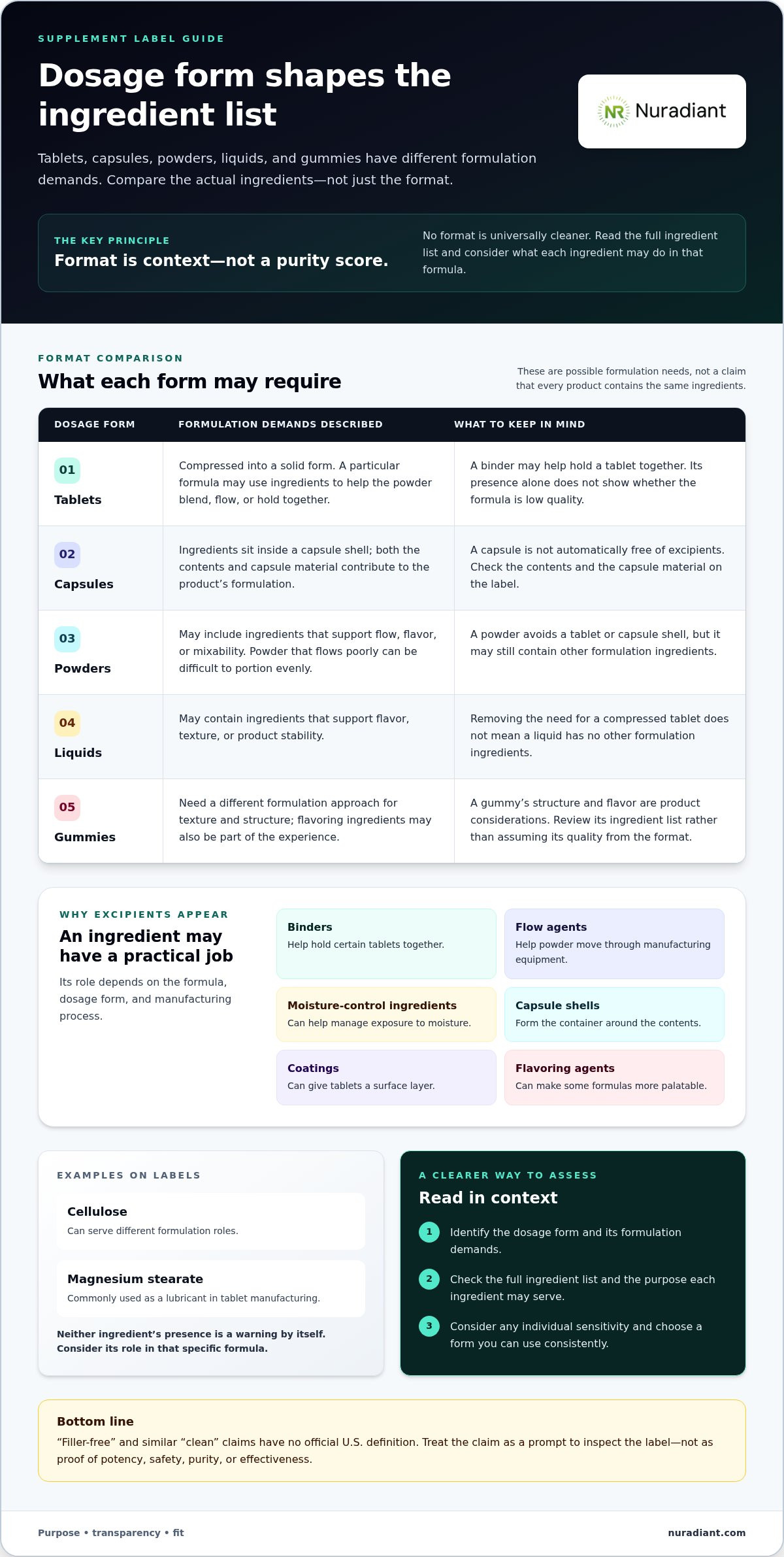
Excipients are the umbrella category. Fillers, sometimes called bulking agents, add volume or help create a usable form. Binders have a narrower job: they help powder ingredients stick together in a tablet. Other excipients may help a product move through manufacturing or break apart after use. Their functions vary because a capsule, powder, gummy, and tablet don’t necessarily need the same ingredients.
That distinction matters when you read a label. Seeing an ingredient that isn’t an active nutrient doesn’t tell you why it’s there or whether it’s appropriate. Consider the dosage form and the ingredient’s possible purpose. A tablet needs to hold together, while a powder has different formulation demands. The label gives you a starting point, not a reason to assume every excipient is unnecessary.
Does “without fillers” mean a supplement is better?
No. A “no fillers” claim alone can’t establish a supplement’s potency, safety, purity, or effectiveness. In the United States, “filler-free” and similar “clean” claims don’t have an official regulatory definition, so brands may use them differently. The phrase tells you little about whether the active ingredients match your needs or whether the product is made and labeled with care.
“No fillers” is a marketing claim, not proof of product quality. Use it as a prompt to inspect the label, not as a final score. Check which ingredients are active, what each serving provides, and whether the product’s directions fit your intended use. Then consider the purpose of the other ingredients instead of treating their presence as an automatic flaw.
Your own needs matter, too. If you know you’re sensitive to a particular ingredient, look for it by name in the ingredient list and choose accordingly. But don’t assume every additive is harmful or that an additive-free formula is automatically superior. A stronger standard is clear labeling, relevant active ingredients, and excipients with an understandable formulation role.
Why Supplements Use Binders and Other Excipients
A supplement has to work as a formula and as a product that can be made, packaged, stored, and used consistently. The demands vary with the active ingredients, dosage form, and manufacturing process. A powder that flows poorly may be difficult to portion evenly. A tablet must hold its shape. A gummy needs enough structure to stay intact.
Excipient purpose depends on the formula and dosage form. An ingredient’s name alone doesn’t tell you whether it’s needed, excessive, or a concern for you. Read it in context: What format is this? What job might the ingredient perform? Do you have an individual sensitivity to it?
What purposes can excipients serve?
Depending on the product, excipients can support several practical functions. Binders help hold certain tablets together. Flow agents help powder move through manufacturing equipment, while moisture-control ingredients can help manage exposure to moisture. Capsule shells form the container around the contents. Coatings can give tablets a surface layer, and flavoring agents can make some formulas more palatable.
Cellulose and magnesium stearate are examples you may see on an ingredient list. Cellulose can serve different formulation roles, while magnesium stearate is commonly used as a lubricant in tablet manufacturing. Their presence isn’t a warning by itself. The useful question is what role an ingredient serves in that specific formula, not whether its name sounds unfamiliar.
How dosage form changes the ingredient list
Each format has trade-offs. Tablets are compressed into a solid form, so a particular formula may use ingredients to help the powder blend, flow, or hold together. Capsules contain ingredients inside a shell, but they aren’t automatically free of excipients. Both the contents and capsule material contribute to the product’s formulation. Neither format is universally cleaner.
- Powders: They avoid a tablet or capsule shell, but may still include ingredients for flow, flavor, or mixability.
- Liquids: They remove the need for a compressed tablet, yet can still contain ingredients that support flavor, texture, or product stability.
- Gummies: Their texture and structure require a different formulation approach, and flavoring ingredients may also be part of the experience.
Don’t use format as a shortcut for judging purity. Compare the actual ingredient lists and choose a form you can use consistently. For broader quality context, the USP Verified Mark for dietary supplements explains an independent verification program. It’s one quality consideration, not a substitute for checking whether the formula fits your needs.
If you’re comparing supplements without fillers and binders, focus on the formula’s purpose before counting ingredients. You can also explore targeted supplement options by health goal, then assess each product’s label and dosage form using the same criteria.
How to Compare Supplement Labels Without Falling for “Clean” Claims
Put the marketing language aside and compare the labels themselves. “Clean,” “pure,” and “premium” don’t tell you exactly what’s in a formula or what a quality claim establishes. When comparing supplements without fillers and binders, use the Supplement Facts panel and the “Other ingredients” list together. One shows active ingredients and serving information; the other identifies additional ingredients in the formula.
Which parts of the label should you compare?
Start with the active ingredients, amounts per serving, and serving directions. Then review the complete other-ingredients list, dosage form, and any specific quality information. Compare products using equivalent serving sizes: ingredient names alone won’t reveal whether the amounts match.
| Label detail | What to compare | What it tells you |
|---|---|---|
| Active ingredients | Ingredient identity and amount per serving | Whether the formula includes the ingredients relevant to your goal, and how much is listed |
| Serving size and directions | Units per serving and suggested use | How to interpret the listed amounts and compare equivalent servings |
| Other ingredients | The full list, alongside the Supplement Facts panel | Which non-active ingredients appear in the formula |
| Dosage form | Tablet, capsule, powder, liquid, or gummy | The format you’re comparing, which can affect the ingredient list |
| Quality information | Named testing program, certification, or specific quality statement | The particular quality feature the claim addresses, not automatically health benefits |
Be precise about what label claims mean. A named test may address identity or purity; a manufacturing standard concerns production practices. Neither, by itself, proves that a supplement will deliver a health benefit or work better for you.
How to assess certifications and quality claims
A third-party testing statement is more useful when it names the program and explains what was assessed. Look for the scope: Does it refer to the finished product, particular ingredients, or a specific quality measure? A logo or the phrase “third-party tested” without that context gives you less to evaluate. Check current program descriptions before treating a certification as evidence of a particular standard.
Keep quality and clinical claims separate. Identity and purity information can help describe what a product contains; manufacturing claims describe how it is produced. Neither establishes that removing excipients improves absorption or reduces side effects. Those claims need evidence specific to the ingredient, formula, and outcome. Don’t infer a benefit from absence alone.
Treat “filler-free” as a prompt to inspect, not a verdict. Identify the active ingredients and serving amounts, read both ingredient sections, and assess each quality statement for its scope. That gives you a consistent basis for comparison without letting undefined “clean” language outrank the facts on the label.
How to Choose a Filler-Free Supplement for Your Needs
Choose by fit, not by the shortest ingredient list. A formula should match your goal, provide relevant active ingredients, and suit your health circumstances. Then weigh whether its excipients matter to you. This sequence keeps a “filler-free” claim in perspective and helps you compare supplements without fillers and binders using factors that affect your actual choice.
A practical five-step supplement comparison
Use the steps in order. They move from what you need to what the label says, without treating the absence of ingredients as proof of superiority.
- Define your goal. Be specific about what you want to support, such as joint, gut, heart, or brain health. Identify active ingredients relevant to that goal through reliable information, rather than choosing a product based only on a “clean” claim.
- Compare active ingredients and serving directions. Check the listed amount per serving, serving size, and suggested use. Compare like with like: an ingredient amount per serving is meaningful only when you account for how many capsules, tablets, or other units make up that serving.
- Choose a usable format. Consider whether you can comfortably and consistently take the tablet, capsule, powder, liquid, or gummy. Different forms may have different ingredient lists, so don’t assume that one format is inherently purer.
- Review excipients in context. Read the complete “Other ingredients” list. Consider each ingredient’s possible formulation role, the product format, and any known allergy, sensitivity, or dietary preference. If an ingredient concerns you, focus on that specific ingredient instead of treating all excipients as a single category.
- Compare labels and quality information. Review the full Supplement Facts panel alongside the other ingredients list. Look for clear, product-specific quality details, then choose the formula that best fits your goal and personal constraints. A broad “filler-free” slogan shouldn’t outweigh relevant actives, serving directions, or transparency.
When should you seek professional guidance?
Get input from a qualified clinician or pharmacist if you take medication, have a chronic condition, are preparing for a procedure, or use several supplements. They can consider interactions and your individual health context. This matters even when a product appears simple or contains few ingredients. A general buying guide can help you compare labels, but it can’t diagnose a deficiency, recommend treatment, or determine whether a formula is appropriate for your circumstances.
Make the decision based on evidence and fit: goal, active ingredients, serving directions, personal constraints, and then the complete label. Explore targeted supplements by health goal and apply the same comparison process to every formula. Don’t let “filler-free” do the thinking for you.
Explore Supplement Options With a Clearer Standard
A stronger supplement choice comes down to four checks: fit with your goal, relevant active ingredients, transparent labeling, and a clear reason for any excipients. Fewer non-active ingredients don’t automatically mean better quality, stronger effects, or fewer side effects. Judge the product in front of you, not the slogan on the bottle.
Match a supplement category to your goal
Start with the area you want to support, then explore the category that fits. Multivitamins may suit shoppers comparing broad nutrient formulas. Joint support, heart health, gut health, and immune health supplements address different goals. Nootropics and brain health supplements are categories to explore for cognitive-support interests. These categories help narrow your search, but they don’t replace checking the formula and serving directions.
- For men over 40 comparing multivitamin options, use the guide to the best multivitamin for men over 40 as a starting point for evaluating formulas.
- If cognitive support is your focus, explore the guide to nootropics for men over 40 alongside your own label review.
- For other priorities, compare targeted categories such as joint, gut, heart, immune, and women’s health supplements based on the active ingredients and directions each product states.
A category name doesn’t prove that a particular product is right for you. Check product-specific ingredient information, serving size, directions, and the complete ingredient list. Don’t assume every supplement in a category has the same formulation or that a product is filler-free without product-specific support for that claim.
Make your next supplement choice deliberately
Before you decide, put two products side by side. Compare the active ingredients and amounts per serving, confirm that you’re comparing equivalent serving sizes, and review the full Supplement Facts panel together with the “Other ingredients” list. Consider dosage form, your personal sensitivities or dietary preferences, and any quality information that clearly explains what it covers.
Then assess each excipient in context. Ask what role it may serve in that formula instead of treating its presence as an automatic flaw. If an ingredient or the serving directions raise questions because of a health condition or medication, seek guidance from a qualified clinician or pharmacist.
Use that standard as you explore Nuradiant’s supplement range by health goal. Compare each formula on fit, active ingredients, transparent labeling, and ingredient purpose. The best choice isn’t the one with the boldest “free-from” claim. It’s the one whose details align with your priorities.
Make Your Next Supplement Choice Count
Your next step isn’t chasing the shortest ingredient list. Choose a formula that fits your goal and preferences, and evaluate the information clearly provided on its label. Search for supplements without fillers and binders if that matters to you, but assess each product on its own ingredients and directions. A “free-from” phrase can’t replace that judgment.
Nuradiant offers a science-backed supplement range designed for adults over 40 and 50, with options across men’s and women’s health, joint support, nootropics, and premium gummies. Explore by the goal you want to support, then review product-specific details to decide whether a formula fits. Make the label earn your confidence.
Explore Nuradiant’s supplement range and take your next step with a clearer standard. Choose deliberately, stay focused on your priorities, and build your routine with confidence.
Frequently Asked Questions
Are fillers and binders in supplements harmful?
Not automatically. An ingredient used to make a tablet hold together or help a powder flow isn’t harmful simply because it’s non-active. Review the exact ingredient, its place in the formula, the serving directions, and your own health context. For example, a known allergy changes the decision more than a generic “free-from” slogan. If you take medication or have a medical condition, discuss the specific product with a qualified clinician or pharmacist.
What is the difference between a filler and a binder in a supplement?
A binder may help ingredients hold together in a tablet, while a filler may add bulk or support a particular formulation. The terms can be used inconsistently in everyday marketing, so don’t rely on the label category alone to judge a product. Look at the specific ingredient and dosage form. An ingredient in a tablet, for example, may serve a different role than the same ingredient in a powder.
How can I tell if a supplement has fillers or binders?
Read both the Supplement Facts panel and the complete “Other Ingredients” section. The latter can include non-active ingredients, but a name you don’t recognize isn’t proof of a problem. Look up the ingredient’s possible function and consider how it fits the product’s format. Also compare serving size and active ingredient amounts. If you’re considering supplements without fillers and binders, treat that phrase as a prompt to inspect the label, not a substitute for reading it.
Are supplements without fillers better absorbed?
Not necessarily. Removing an excipient alone doesn’t demonstrate that the body absorbs an active ingredient more effectively. Absorption can depend on the active ingredient, the full formulation, the amount taken, and individual factors. A claim about improved absorption should identify the specific ingredient and be supported by relevant evidence, not just a shorter ingredient list. Don’t assume that “clean” or “additive-free” means better results.
Can capsules be free of fillers and binders?
Some capsule formulas may contain few excipients, but the capsule format doesn’t guarantee an ingredient-free formula. The capsule shell and its contents can both contribute ingredients that appear on the label. Powders and liquids may also include ingredients for flavor, flow, or other formulation needs. If you prefer capsules, compare the complete ingredient information for the specific product instead of assuming the format makes it cleaner.
What does “clean supplement” mean?
“Clean supplement” is a marketing phrase, and different brands may use it to mean different things. It doesn’t tell you exactly what the product contains or establish its purity, safety, or effectiveness. Look for specific details instead: clearly identified ingredients, serving information, and quality claims that explain what was assessed. A claim about manufacturing practices, for instance, is not the same as evidence that a product provides a health benefit.
Should I avoid magnesium stearate or microcrystalline cellulose?
Not based on the name alone. Magnesium stearate and microcrystalline cellulose can serve formulation or manufacturing roles, and their presence doesn’t automatically indicate a harmful or inferior supplement. Start by checking whether you have a known sensitivity, then consider the product’s full formula and directions. If you’re unsure because of a health condition, medication, or previous reaction, ask a qualified clinician or pharmacist about that specific ingredient.