

Immune Health Supplements in 2026: Evidence, Ingredients, and Smart Choices
More immune health supplements don’t automatically mean stronger immune defenses. No pill can turn your immune system into an all-purpose shield, and bold marketing claims don’t replace evidence. A better approach is to identify a real need before choosing a product.
If conflicting claims have left you unsure what matters, start with practical questions: Does your diet provide the nutrients you need? Which ingredients are in a product, and how much does a serving contain? Could it overlap with another supplement or interact with medication? Those are useful questions to answer before adding anything to your routine.
This guide separates established nutrient roles from claims that go beyond the evidence. You’ll learn what supplements can and can’t do for normal immune function, how to assess familiar ingredients such as vitamin C, vitamin D, and zinc, and how to read labels against your needs. You’ll also see why nutrient status, diet, dose, and personal health factors matter, and when to seek qualified medical guidance. The aim is a practical framework for making informed choices without relying on hype.
Key Takeaways
- Immune health supplements can provide nutrients relevant to normal immune function, but they can’t guarantee protection from illness.
- Assess whether your diet and health needs point to a nutrient gap before choosing a supplement.
- Compare active ingredients and serving sizes, then check for overlapping nutrients across products.
- Evidence for vitamin C, vitamin D, and zinc depends on context; none is a universal solution for immune health.
- Use a clear plan to explore immune health supplements, and seek qualified medical guidance when safety or interactions are a concern.
What immune health supplements can, and cannot, do
Immune health supplements provide nutrients or other ingredients that play a role in normal immune function. That purpose is narrower than some label language suggests. A supplement can help fill a nutrient gap; it can’t switch on flawless defenses or guarantee you won’t get sick.
Nutrient support helps maintain normal immune function, but it isn’t a promise of stronger protection from infection. Keep that distinction in view when evaluating ingredients, claims, and whether a product fits your needs.
How the immune system defends the body
Your immune defenses work as a coordinated network, not a single switch. The NIH Office of Dietary Supplements describes the immune system as a combination of cells, tissues, and organs that help defend the body against germs. For an accessible overview of the human immune system, consider how its different components work together rather than looking for one “immunity” lever.
Protection starts at the boundaries. Skin and the linings of the respiratory and digestive tracts help block unwanted microbes from entering. If a germ gets past those barriers, immune cells can recognize and respond to it. Some responses act quickly; others involve more targeted defenses, including antibodies and immune memory. These processes rely on communication between different parts of the body. A nutrient may support a normal role within that system, but it doesn’t direct every response or control the whole network.
That complexity matters. More immune activity isn’t automatically better. A healthy response needs to be appropriately timed and regulated, not simply intensified. Treating immunity like a dial that a supplement can turn up oversimplifies the biology and sets unrealistic expectations.
What supplement claims mean in practice
Nutrients have specific roles. When intake or nutrient status is inadequate, getting enough of a relevant nutrient can help support normal body functions, including those involved in immune defense. The NIH Office of Dietary Supplements notes that inadequate intake of some nutrients can impair immune function. That’s a reason to assess a possible shortfall, not proof that everyone benefits from taking more.
Look closely at what a claim promises. “Supports normal immune function” describes a general role. A promise of fewer infections, guaranteed prevention, or faster recovery makes a different claim about health outcomes. Those outcomes can depend on the nutrient, a person’s starting status, the amount used, and other factors. Evidence that correcting inadequate intake is useful doesn’t establish that extra supplementation prevents illness in people who already get enough.
Use a practical standard: identify a plausible need, then judge whether the ingredient and claim match the evidence. Be wary of products framed as a shortcut to invulnerability. If you’re unsure whether a nutrient gap exists, or whether supplementation is suitable for you, discuss it with a qualified healthcare professional, especially if you have a health condition or take medication.
Which nutrients matter for immune function, and what evidence says
Vitamin C, vitamin D, and zinc draw attention because each has a recognized role in normal immune function. That doesn’t make any of them a universal fix. The useful question is whether you get enough and have a sound reason to supplement, not whether a larger dose sounds more powerful.
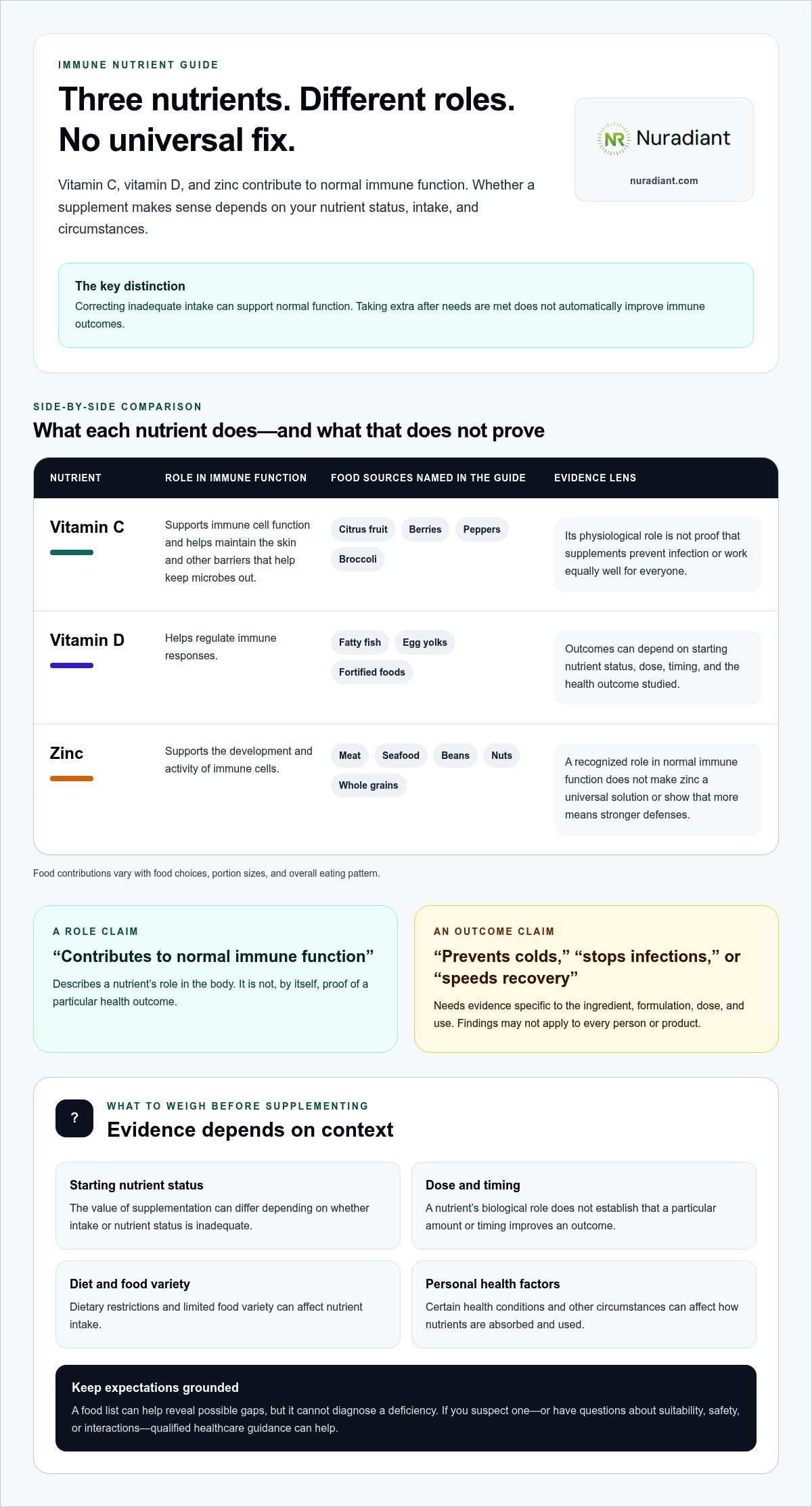
Correcting a nutrient deficiency can restore a function that inadequate intake may impair; taking extra after needs are met doesn’t automatically improve immune outcomes. Keep that distinction in mind when comparing ingredient claims.
Vitamin C, vitamin D, and zinc
Vitamin C supports immune cell function and helps maintain the skin and other barriers that help keep microbes out. Vitamin D helps regulate immune responses, while zinc supports the development and activity of immune cells. These are established physiological roles, not proof that supplements prevent infection or work equally well for everyone.
Supplementation outcomes are a separate question from nutrient function. Evidence can differ by starting nutrient status, dose, timing, and the health outcome studied. The Office of Dietary Supplements’ expert recommendations on immune supplements underscore why ingredient claims should be judged against research, not just a nutrient’s biological role. Don’t assume that taking more of any of these nutrients means stronger defenses.
Food sources, gaps, and evidence limits
Start with a varied diet where possible. Citrus fruit, berries, peppers, and broccoli provide vitamin C. Fatty fish, egg yolks, and fortified foods can contribute vitamin D. Meat, seafood, beans, nuts, and whole grains provide zinc. The amount you get depends on your food choices, portion sizes, and overall eating pattern.
Needs and nutrient status aren’t identical for everyone. Dietary restrictions, limited food variety, certain health conditions, and other personal circumstances can affect intake or how nutrients are absorbed and used. A food list can help you notice possible gaps, but it can’t diagnose a deficiency. If you suspect one, a qualified healthcare professional can help determine whether assessment or supplementation makes sense.
Be precise about the claim you’re evaluating. “Contributes to normal immune function” describes a nutrient’s role. “Prevents colds,” “stops infections,” or “speeds recovery” makes a claim about outcomes that needs evidence specific to that ingredient, formulation, dose, and use. Research findings may not apply to every person or product. Check outcome claims against current, high-quality evidence before relying on them.
Use food as your starting point, then consider a supplement to address a plausible need. If you’re exploring immune health supplements, weigh the ingredient and its evidence against your diet and circumstances. A familiar nutrient name alone isn’t a reason to add another product to your routine.
Do immune health supplements really boost immunity?
“Boost immunity” sounds like a clear performance upgrade. Biologically, stronger immune activity isn’t automatically healthier. The body needs defenses that respond effectively and stay regulated. A product that claims to turn immunity up doesn’t explain which response it affects, whether that change helps, or whether the evidence applies to you.
No supplement guarantees that you’ll avoid an infection. Keep that in mind when weighing sweeping promises, even when an ingredient has a legitimate role in normal immune function.
Support is not the same as prevention
In practical terms, “support” should mean helping meet nutrient needs relevant to normal body function. If someone’s intake or nutrient status is inadequate, addressing that gap may help restore a normal function that depends on the nutrient. It doesn’t establish that the supplement prevents illness in people whose needs are already met.
Keep the claim and evidence aligned. A nutrient’s role in immune cells isn’t, by itself, proof that taking it reduces infections, shortens illness, or improves recovery. Those are distinct health outcomes, and each needs relevant evidence. Findings in a particular group or under specific study conditions shouldn’t be stretched into a promise for everyone.
Supplements also aren’t replacements for vaccination, appropriate medical care, sufficient sleep, or a varied diet. They address a narrower question: whether a product’s ingredients can help meet a need. If a label implies one product can replace several foundations of health, scrutinize the claim rather than expecting more from the product.
Why results differ between studies and people
Starting point matters. A study involving people with low nutrient status may produce different results from a study of participants already getting enough. The same ingredient can also be studied at different doses, for different lengths of time, and against different outcomes. A result about one measure of immune response doesn’t automatically show fewer infections or faster recovery.
Ingredients and studies aren’t interchangeable. Evidence about one nutrient cannot validate a blend simply because it includes that nutrient. Nor does a finding for one formulation, dose, or population prove that another product will have the same effect. Check what researchers actually measured, who took part, and whether the result relates to the claim being made.
For a practical filter, ask: Is this claim about a nutrient’s normal role, or a demonstrated outcome? Were study participants similar to me, and was their nutrient status considered? Does the evidence test the ingredient and use described, or is the marketing drawing a broader conclusion? These questions cut through vague “immune boost” language and help keep expectations grounded.
How to choose and use immune health supplements safely
Make the choice in order: review what you already get, identify a plausible gap, compare the full label, then consider safety. This sequence helps you look past front-label promises and avoid stacking products without a clear reason.
- Assess your diet. Review your usual meals and any restrictions that limit food choices. Include nutrients you may get from fortified foods, multivitamins, or other supplements.
- Identify a need. Consider whether your diet or health circumstances point to a possible shortfall. A general desire for “stronger immunity” doesn’t prove that you need a supplement.
- Compare labels. Look at active ingredients and amounts per serving, not just the product name or front-label claims. Check the serving size and compare it with products you already take.
- Check safety. Review possible medication interactions, health conditions, and other personal factors with a qualified clinician or pharmacist when relevant.
Read the label before choosing
Start with the Supplement Facts panel. Compare the amount of each nutrient per serving and confirm how many capsules, gummies, or scoops make up that serving. A large number on the front may refer to a blend or a full serving, not the amount of a specific active ingredient.
Look for overlap across your products. A multivitamin and a separate immune-focused product may both contain the same vitamins or minerals. Add the amounts from all products rather than evaluating each label in isolation. For a wider nutrient review, multivitamin guidance for men over 40 can help you consider how products may overlap.
In the United States, dietary supplement labels include a Supplement Facts panel, but a label or quality seal shouldn’t be mistaken for proof that a product prevents illness. Third-party quality seals relate to the standards and checks of the organization behind them; they don’t establish that an ingredient works for every advertised outcome. Verify what a seal evaluates instead of treating it as a blanket endorsement.
Check safety, medications, and personal context
Supplements can cause side effects or interact with medicines. If you take medication, manage a health condition, or have a planned procedure, review the ingredients with a qualified clinician or pharmacist before starting. Bring the product label and a list of your other supplements so the full combination can be assessed.
Life stage can also shape broader nutrient discussions. For context on changing needs, explore this guide to supplements during menopause, while grounding personal decisions in your own health circumstances.
Once you’ve identified a relevant need and considered the label and safety factors, explore Nuradiant’s immune health supplements. Base your decision on fit and evidence, not a promise of disease prevention.
Explore immune health supplements with a clear plan
A smart supplement choice starts with a reason, not a promise. Review your usual diet and current products, identify a plausible nutrient need, assess the evidence for the ingredient and outcome, then check the label and safety factors. If any step raises questions, pause before adding another product.
This process keeps the decision grounded in your circumstances. A nutrient’s role in normal function doesn’t prove that extra intake will prevent illness. And a product category can’t replace medical care or guidance tailored to a health condition.
Match your next step to your actual need
Before browsing, make a quick inventory of foods you regularly eat, dietary restrictions, current supplements, and relevant health considerations. Look for possible gaps without assuming that a symptom or general goal proves a deficiency. If you’re managing a condition, taking medication, or unsure whether supplementation is appropriate, bring the question to a qualified healthcare professional.
Then apply the same standard to every option: Does it address a relevant need? Is the evidence connected to the claim? Can you understand the serving size and ingredients? Have you considered overlap with products you already take? Those checks matter more than a bold promise on a label.
Explore Nuradiant’s immune health supplement category
Nuradiant offers immune health supplements as part of a broader range of supplements. The category gives you options to compare, not a promise that a product prevents infection or treats disease. Keep your decision tied to evidence, your overall intake, and your personal health context.
Use this short checklist before you move forward:
- Need: Identify the specific reason you’re considering a supplement.
- Evidence: Separate a nutrient’s normal role from claims about preventing illness.
- Label: Review ingredients, amounts per serving, and overlap with other products.
- Safety: Seek qualified guidance when medication, a health condition, or uncertainty affects your decision.
No single product can do the work of a sound, considered plan. If you’ve reviewed your needs and are ready to compare options, explore Nuradiant’s immune health supplements with these checks in mind. Choose deliberately and skip the hype.
Make your next choice work for you
Make supplement decisions a habit of deliberate review, not automatic reordering. Keep a simple note of what you take and why. Revisit it when your diet, health circumstances, or medications change. This can help prevent a once-useful choice from becoming an unnecessary addition to your routine.
Keep qualified care in the picture. Supplements shouldn’t replace medical advice or treatment, and a healthcare professional can help you assess questions about your needs or potential interactions. The goal isn’t to take more. It’s to make choices that fit your situation and stand up to scrutiny.
Nuradiant offers immune health supplements within a broader range that includes options tailored in part to adults over 40 and 50. Explore the category with your own needs in mind, and let evidence guide your next step.
When you’re ready to compare options, explore Nuradiant’s immune health supplements. Make informed choices, stay intentional, and keep moving forward with confidence.
Frequently Asked Questions
Can immune health supplements prevent colds or the flu?
No. Immune health supplements can’t guarantee protection from colds or flu. For example, taking vitamin C after cold symptoms begin hasn’t consistently been shown to shorten the illness. Vaccination, hand hygiene, and staying home when sick are more practical steps for reducing infection risk. If you develop severe symptoms or are at higher risk of complications, seek medical advice rather than relying on a supplement.
Is vitamin C worth taking for immune health?
It can be useful if your diet doesn’t provide enough, but it isn’t a guaranteed cold-prevention strategy. The NIH Office of Dietary Supplements reports that regular vitamin C use may modestly shorten colds for some people, while it generally doesn’t reduce how often people in the general population catch one. If you already eat foods such as citrus, berries, or peppers regularly, consider your overall intake before adding a supplement.
How much vitamin D should I take for immune support?
There isn’t one vitamin D dose proven to boost immunity for everyone. For adults, the NIH Office of Dietary Supplements lists a recommended daily intake of 600 IU through age 70 and 800 IU after age 70. Those are general intake recommendations, not a personalized supplement prescription. Check the amount in your existing products, and ask a healthcare professional whether testing or supplementation is appropriate for your circumstances.
Can zinc and other immune supplements interact with medication?
Yes. Zinc can reduce absorption of certain antibiotics, including some tetracyclines and quinolones, if taken too close together. The spacing depends on the specific medicine, so ask a pharmacist or prescriber how to time them. Other ingredients can also affect medication safety. Share the full supplement label and your medication list with a qualified professional before starting a product, especially if you take several medicines.
What happens if I take too many immune supplements?
Excess intake can cause harm, and combining products makes it easier to exceed safe amounts without realizing it. Too much zinc over time can interfere with copper absorption; excessive vitamin D can raise calcium levels and damage the kidneys. High vitamin C intake may cause diarrhea, nausea, or stomach cramps. Add up nutrients from every product, follow label directions, and seek medical help for severe or unusual symptoms.
Are food sources better than immune health supplements?
Food is usually the stronger starting point because it supplies nutrients alongside fiber and other components of a varied diet. For instance, beans provide zinc as well as protein and fiber. Supplements can be useful when a dietary restriction, limited food variety, or health circumstance makes adequate intake difficult. Review what you eat and what you already take, then consider whether a supplement addresses a specific gap.