

Energy Supplements for Men Over 50: Evidence, Expectations, and Smart Choices
Low energy isn’t a reason to reach for another bottle straight away. The best energy supplements for men over 50 depend on what’s behind the dip: sleep, activity, diet, a nutrient gap, medication, or an underlying health issue. Age may be part of the picture, but it shouldn’t be the whole explanation.
If you’re weighing bold marketing claims against concerns about side effects and interactions, it’s sensible to pause. A supplement may support normal energy metabolism when it fills a specific nutritional gap. That’s different from treating persistent fatigue, and no ingredient can replace finding its cause.
This guide explains what may affect energy after 50, which supplement categories are worth understanding, and which claims deserve skepticism. You’ll also find a practical way to review labels, consider whether testing makes sense, and discuss options with a healthcare professional, especially if you take medication or have a health condition. The goal isn’t another guess. It’s a decision grounded in evidence and your actual needs.
Key Takeaways
- Distinguish an occasional low-energy day from persistent, unexplained fatigue, which may need attention beyond supplements.
- Understand how nutrient-based options, creatine, and stimulant-containing products differ in purpose, evidence, and safety considerations.
- Use a practical label and safety review before deciding whether energy supplements for men over 50 belong in your routine.
- Match any supplement to a clear goal, while keeping sleep, nutrition, activity, and appropriate medical care in the plan.
Why Energy Can Change After 50, and When Supplements Are Not the Answer
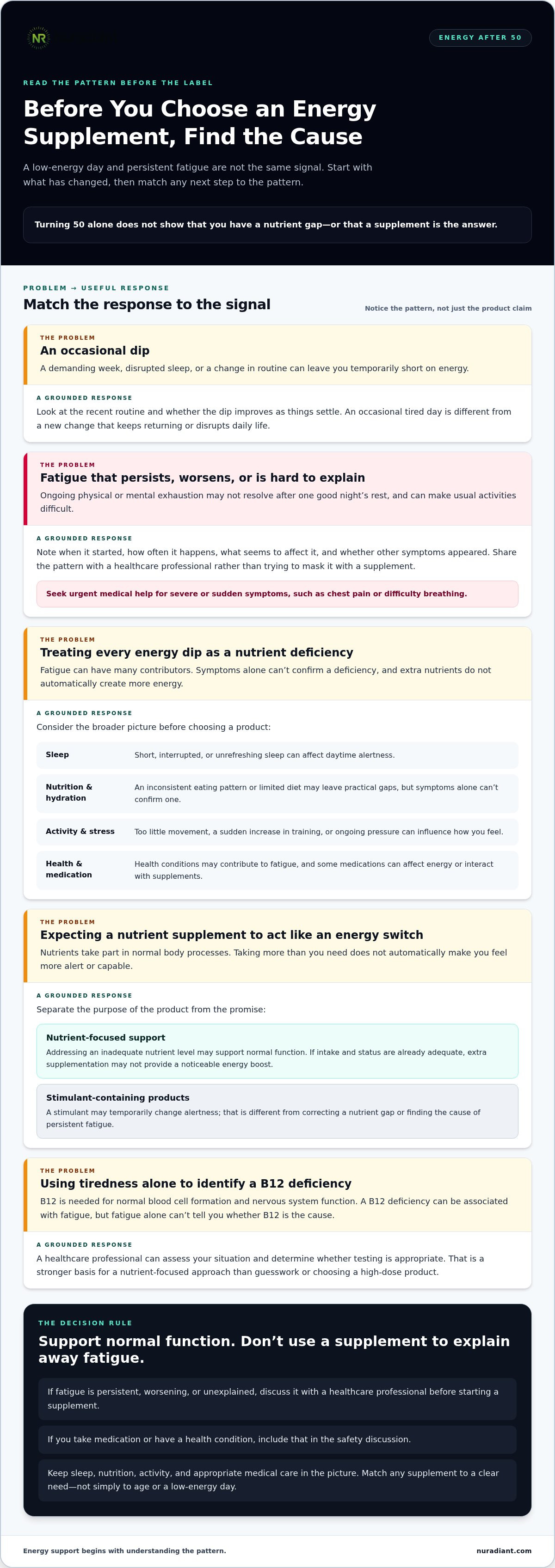
An occasional tired day is different from fatigue that keeps returning. A demanding week, disrupted sleep, or a change in routine can leave you temporarily short on energy. But if tiredness is persistent, worsening, or hard to explain, don’t write it off as “just getting older” or try to mask it with a supplement. Look at the pattern and consider whether it needs medical attention.
Everyday energy dips versus persistent fatigue
Fatigue is an ongoing sense of physical or mental exhaustion, reduced energy, or difficulty carrying out usual activities. It can feel different from ordinary sleepiness and may not resolve after one good night’s rest. Duration matters, as do severity and impact. Are you repeatedly struggling with work, exercise, household tasks, or time with family?
A short-lived dip that improves as your routine settles is not the same as a new, unexplained change that disrupts daily life. Note when it started, how often it occurs, what seems to affect it, and whether other symptoms have appeared. Share those details with a healthcare professional if fatigue persists, worsens, or has no clear explanation. Seek urgent medical help for severe or sudden symptoms, such as chest pain or difficulty breathing.
Why the cause matters before choosing a supplement
Energy support means supporting normal body functions. It doesn’t mean treating the condition behind fatigue. Nutrients help the body carry out essential processes, but taking extra won’t necessarily help if you already get enough. A supplement may also be irrelevant if another factor is affecting how you feel.
Consider the wider picture before you shop:
- Sleep: Short, interrupted, or unrefreshing sleep can affect daytime alertness.
- Nutrition and hydration: An inconsistent eating pattern or limited diet may leave practical gaps, but symptoms alone can’t confirm a deficiency.
- Activity and stress: Too little movement, a sudden increase in training, or ongoing pressure can all influence how you feel.
- Health conditions and medications: These may contribute to fatigue, and some medications can affect energy or interact with supplements.
That’s why energy supplements for men over 50 should be considered in context, not as the default response to every low-energy day. For example, creatine is discussed in relation to exercise and muscle, but that doesn’t make it a universal answer to fatigue. An overview of creatine supplements can explain the category, but it can’t determine whether it suits you.
If fatigue is persistent or unexplained, discuss it with a healthcare professional before starting a supplement. Education can help you ask more focused questions and compare options, but it can’t diagnose the cause or replace an appropriate medical evaluation.
How Energy Supplements Relate to Nutrient Gaps and Normal Metabolism
Your body doesn’t get energy from a capsule in the way it gets fuel from food. It breaks down nutrients and uses them in the chemical processes that keep cells working. Vitamins and minerals can take part in those processes, but taking more than you need doesn’t automatically make you feel more alert or capable. The effect depends on the nutrient, your current intake and health, and whether a shortfall is actually present.
Supporting normal nutrient-dependent function is not the same as treating fatigue. A nutrient can matter to the body’s normal processes without being a proven answer to persistent tiredness.
What nutrients can, and cannot, do for energy
Think of nutrients as components in a working system, not a switch that creates energy on demand. If a person has an inadequate level of a nutrient, addressing that gap may support normal function. If their intake and status are already adequate, extra supplementation may not provide a noticeable energy boost. Turning 50, by itself, doesn’t establish that a particular nutrient is low or that a supplement is needed.
Vitamin B12 is a useful example. The body needs it for normal blood cell formation and nervous system function. A B12 deficiency can be associated with fatigue, but tiredness alone can’t tell you whether B12 is the cause. A healthcare professional can assess your situation and determine whether testing is appropriate, rather than relying on guesswork or a high-dose product.
Why a nutrient gap is different from an energy booster
Correcting an identified shortfall is different from taking a product and expecting a stimulant-like lift. A stimulant may temporarily change alertness; a nutrient supplement is not automatically a fast-acting energy source. If there’s no relevant gap, increasing intake may add cost or risk without addressing what’s making you feel depleted. More is not a performance strategy by default.
Symptoms overlap. Fatigue may have many possible contributors, and it can’t identify a nutrient deficiency on its own. Don’t use a supplement trial as a substitute for assessment when fatigue is ongoing, worsening, or unexplained. A clinician can consider your health history, diet, medications, and whether tests are warranted. That gives you a stronger basis for deciding whether a nutrient-focused approach fits.
For a broader overview of baseline nutrient choices, the multivitamin guide for men over 40 can help you compare general considerations. Use it as education, not as a personal prescription. The same principle applies to energy supplements for men over 50: match the category to a clear need, and separate the claim from what the evidence can support.
If you’re exploring a targeted category as one part of a broader routine, review men’s health supplements with your goal and current medications in mind. A supplement can complement sound nutrition and appropriate care; it can’t diagnose the reason your energy has changed.
Energy Supplement Categories for Men Over 50: Evidence, Limits, and Claims
“Energy” on a label can mean different things: supporting normal nutrient metabolism, supporting exercise performance, or temporarily increasing alertness. These aren’t interchangeable outcomes. Compare the intended role and evidence, then weigh the limitations and safety factors before considering a product. No category should be treated as a guaranteed fix for low energy.
| Category | Intended role | Evidence context | Key limitation | Safety consideration |
|---|---|---|---|---|
| Nutrient-focused products, such as B12 or multivitamins | Provide nutrients involved in normal body functions | Most relevant when intake is inadequate or a deficiency is identified | Extra nutrients aren’t an automatic energy boost when needs are already met | Review total intake and health context with a professional, especially when using other supplements or medications |
| Creatine | Support exercise-related performance and muscle goals | Studied in exercise contexts; research also recognizes potential benefits for muscle mass and strength in older adults | That context does not establish it as a general remedy for fatigue or all-day energy | Discuss suitability with a healthcare professional, particularly with health conditions or medication use |
| Stimulant-containing options, including caffeine | Temporarily increase alertness | Caffeine may affect alertness, but that is distinct from correcting a nutrient gap | A short-term alertness effect doesn’t resolve why energy is low | Consider individual sensitivity, sleep effects, and possible interactions |
Nutrient-focused options and individual need
Vitamin B12 and multivitamins are examples, not universal recommendations for men over 50. Whether either makes sense depends on factors such as diet and health context. If fatigue raises concern about a deficiency, symptoms alone can’t confirm it; a healthcare professional can help determine whether assessment or testing is appropriate. Don’t assume age automatically creates a nutrient gap, and don’t equate a broad multivitamin with treatment for fatigue.
Apply the same standard to energy supplements for men over 50: ask what role the product is meant to serve and whether that role matches a specific need. A label’s use of “energy” doesn’t prove that a product improves persistent tiredness or delivers broad rejuvenation.
Performance ingredients and energy marketing
Creatine belongs in a different conversation from vitamins. Its use is associated with exercise performance and muscle-related goals, not a guaranteed lift in everyday energy. The outcome studied matters: evidence about strength or exercise performance shouldn’t be stretched into a promise of less fatigue.
Caffeine also has a distinct role. It may increase alertness, but that doesn’t mean it corrects inadequate nutrient intake or addresses an underlying cause of fatigue. Products combining stimulants or making sweeping promises deserve extra scrutiny, particularly if they might disrupt sleep or conflict with your health context. For a focus-specific discussion, the nootropics guide for men over 40 explores a related category without equating focus claims with energy support.
How to Evaluate Energy Supplements Safely Before You Buy
Use a clear process, not a persuasive label. A supplement’s label doesn’t establish that it suits everyone. Your goal, current diet, health conditions, and medications all matter, so work through these checks before adding a product to your routine.
- Define the goal. Be specific. Are you addressing a documented nutrient gap, supporting an exercise goal, or looking for temporary alertness? If fatigue is persistent or unexplained, make assessment the priority rather than trying to self-treat it.
- Review the label. Read the full ingredient list, serving directions, and warnings. Check what the product claims to do. Promises to cure fatigue, reverse aging, or guarantee all-day energy are reasons to pause, not proof of performance.
- Check for overlap. Compare the ingredients with every supplement you already use. The same nutrient may appear in a multivitamin, a targeted product, and a fortified food. Add up the sources before taking more.
- Assess safety. Consider your health history and medications. Review the product and its label with a healthcare professional or pharmacist before starting, especially if you take prescription medication or manage a health condition.
- Track use and response. If a professional agrees the product is appropriate, record when you take it and any changes or unwanted effects. Stop and seek advice if you notice a concerning reaction. Tracking helps organize information; it doesn’t replace medical care.
Read the claim, not just the headline
In the United States, dietary supplements are regulated differently from prescription drugs. The FDA doesn’t approve supplements for safety or effectiveness before they’re marketed. Under the Dietary Supplement Health and Education Act, manufacturers are responsible for ensuring their products are safe and properly labeled before sale; the FDA can take action against adulterated or misbranded products on the market. That makes careful label review essential. A polished package or bold “energy” language is not a substitute for evidence that a product fits your specific goal.
Look for transparency in the ingredient list and clear directions, then compare the claims with the intended role of the ingredients. Be cautious about language suggesting one product can address every cause of low energy. No label can diagnose fatigue or establish that a nutrient gap exists.
Factor in your health context
Interactions and personal health history can change whether an ingredient is appropriate. Bring a complete list of supplements and medications to a healthcare professional or pharmacist rather than reviewing a new product in isolation. This matters even if an ingredient is familiar or sold without a prescription.
Choosing energy supplements for men over 50 should be deliberate, not a response to pressure or a sweeping promise. If you’re comparing a targeted option, explore Nuradiant’s men’s health supplements as one category to consider alongside professional guidance and your wider health plan.
A Smarter Next Step: Match Men’s Supplements to Your Actual Goal
The strongest next move isn’t building a bigger supplement stack. It’s making a clearer decision. Identify the concern, consider what may be contributing to it, then decide whether a relevant supplement category belongs in your plan. If fatigue is new, persistent, worsening, or unexplained, start with appropriate medical guidance rather than assuming a product is the answer.
That sequence keeps energy supplements for men over 50 in their proper role: a possible part of an informed approach, not a shortcut around understanding what your body needs.
Build a focused plan instead of stacking products
Start with one clearly defined goal. “I want more energy” is broad; “I want to understand whether my diet is meeting a specific nutrient need” gives you a more useful question to explore. A defined goal also makes it easier to decide whether a product’s intended role matches what you’re trying to support.
Keep the process simple:
- Name the concern. Note what has changed and how it affects your routine.
- Set the context. Consider sleep, food, activity, stress, health conditions, and medications.
- Choose a relevant category, if appropriate. Match the category to the goal instead of combining products based on broad marketing language.
- Review and reassess. Check for overlapping ingredients and track any effects or unwanted changes.
Adding one product at a time can make ingredient overlap easier to spot and your response easier to interpret. It doesn’t prove that a supplement caused a change, and it isn’t a personalized medical plan. For ongoing fatigue or safety questions, bring the goal and product label to a healthcare professional or pharmacist.
Explore men’s health supplements with informed expectations
A supplement can only play a supporting role. Sleep, balanced nutrition, regular physical activity, and appropriate medical care remain central to a broader energy-support plan. A men’s supplement category may be worth exploring when it aligns with a clear goal, but no supplement should be treated as a guaranteed energy solution or substitute for investigating persistent fatigue.
Nuradiant offers science-backed supplements for men and adults over 40 and 50, including men’s health, brain health, and general health categories. Keep expectations grounded: a category name doesn’t establish that a particular product will change your energy, and suitability depends on your needs and health context. Use the evaluation steps in this guide to make a deliberate choice.
Ready to explore options at your own pace? Explore Nuradiant supplements and consider whether the men’s health category fits the goal you’ve identified.
Make Your Next Move Deliberate
Don’t let a low-energy stretch push you into buying the loudest promise on the shelf. Make your next move deliberate: choose one clear question about your energy, note what you want to improve or understand, and use that as your filter. That puts you in control of the decision instead of letting marketing set the agenda.
The right approach to energy supplements for men over 50 isn’t about chasing a quick fix. It’s about making choices that fit your actual goal and broader health plan. If you’re ready to explore a men’s health category with informed expectations, explore Nuradiant supplements for men.
Progress starts with clarity, not a crowded supplement shelf. Take the next step with purpose and keep building a routine that supports the way you want to feel and function.
Frequently Asked Questions
Can energy supplements help men over 50 feel less tired?
Sometimes, if a supplement addresses a specific need, but it’s not a reliable fix for tiredness in general. A product intended to fill a nutrient gap won’t necessarily help if your intake is already adequate or another factor is affecting how you feel. Treat energy supplements for men over 50 as a targeted option, not a shortcut. If fatigue continues, seek guidance rather than repeatedly switching products.
What is the best energy supplement for a man over 50?
There isn’t one best option for every man. The right category depends on your goal, diet, health history, and other products or medications in your routine. Before choosing, write down what you want the supplement to support and compare that with its stated purpose. A healthcare professional or pharmacist can help assess whether it fits your circumstances. Avoid choosing solely because a product is marketed specifically for men over 50.
Is vitamin B12 an energy booster for men over 50?
Vitamin B12 isn’t a dependable energy booster for someone who already gets enough. Supplementation may be relevant if a deficiency or inadequate intake is identified, but feeling tired alone doesn’t establish that B12 is the reason. Rather than starting a high-dose product based on symptoms, ask a healthcare professional whether reviewing your diet, health history, or B12 status makes sense. Don’t assume that turning 50 automatically means you need extra B12.
Can men over 50 take caffeine and other energy supplements together?
Combining them isn’t automatically safe. First check all sources of caffeine, including coffee, tea, energy drinks, and combination supplements, since labels may list several ingredients with overlapping effects. Caffeine can interfere with sleep for some people, so note whether timing changes your rest. A pharmacist or healthcare professional can review the full ingredient list alongside your medications and health conditions before you combine products.
How long does it take to notice an effect from an energy supplement?
There’s no universal timeline. A caffeine-containing product may affect alertness relatively soon, while addressing an identified nutrient shortfall is a different process and shouldn’t be judged by a quick, stimulant-like feeling. Follow the label and professional guidance; don’t increase the amount or add another product just because you don’t notice a change. If fatigue persists, reassess the cause rather than extending a supplement trial indefinitely.
What should a man over 50 do about fatigue that does not improve?
Arrange a medical evaluation, especially if the fatigue is affecting your usual routine or getting worse. Before the appointment, note when it began, how it changes through the day, recent sleep or routine changes, and every medication and supplement you use. This record can help guide a focused conversation about possible next steps, including whether tests or a medication review are appropriate. Don’t stop prescribed medication without medical advice.