

Doctor-Recommended Supplements for Aging: 2026 Guide
A doctor-recommended supplement plan isn’t a universal anti-aging stack. It starts with your health, diet, medications, and any nutrient gaps that deserve attention. Bold claims can blur the line between promising research and proven benefits, while an unnecessary supplement can add cost or create interaction risks. If you’re searching for doctor recommended supplements for aging, the better question is which options fit your needs, not which ones everyone should take.
Aging can change nutritional needs, but no supplement has been proven to extend human lifespan, and evidence varies widely by ingredient. This 2026 guide compares commonly discussed categories, explains what research can and can’t tell us, and outlines why individual assessment matters before you start. You’ll also find practical questions to raise with your healthcare professional about medications, health history, and whether testing could clarify a need. Make informed choices and skip the hype.
Key Takeaways
- Doctor recommended supplements for aging should reflect an individual’s health history and assessed needs, not age alone.
- Compare supplement categories as discussion points, and distinguish addressing an identified nutrient shortfall from seeking a broad wellness benefit.
- Check product labels to see which ingredients and amounts are listed before weighing a supplement’s claims.
- Set a clear goal, review possible interactions with your healthcare professional, and monitor your plan rather than stacking products blindly.
- Explore multivitamins for adults over 40 and 50, or targeted categories, according to your goals and your clinician’s guidance.
What Does 'Doctor-Recommended Supplements for Aging' Actually Mean?
A clinician may recommend a supplement to address a specific need, not simply because someone has reached a certain age. A sound recommendation considers health history, diet, medicines, and relevant evidence. It may involve a supplement, a change in eating habits, further assessment, or no action at all.
That distinction matters in a market full of confident claims. The categories in this guide are topics to discuss with a healthcare professional, not a prescription, diagnosis, or universal stack to copy. A product’s inclusion in a roundup doesn’t mean it’s appropriate for you.
Professional guidance is based on an individual’s needs and evidence; marketing language is written to sell a product. A broad overview of what qualifies as a dietary supplement can provide useful context, but it can’t determine whether a particular product fits your health situation.
Why supplement needs can change with age
Nutrient needs and intake can be influenced by more than age. Changes in appetite or food choices may affect what someone gets from their diet. Health conditions, medicines, and life stage can also shape whether a nutrient deserves attention. Individual assessment is more useful than assuming everyone needs the same formula.
Age alone doesn’t prove a deficiency, and feeling tired or noticing another change doesn’t identify its cause. Symptoms can have many explanations. Choosing a supplement based on symptoms alone may miss the real issue or add something you don’t need. Track what has changed, when it started, and what you eat or take. Those details can make a clinical discussion more focused.
What a clinician may review before recommending a supplement
Expect the conversation to start with context, not a shopping list. A clinician may review your usual eating pattern, relevant medical history, current medicines and supplements, and the reason you’re considering supplementation. Bring product labels or a current list of what you take, including products you use only occasionally. Ingredients can overlap across products, so the full list matters.
Testing may be appropriate if a clinician has a relevant question that a test can help answer. It isn’t automatically necessary for every person or every supplement. The decision should reflect your circumstances, and the result should inform a practical next step. A recommendation for you is different from a general claim that everyone in an age group should take a product.
- Identify the concern or goal you want to address.
- Share your diet pattern, health history, and full list of medicines and supplements.
- Discuss whether assessment or testing could clarify a specific need.
- Agree on whether a supplement makes sense and how to review the plan.
Approach doctor recommended supplements for aging with precision: define the question first, then consider the product. Next, compare categories by intended use and evidence without mistaking a possible benefit for a personal recommendation.
Which Supplement Categories Have Evidence Worth Discussing?
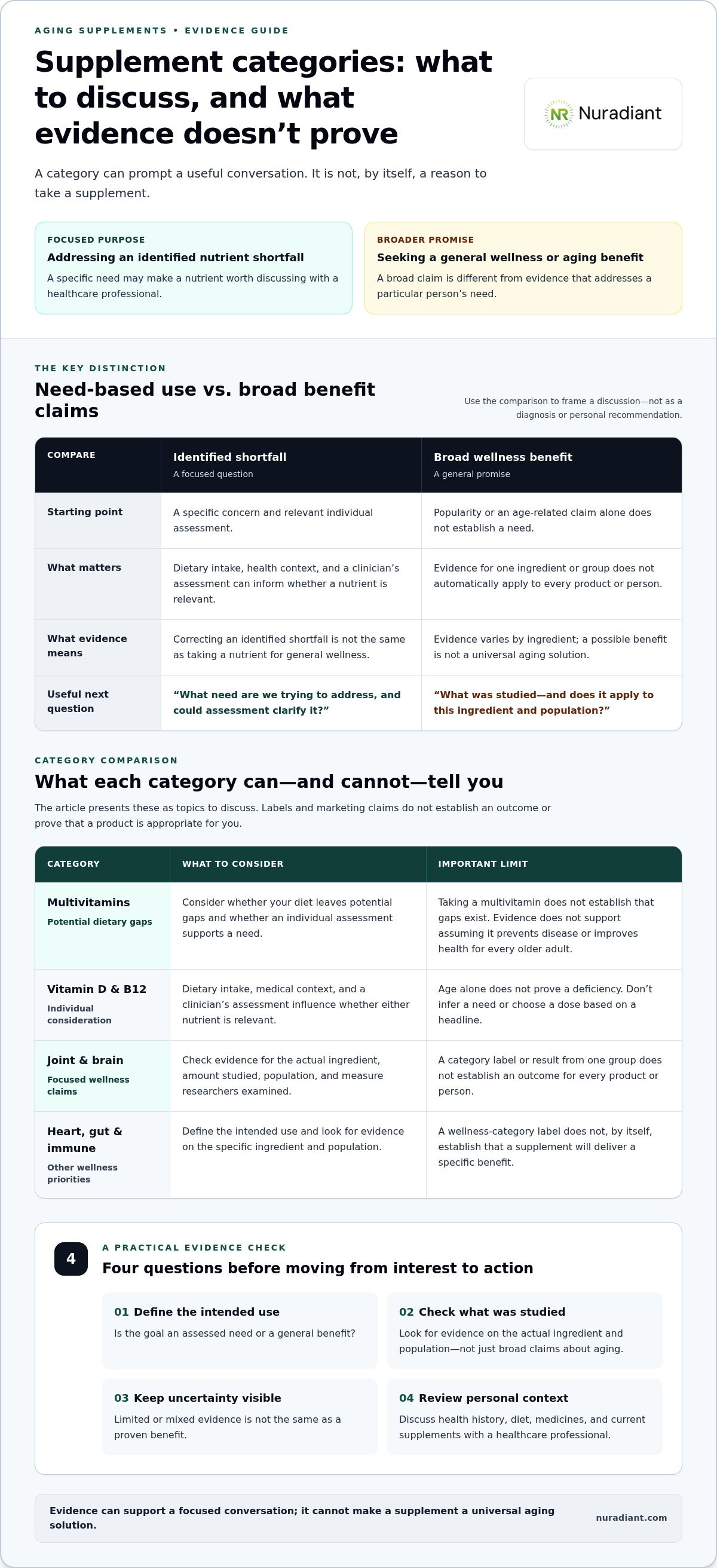
Evidence isn’t a blanket endorsement. A nutrient may be useful for addressing an identified shortfall, but taking it for a broad promise such as sharper thinking or longer life is a different claim. The key question isn’t whether a category is popular, but what evidence applies to your situation and what uncertainty remains.
Evidence can support a focused conversation; it can’t turn a supplement into a universal aging solution. The National Institute on Aging’s Dietary Supplements for Older Adults from NIH offers practical context. NIH Office of Dietary Supplements fact sheets are also useful for examining evidence, safety, and the populations studied for individual nutrients.
Multivitamins and nutrients such as vitamin D or vitamin B12
A multivitamin may be worth discussing if your diet leaves potential gaps, but taking one doesn’t establish that those gaps exist. Evidence does not support assuming multivitamins prevent disease or improve health for every older adult. Vitamin D and B12 also call for individual consideration. Dietary intake, medical context, and a clinician’s assessment influence whether either is relevant.
Correcting an identified shortfall is not the same as taking a nutrient for a general wellness claim. Don’t infer a need from age or choose a dose based on a headline. Ask what concern the supplement is meant to address and whether assessment could clarify it.
Targeted categories for joints, cognition, and other health priorities
Joint and brain supplements are marketed around distinct concerns, while heart, gut, and immune categories address other wellness priorities. Those labels don’t establish an outcome. Evidence depends on the ingredient, the amount studied, the population, and the specific measure researchers examined. A result for one group or ingredient can’t automatically be applied to every product in a category.
For focused comparisons, explore Nuradiant’s joint supplement guide for men and nootropics guide for men over 40. Treat them as category information, not proof that a particular supplement is right for you or an endorsement from a clinician.
Use a simple evidence check before moving from interest to action:
- Define the intended use. Is the goal to address a specific, assessed need or pursue a general benefit?
- Check what was studied. Look for evidence on the actual ingredient and population, not just broad claims about aging.
- Keep uncertainty visible. Limited or mixed evidence is not the same as proof of benefit.
That’s the practical standard for comparing doctor recommended supplements for aging: match the evidence to the question, then discuss suitability and safety with a healthcare professional. If a defined goal points you toward a category, explore Nuradiant’s multivitamins for adults over 40 and 50 and targeted wellness supplements at Nuradiant’s supplement categories.
How to Compare Aging Supplements Without Buying Into Hype
Start with a defined need, not a bestseller list. Products in the same category can differ in ingredients, amounts, directions, and warnings. A disciplined comparison asks what the product is intended for, what evidence supports its ingredients, and whether its label gives you enough information to assess it with a healthcare professional. No single supplement earns a universal “best” ranking for every aging adult.
Match the supplement category to a defined need
Name the concern before comparing options. A general goal such as “support wellness” differs from addressing a nutrient need identified through clinical assessment. Keeping that distinction in mind prevents marketing claims from standing in for a personal reason to supplement. For a focused overview of one category, Nuradiant’s multivitamin guide for men over 40 offers a comparison point, not a universal prescription.
Use this framework to organize the conversation:
| Category | Intended use | Evidence caveat | Discussion prompt |
|---|---|---|---|
| Multivitamin | Broad nutrient coverage | Doesn’t establish or correct a specific need by itself | Does my diet or health context point to a gap? |
| Vitamin or mineral | Address a particular nutrient concern | Relevance depends on the individual and the evidence for that nutrient | Would assessment help determine whether this is appropriate? |
| Joint or brain category | Support a stated wellness priority | Evidence may vary by ingredient, product, and population studied | What outcome is realistic to discuss? |
| Heart, gut, or immune category | Target a broad health interest | A category label alone doesn’t demonstrate effectiveness | Does this fit my health plan and medicines? |
Read labels and claims with a critical eye
Check the serving size, named ingredients, amount per serving, directions, and warnings. Look for a clear account of what the product contains. If amounts are hidden in a blend or the label doesn’t answer basic questions, comparison becomes harder. “Natural” and “premium” are marketing terms, not proof of effectiveness, safety, or suitability.
A third-party quality seal may indicate that a product or manufacturing process was checked against particular quality standards, but the seal and its verification need to be confirmed. It doesn’t prove that the supplement delivers a health benefit or is right for you.
Regulation matters, but don’t confuse it with premarket approval. The FDA’s dietary supplement guidance explains that supplements aren’t approved by FDA for safety and effectiveness before they’re marketed. FDA oversight still applies, and the agency can take action against products that violate applicable requirements. That’s why careful label review matters.
When comparing doctor recommended supplements for aging, weigh the need, label, evidence, and safety discussion, not the boldness of the claim. Once you’ve defined a relevant category, explore Nuradiant’s supplement options and assess them alongside your healthcare professional’s guidance.
How to Use Supplements More Safely as You Age
A supplement plan needs a safety check, not guesswork. Products can interact with medicines or with one another, and overlapping ingredients may increase total intake. The more products you use, the harder it can be to spot duplication or identify what may be causing a side effect. Use this checklist before starting, stopping, or adding a supplement.
- Define the goal. State the specific concern you want to address and what would count as a useful result. A vague aim makes it harder to judge whether a product belongs in your plan.
- Review the full label. Check ingredients, amounts per serving, directions, and warnings. Compare the label with every other supplement you take, including multivitamins and products used only occasionally.
- Discuss risks first. Share your health history and complete list of medicines and supplements with a healthcare professional. Ask about interactions, ingredient overlap, and whether a food-first approach, testing, or no supplement makes more sense.
- Agree on monitoring. Ask what side effects to watch for, when to stop, and when to seek care. If you proceed, follow the plan you discussed and review whether the original goal still makes sense.
Don’t use this article to make personal medical decisions. It offers general information, not an assessment of your health. Get individualized clinical guidance before starting a supplement, especially if you take prescription medicines, manage a health condition, or use several products.
Questions to take to a healthcare professional
Bring the product label and ask direct questions: Does this fit my health history, medicines, diet, and stated goal? Could testing clarify whether I need it, or would food-first changes or no supplement be more appropriate? What potential side effects should I recognize, and which symptoms mean I should stop or seek care? Clear answers make the decision more actionable.
Avoid stacking products and duplicating nutrients
More products don’t automatically mean a stronger plan. A multivitamin and a targeted supplement may contain overlapping ingredients, so taking both can add up to more than you intended. Review every label together with a clinician or pharmacist rather than assessing each bottle in isolation. Keep your list current when you add, remove, or switch a product.
Life stage can also shape the questions worth raising. For a focused discussion of menopause-related supplement considerations, Nuradiant’s menopause hormone balance supplement guide offers category-specific context, not an individualized recommendation.
Build your plan around a defined need, a complete product review, and follow-up that fits your situation. If you’re ready to compare options by category, explore Nuradiant’s supplement range and discuss relevant products with your healthcare professional before deciding what belongs in your routine.
How to Explore Nuradiant Supplements With a Personalized Plan
A useful plan starts with a clear question. Once you’ve identified a wellness priority and discussed whether supplementation makes sense, browse by category rather than choosing a product because it’s popular or marketed for a certain age. Nuradiant’s catalog includes multivitamins for adults over 40 and 50, alongside targeted supplement categories. These options let you compare products, but they aren’t a diagnosis, treatment, or clinician endorsement.
Age can shape the questions you bring to a healthcare professional, but it doesn’t establish that you need a supplement. Your diet, health context, medicines, and specific goal matter more than an age label. Use them to narrow what you want to review, then assess the product’s current label and evidence before deciding whether it fits your plan.
Choose a category that matches the question you are trying to answer
Connect your stated interest to a relevant category without assuming the category itself will deliver a particular result. For example, someone comparing broad nutrient coverage may review multivitamins, while someone focused on a particular area may explore the corresponding targeted category. Browsing helps you compare options; it doesn’t confirm that you need one.
- Broad coverage: Compare multivitamins for adults over 40 and 50 against your diet and the questions you’ve discussed with your healthcare professional.
- Men’s or women’s health: Explore these categories in relation to your stated interests and individual context, not as automatic age-based recommendations.
- Specific wellness priorities: Review joint, heart, immune, gut, and brain categories according to the concern you want to discuss.
Don’t infer an ingredient or benefit from a category name. Formulations and label details matter. Check the current product information, and bring questions about listed ingredients, amounts, directions, and warnings to your healthcare professional.
Take the next step with evidence and context
Before choosing, compare the label with your goal and the rest of your routine. Ask whether the product’s stated ingredients and amounts are relevant, whether anything overlaps with products you already use, and whether it fits your health history and medicines. If the reason for taking it remains unclear, pause and get individualized clinical guidance rather than adding it to your routine by default.
The standard is simple: make the decision specific, informed, and safe. That’s how to approach doctor recommended supplements for aging without turning a category list into a personal prescription. Explore options with a defined question in mind, then take the relevant label and your questions to your healthcare professional.
Explore Nuradiant's supplement range and compare categories that align with your stated interests. Choose with context, not hype.
Make Your Next Supplement Decision Deliberate
The strongest next move isn’t adding another product. Bring one clear question to your healthcare professional: what am I trying to address, and what information would make a supplement worth considering? That approach puts evidence and personal context ahead of pressure, trends, and promises. Use the same standard as you explore doctor recommended supplements for aging: look for a fit with your goals, then decide with informed guidance.
When you’re ready to compare options, review current labels and keep your questions specific. Explore Nuradiant’s supplement range as a starting point for that conversation. A focused plan beats guesswork. Take the next step with clarity and keep building toward the health and capability you want to maintain.
Frequently Asked Questions
Are there doctor-recommended supplements everyone should take as they age?
No. There’s no universal supplement stack for every older adult. The doctor recommended supplements for aging that may be appropriate depend on diet, health history, medicines, life stage, and clinically relevant findings. A recommendation for an individual need is different from marketing that presents one formula as essential for everyone. Before starting anything, ask your healthcare professional what specific need it addresses and why age alone isn’t enough reason.
Can a doctor recommend supplements without a blood test?
Yes, depending on the nutrient, your health context, and the clinical question. A clinician may consider your usual diet and medical history, while testing may help clarify a particular concern. Not every supplement requires a test, and symptoms alone don’t prove a deficiency. Ask what information supports the recommendation, whether testing would change the decision, and whether follow-up is needed to assess how the plan is working.
How do I know if an aging supplement is safe with my medications?
You can’t determine that from an article or product category alone. Supplements may interact with medicines or with other supplements, so share a complete list with your healthcare professional or pharmacist before adding a product. Include prescriptions, over-the-counter medicines, vitamins, and occasional-use products. Bring the labels too, since ingredient names and amounts can affect the review. Don’t stop or change prescribed medication without guidance from the professional who manages it.
Are multivitamins enough to meet nutritional needs as you get older?
Not necessarily. A multivitamin isn’t a substitute for a varied diet or individualized care, and it may not address every person’s needs. Products differ in nutrient content, while diet, health conditions, and medicines affect suitability. Taking a multivitamin doesn’t establish that it covers a specific concern. Review its label and discuss that concern with a clinician instead of assuming a multivitamin is necessary or complete.
What should I look for on an aging supplement label?
Check the serving size, ingredient names and amounts, directions, warnings, and any relevant quality information. Then compare those details with your reason for considering the product. Words such as “natural” don’t prove that a supplement works or suits you. If you take medicines or use several products, bring all the labels to a healthcare professional or pharmacist so they can review the ingredients together and flag questions you may miss.
Do supplements prevent normal aging or age-related diseases?
No supplement should be treated as a way to stop aging or prevent, treat, or cure disease. Evidence varies by ingredient, outcome, and the people studied, while marketing can make broader promises than research supports. Look for reliable evidence tied to the specific claim, and get advice that accounts for your health situation. A supplement may be one consideration in health decisions, but it isn’t a replacement for medical care.
Should I take separate supplements alongside a multivitamin?
Only after checking whether the products overlap and whether the combination fits your situation. A targeted supplement may repeat ingredients already present in a multivitamin, so consider the labels together rather than one bottle at a time. Your medicines and health history also matter. Review every product with a clinician or pharmacist before combining them; don’t build a stack or choose a dose without product-specific details and individualized guidance.