

Digestive Enzymes for Adults Over 50: How to Choose Wisely
Age isn’t a diagnosis, and a supplement isn’t a shortcut. If meals now bring bloating, gas, or discomfort, it’s understandable to wonder whether digestive enzymes for adults over 50 could help. But symptoms don’t prove that age has slowed digestion, and a new or persistent problem deserves more than guesswork.
Digestive enzymes help break down food, but over-the-counter supplements aren’t a fix for every digestive complaint or a substitute for finding its cause. The right choice depends on the concern you’re trying to address, the enzymes and activity declared on the label, and your health needs, including any medications you take. A long ingredient list doesn’t automatically make a product effective or suitable.
This guide explains what enzymes do and don’t do, when symptoms call for medical evaluation, and how to check a supplement’s ingredients, directions, label details, and safety considerations. Use a clear decision framework: choose based on the digestive concern and relevant evidence, not age alone, and ask a healthcare professional when you’re unsure whether a supplement is appropriate.
Key Takeaways
- Match an enzyme to the food component it helps break down. A broad blend isn’t automatically the better choice.
- Compare named enzymes, intended food substrates, activity units, and label clarity instead of relying on ingredient weight alone.
- Use a clear decision path for digestive enzymes for adults over 50: define the concern, check whether an enzyme is relevant, and review safety.
- Track symptoms and consider other possible causes before assuming an enzyme deficiency.
- Know when self-selection isn’t enough. Some symptoms call for professional evaluation rather than an over-the-counter supplement.
What digestive enzymes do and what changes after 50
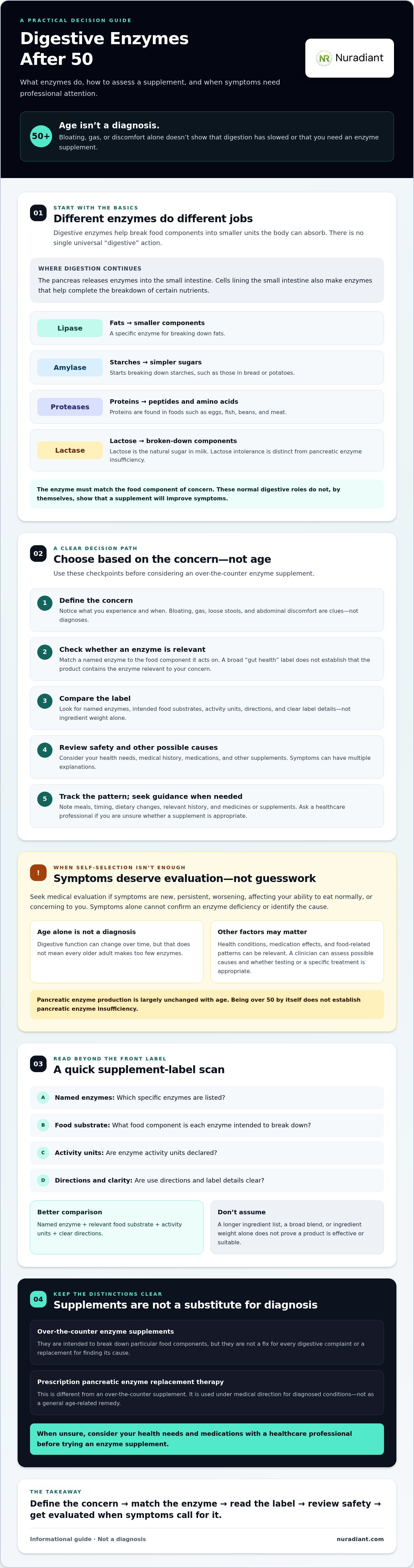
Digestive enzymes help break food components into smaller units the body can absorb. Digestion relies on several enzymes, not one universal “digestive” action. The pancreas releases enzymes into the small intestine, where much of digestion continues. Cells lining the small intestine also make enzymes that help complete the breakdown of certain nutrients. For a foundational overview of what digestive enzymes do, it helps to understand that different enzymes have different roles.
That distinction matters when assessing digestive enzymes for adults over 50. Age alone doesn’t establish an enzyme deficiency or show that a supplement is needed. Enzyme supplements are a specific category: they contain enzymes intended to break down particular food components. General digestive or gut health supplements may contain other ingredients and serve different purposes. A broad “gut health” label doesn’t tell you whether a product contains the enzyme relevant to your concern.
Which enzymes digest fats, carbohydrates, and proteins?
Lipase breaks fats into smaller components. Amylase starts breaking down starches, such as those in bread or potatoes, into simpler sugars. Proteases break proteins, found in foods like eggs, fish, beans, and meat, into smaller pieces called peptides and amino acids. These are normal digestive roles, not proof that taking an enzyme supplement will improve symptoms. The specific enzyme matters because each acts on different food components.
Does digestion naturally decline after age 50?
Digestive function can change over time, but that doesn’t mean every older adult makes too few digestive enzymes. Age isn’t a diagnosis. Gas, bloating, or discomfort can have multiple explanations, including health conditions or medication effects, and symptoms alone can’t identify the cause.
Keep the distinction clear: a change in digestion isn’t automatically an enzyme problem. If symptoms are new, persistent, worsening, or affecting your ability to eat normally, seek medical evaluation rather than assuming age is responsible or trying to self-diagnose with a supplement. A clinician can assess possible causes and whether an enzyme product is relevant. That’s a stronger starting point than choosing a blend based on an “over 50” label.
Digestive symptoms after 50: identify possible causes before choosing enzymes
Bloating, gas, loose stools, and abdominal discomfort are clues, not diagnoses. They can have several causes, and symptoms alone can’t confirm an enzyme deficiency or reveal what’s driving them. Choosing a supplement before understanding the pattern risks targeting the wrong problem.
Keep diagnosed enzyme disorders separate from routine age-related concerns. Exocrine pancreatic insufficiency is a medical condition in which the pancreas doesn’t provide enough digestive enzymes. Being over 50 by itself doesn’t establish that condition. The Merck Manual’s overview of the effects of aging on digestion notes that pancreatic enzyme production is largely unchanged with age, although other digestive changes can occur. Age alone is not a reason to assume you need digestive enzymes for adults over 50.
When might a specific enzyme or condition be relevant?
Lactase breaks down lactose, the natural sugar in milk. Lactose intolerance involves difficulty digesting lactose, while pancreatic enzyme insufficiency involves a different set of enzymes used to digest fats, carbohydrates, and proteins. These are distinct issues, not interchangeable labels for digestive discomfort. Prescription pancreatic enzyme replacement therapy is also different from over-the-counter enzyme supplements. It’s used under medical direction for diagnosed conditions, not as a general age-related remedy.
Arrange a clinical assessment if symptoms persist, worsen, or concern you, especially before starting a supplement to treat them. A clinician can consider whether testing or a specific treatment is appropriate. Don’t use a supplement label as a substitute for that evaluation.
What else can affect digestion?
Look for patterns you can describe clearly, rather than trying to diagnose the cause yourself. Before speaking with a clinician, note:
- When symptoms occur, such as after a particular meal or at a certain time of day.
- Any recent dietary changes and whether symptoms seem linked to specific foods.
- Your relevant medical history and the medications or supplements you take.
Medications can be one factor a clinician considers. Don’t stop or change a prescribed medicine on your own. Ask the prescriber or pharmacist whether it could be relevant. The goal is to assess the whole picture, rather than chalking symptoms up to aging or assuming an enzyme blend is the answer. If you’re comparing general options while you gather questions, you can explore gut health supplements, then check whether a product’s ingredients and intended use match your needs and discuss safety with a qualified professional.
How to compare digestive enzyme supplements and read labels
Start with the reason you’re considering a product, then check whether its label provides enough detail to judge whether it’s relevant. For digestive enzymes for adults over 50, age isn’t a useful basis for comparing formulas. A product should identify the enzymes it contains, what they act on, and how their activity is declared. A longer ingredient list or a larger number on the front label doesn’t prove a better fit.
Use this framework to assess what the label actually tells you. The examples describe common enzyme roles, not a recommendation or a specific product.
| Enzyme named | Intended food substrate | Declared activity units | Label clarity |
|---|---|---|---|
| Lipase | Fats | Are units stated for lipase activity? | Can you identify the amount or activity per serving? |
| Amylase | Starches and other carbohydrates | Are units stated for amylase activity? | Is the enzyme listed separately, rather than hidden in a blend? |
| Protease | Proteins | Are units stated for protease activity? | Can you tell which enzyme is included and how much activity is declared? |
Activity units describe an enzyme’s measured ability to act under specified test conditions. They may tell you more about declared enzyme activity than ingredient weight alone, which reports mass but not necessarily how active the enzyme is. Units and testing methods can differ across enzyme types and labels. Don’t compare unlike units as if they were interchangeable, and don’t assume a bigger number means a stronger real-world result.
Which label details deserve a closer look?
Read the full label, not just the front. Check the specific enzymes, serving size, directions, complete ingredient list, and cautions. Look for activity units for each enzyme. A proprietary blend that gives only a combined weight, or an unclear unit with no enzyme-specific detail, limits meaningful comparison. Treat missing or unclear information as a reason to pause, not as proof that a product is ineffective or unsafe.
How to compare enzyme types without overclaiming
Compare products against the specific digestive concern a clinician has identified, if applicable. A blend containing several enzymes isn’t automatically relevant to every symptom, and a label claim doesn’t establish proven benefit. First confirm the intended use, then compare named enzymes and like-for-like activity units. If those details are missing, you don’t have a sound basis for ranking products. Choose clarity over complexity.
Safety, evidence, and when to ask a clinician before trying enzymes
Use a disciplined sequence before adding digestive enzymes for adults over 50: define the concern, review the full label, check safety with a clinician or pharmacist, then decide whether a supplement makes sense. Don’t let a bold front-label claim make the decision. Supplement marketing isn’t proof that a product treats a condition, and a supplement shouldn’t delay assessment of symptoms that may have another cause.
What evidence can and cannot tell you
Evidence for a prescribed enzyme treatment in a diagnosed condition is not the same as evidence that an over-the-counter blend improves digestion for everyone. Some research has examined multi-enzyme supplements for functional dyspepsia, but evidence in otherwise healthy people isn’t definitive. Claims of better nutrient absorption, symptom relief, or disease treatment need support from suitable human research and authoritative health sources. A product description alone can’t establish those outcomes.
Keep the question specific: what concern is the product intended to address, and what evidence supports that use? A blend with several enzymes may sound comprehensive, but that doesn’t prove it helps every type of discomfort. If you can’t connect a claim to credible evidence or a clear health need, treat it as a claim, not a result.
Questions to ask before using a supplement
Before trying a product, consider these questions with a qualified professional:
- Do my symptoms need medical evaluation before I choose a supplement?
- Do the listed ingredients or directions raise concerns with my medications, health conditions, or other supplements?
- Is the intended use supported by evidence, or is the label making a broad wellness promise?
Bring the product label and an up-to-date list of medications and supplements to a clinician or pharmacist. They can help review possible safety concerns in light of your health history. Don’t stop or change a prescribed medicine based on a supplement label, and don’t exceed product directions. Seek medical evaluation for symptoms that are persistent, severe, or worsening, rather than trying to manage them by trial and error.
Once you’ve clarified the concern and checked safety, you can make a more informed choice. To review the broader category without assuming a specific enzyme formula is available, explore Nuradiant’s gut health supplements.
Make a confident digestive enzyme decision and choose your next step
A good decision starts with the problem, not the product. For digestive enzymes for adults over 50, use a simple sequence: understand the concern, verify whether an enzyme is relevant, compare clear labels, and check safety. If symptoms are persistent, severe, worsening, or affecting daily life, seek medical evaluation instead of relying on an over-the-counter supplement.
A practical checklist before choosing
Before comparing products, get specific. Write down what you’re experiencing, when it happens, and whether you’ve noticed a pattern with particular foods. This record can help you describe the concern accurately to a clinician, but it can’t diagnose the cause on its own.
- Define the concern: Note the symptom, its timing, and any possible food triggers.
- Check relevance: Has a clinician identified a specific enzyme-related need, or are you guessing based on symptoms or age?
- Compare the labels: Check named enzymes, intended use, activity units, serving directions, ingredients, and cautions.
- Review safety: Ask a clinician or pharmacist whether the ingredients and directions are appropriate alongside your medications and health conditions.
If you can’t tell what an enzyme product is intended to do, or the label doesn’t clearly disclose its ingredients and activity, you don’t have a solid basis for comparing it. Pause and get guidance rather than treating a complex blend as a guaranteed solution. A supplement may not be the right next step, especially if the underlying cause of symptoms hasn’t been assessed.
When a supplement store may be the next step
Once you’ve clarified your concern and checked whether self-selection is appropriate, browsing supplement categories can help you understand what options are available. A store’s product listings aren’t a diagnosis or medical advice, and a broad gut health category doesn’t confirm that a specific digestive enzyme supplement is offered. Check each product’s current label and suitability, and ask a qualified professional about any safety questions.
Nuradiant offers a broader gut health supplements category, but the available information doesn’t confirm a specific digestive enzyme product or formula. If you’re exploring general supplement options, explore Nuradiant’s supplement range. Make the choice based on a clear need, transparent product information, and appropriate safety guidance, not age alone.
Make your next move with clarity
Age alone doesn’t tell you whether digestive enzymes are right for you. Start with the concern, look for a clear connection between the enzyme and its intended use, then check label details and safety. If symptoms are persistent, severe, or worsening, prioritize medical evaluation over trial-and-error supplement choices.
That’s the smarter approach to digestive enzymes for adults over 50: make decisions based on a defined need, not a birthday or a bold marketing claim. Enzyme activity units and ingredient transparency can help you compare products, but they can’t confirm a diagnosis or guarantee results.
Nuradiant offers a broader gut health supplements category. Its supplement range is described as science-backed, but check product-specific evidence and current labels rather than assuming a digestive enzyme formula is available or suitable. For general supplement exploration, explore Nuradiant’s supplement range.
Stay informed, ask the right questions, and choose your next step with confidence.
Frequently Asked Questions
Do adults over 50 need digestive enzyme supplements?
Usually, age alone doesn’t mean you need a supplement. Digestive enzymes for adults over 50 should be considered based on a specific need, not a birthday or general wellness claim. Digestive symptoms have multiple possible causes, and they can’t confirm an enzyme deficiency by themselves. If symptoms persist or concern you, seek professional evaluation before choosing a product. A clinician can help determine whether an enzyme-related condition is relevant.
Can digestive enzymes help with bloating after 50?
Possibly in some specific situations, but enzymes aren’t a proven fix for every cause of bloating. The right enzyme depends on what’s causing the symptom. For example, lactase helps digest lactose, but bloating can also relate to other foods, health conditions, or medications. Track when symptoms occur and discuss persistent or worsening bloating with a clinician before relying on an over-the-counter enzyme blend.
Which digestive enzymes should adults over 50 look for?
Look for an enzyme that matches a specific, identified need, rather than selecting a broad blend just because you’re over 50. Lactase is involved in lactose digestion; lipase, amylase, and proteases act on fats, carbohydrates, and proteins. Check that the label clearly names the enzymes and declares their activity units. If a clinician has identified a condition or need, ask which enzyme type is relevant before buying a supplement.
Are over-the-counter digestive enzymes the same as prescription pancreatic enzymes?
No. Over-the-counter enzyme supplements are dietary supplements, while prescription pancreatic enzyme replacement therapy is a medical treatment for specific diagnosed conditions. They aren’t interchangeable. A prescription treatment is selected and managed by a healthcare professional; an OTC product shouldn’t be used to self-treat suspected pancreatic insufficiency. If you have ongoing digestive symptoms or think you may need pancreatic enzymes, seek medical evaluation rather than substituting a supplement.
How do I compare digestive enzyme supplement labels?
Check the named enzymes, intended food substrates, serving directions, full ingredient list, serving size, and cautions. Look for enzyme-specific activity units, which can be more informative than ingredient weight alone. Units may differ across enzymes, so don’t compare unlike measurements or assume a larger number means better results. Proprietary blends or unclear units make products harder to compare. Only compare products when their intended uses and measurements are clear.
Are digestive enzyme supplements safe to take with medications?
Don’t assume a supplement is suitable just because it’s sold over the counter. Safety can depend on its ingredients, directions, your health conditions, and the medicines or other supplements you take. Show the complete product label and an up-to-date medication list to a clinician or pharmacist before starting. Don’t stop or change prescribed medicine based on supplement marketing, and follow professional guidance if you have questions about use.
When should I see a doctor instead of trying digestive enzymes?
Seek medical evaluation if symptoms are persistent, severe, worsening, or interfering with eating or daily activities. Don’t use an enzyme supplement to delay checking a symptom that concerns you. A clinician can review your health history, medicines, and symptom patterns to assess possible causes and whether an enzyme treatment is appropriate. Bring notes about when symptoms occur and any related food or medication changes to make the discussion more useful.