

Bone Density Supplements for Women Over 50: 2026 Guide
Chalky calcium tablets won't protect your bones. For decades, conventional advice told mature women to swallow massive doses of cheap calcium carbonate, often causing severe digestive distress while doing virtually nothing for structural bone matrix integrity. If you're frustrated by contradictory mineral guidelines and refuse to surrender your physical independence, your skepticism is justified. Choosing effective bone density supplements for women over 50 demands rejecting low-absorption commodities and demanding real biological precision.
You already know that passive aging is a losing strategy, especially when post-menopausal estrogen shifts accelerate skeletal decline. That's why this guide gives you the exact clinical criteria, critical co-factors, and bioavailability standards required to rebuild your skeletal strength after 50. You'll discover why isolated calcium fails, how the targeted synergy between Vitamin D3, K2, and magnesium directs minerals straight into bone tissue, and how to establish an uncompromising, high-performance daily supplementation routine.
Key Takeaways
- Understand how post-menopausal estrogen shifts accelerate bone resorption and why standard dietary intake alone leaves your skeletal matrix vulnerable.
- Discover why premium bone density supplements for women over 50 must pair bioavailable calcium with Vitamin D3, K2, and magnesium to prevent vascular arterial calcification.
- Learn to identify and eliminate low-grade mineral fillers like calcium carbonate that trigger gastrointestinal distress without strengthening bone tissue.
- Execute a 4-step framework to audit your daily mineral baseline and select medical-grade formulations calibrated for mature physiological absorption.
- Combine targeted, highly bioavailable supplementation with axial loading protocols to actively stimulate osteoblast activity and preserve lifelong independence.
The Post-50 Bone Crisis: Why Standard Nutrition Falls Short
Your skeleton is not an inert scaffold. It is dynamic, living tissue constantly breaking down and rebuilding through a precise metabolic cycle. Once you cross age 50, that balance fractures. Bone matrix deterioration remains completely silent for years, masking internal porosity until a minor fall causes severe structural failure. Generic multivitamins cannot stop this trajectory. They deliver micro-dosed ingredients formulated for broad population averages, not the aggressive biological depletion occurring in mature women.
The Biology of Bone Loss: Osteoclasts Outrunning Osteoblasts
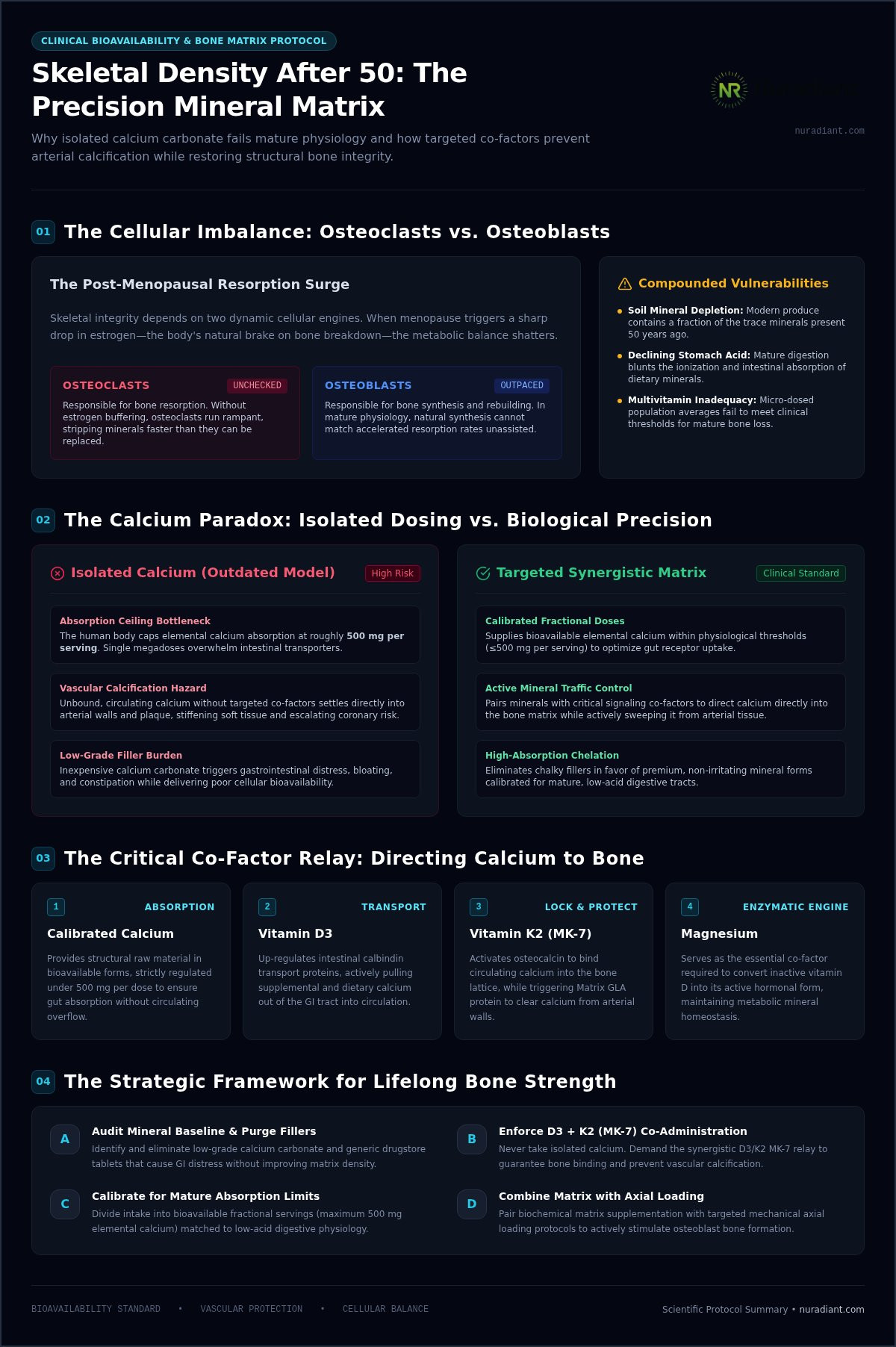
Skeletal integrity hinges on two cellular engines: osteoblasts, which synthesize bone, and osteoclasts, which resorb it. Under optimal physiological conditions, they work in tandem. Estrogen acts as the natural brake on osteoclasts, capping cellular breakdown. When menopause causes estrogen levels to plummet, that critical brake disappears. Osteoclasts run unchecked, stripping bone minerals faster than osteoblasts can replace them. Understanding what is osteoporosis begins with recognizing this cellular imbalance, where unchecked resorption hollows out the structural lattice of your hips and spine. Halting this decline requires aggressive biochemical support, leading many women to pair structural bone protocols with targeted supplements for menopause hormone balance.
The Fallacy of the Average Diet
Relying solely on "clean eating" to fortify mature bone density is an outdated gamble. Modern agricultural soils are depleted of essential trace minerals, leaving produce with a fraction of the micro-nutritional density it had fifty years ago. Worse, your internal digestive machinery shifts after 50. Declining stomach acid blunts your ability to ionize and absorb dietary minerals from food, cutting GI absorption efficiency just when your skeleton needs replenishment most.
Passive dietary assumptions leave you exposed to several compounded vulnerabilities:
- Accelerated Resorption: Unbuffered osteoclast activity hollows bone architecture from the inside out.
- Impaired Bioavailability: Diminished gastric acidity prevents effective mineral extraction from conventional meals.
- Multivitamin Inadequacy: Standard drugstore tablets dilute active compounds, falling far short of clinical bone density thresholds.
Targeted bone density supplements for women over 50 are not an optional luxury. They represent an essential biochemical intervention designed to outpace accelerated resorption and lock in skeletal strength.
The Critical Nutrient Matrix: Beyond Isolated Calcium
Swallowing standalone calcium pills is obsolete science. Loading high-dose calcium without biological traffic control doesn't reinforce your skeleton. It pools in your circulation. Without proper co-factors, excess circulating minerals settle directly into arterial walls, stiffening soft tissue and driving coronary risk. True skeletal resilience demands a synchronized biological matrix, not an isolated mineral blast.
The Calcium Paradox: Why More Calcium Isn't the Answer
Research confirms that menopause significantly speeds bone loss, yet force-feeding the body isolated calcium carbonate creates a dangerous vascular trap. When gut absorption falters, unbound calcium deposits into arterial plaque rather than entering cortical bone. Your body caps elemental absorption at roughly 500 mg per serving. Megadoses beyond this threshold simply circulate unguided. High-performance bone density supplements for women over 50 abandon isolated mega-dosing, focusing instead on calibrated amounts paired with precise delivery vehicles.
The Triad: D3, K2 MK-7, and Magnesium Synergy
Directing minerals into your bone matrix requires an unbroken biological relay. Each player handles an exact physiological task:
- Vitamin D3: Up-regulates intestinal calbindin proteins, pulling dietary and supplemental calcium out of the gut and into your bloodstream.
- Vitamin K2 (Menaquinone-7): Activates osteocalcin, the biochemical lock that binds blood calcium into the bone lattice, while triggering matrix GLA protein to clear calcium out of arterial linings. MK-7 delivers a sustained half-life that standard K1 can't match.
- Magnesium: Converts inactive 25-hydroxyvitamin D into active 1,25-dihydroxyvitamin D while stimulating calcitonin. Maintaining a 2:1 calcium-to-magnesium ratio prevents intracellular calcium overload and muscular cramping.
Essential Micro-Minerals: Boron, Zinc, and Trace Elements
The major triad requires micro-mineral support to lock in mineral crystallization. Boron reduces urinary excretion of calcium and magnesium, extending the biological half-life of systemic estrogen and active D3. Zinc drives osteoblast proliferation while serving as a non-negotiable co-factor for alkaline phosphatase, the enzyme that mineralizes bone tissue. Silica fortifies the underlying collagen mesh, giving your skeletal frame tensile shock absorption alongside compressive density.
Preserving peak physical function after 50 means optimizing your entire endocrine and mineral ecosystem. While fine-tuning skeletal integrity, many women integrate these protocols with metabolism boosting supplements for women over 50 to maintain cellular energy. For targeted support built to elite biological thresholds, explore a medical grade supplement line engineered specifically for mature physiology.
Evaluating Formulations: Low-Grade Fillers vs. Clinical Bioavailability
Most drugstore shelves are stocked with low-cost mineral salts dressed up as premium bone health solutions. Manufacturers rely on industrial shortcuts, pressing cheap limestone into oversized tablets that pass straight through your digestive tract unabsorbed. High-performance bone density supplements for women over 50 reject these compromised ingredients. If a formula triggers gastrointestinal distress or relies on poorly absorbed compounds, it fails the baseline test of functional efficacy.
Mineral Forms Matter: Salts vs. Organic Chelates
Look directly at the supplement facts panel. If the primary ingredient reads "calcium carbonate," you're holding pulverized chalk. Carbonate requires massive amounts of hydrochloric acid to break down, guaranteeing bloating, chronic constipation, and abysmal uptake in mature stomachs. Organic chelates solve this breakdown entirely.
Demand superior biochemical delivery models:
- Calcium Citrate and Malate: Pre-acidified chelates that absorb seamlessly across the intestinal brush border, regardless of whether you take them on an empty stomach or with a meal.
- Microcrystalline Hydroxyapatite (MCHA): A whole-food bone matrix providing calcium and phosphorus in a natural crystalline structure alongside collagenous proteins.
- Magnesium Glycinate vs. Oxide: Dump formulas containing magnesium oxide, which acts primarily as an osmotic laxative. Chelated bisglycinate crosses the intestinal wall intact to fuel parathyroid activation without digestive upset.
Manufacturing Purity and Contaminant Screening
Clinical efficacy depends on pristine purity standards. As outlined in federal guidelines for Calcium and Vitamin D for Bone Strength, adequate mineral balance is foundational, yet unrefined calcium derived from fossilized oyster shells or unpurified limestone frequently carries trace levels of lead, aluminum, and cadmium. Heavy metals directly displace calcium in bone tissue, weakening the matrix from within.
Demand uncompromising manufacturing rigor. Legitimate formulations adhere strictly to certified cGMP protocols and validate every production batch through third-party Certificates of Analysis (COA). Never settle for formulas padded with hydrogenated oils, synthetic food dyes, titanium dioxide, or sugar-packed gummy matrices. You need clean, medical-grade delivery engineered for optimal cellular bioavailability.
The 4-Step Selection Framework: How to Choose Your Bone Protocol
Selecting effective bone density supplements for women over 50 requires a systematic audit, not random trial and error. Drugstore aisles encourage passive guesswork, pushing proprietary blends that obscure exact dosages. Take total ownership of your mineral strategy. Use this four-step selection framework to separate clinically viable formulations from marketed dust.
Step 1 & 2: Audit Diet and Demand Synergistic Co-Factors
Never supplement blind. First, calculate your baseline dietary intake. Women over 50 require 1,200 mg of total daily calcium from combined dietary and supplemental sources. Estimate your typical daily baseline: assign roughly 300 mg if your diet includes minimal dairy, or 600 to 800 mg if you regularly consume yogurt, fortified greens, or hard cheeses. Your supplement must only bridge the remaining gap, usually 400 to 600 mg.
Second, establish non-negotiable synergy requirements. Immediately reject standalone calcium pills. Confirm these mandatory co-factors on the panel:
- Vitamin D3: A minimum of 800 to 1,000 IU daily to open intestinal mineral absorption channels.
- Vitamin K2 as MK-7: Specifically demand the menaquinone-7 isomer to activate osteocalcin; reject vague "Vitamin K" entries that use cheap K1.
- Chelated Magnesium: Calibrated to maintain that essential 2:1 ratio alongside your total elemental calcium intake.
Step 3 & 4: Scrutinize Elemental Yields and Timing Protocols
Deconstruct the supplement facts panel with clinical precision. Manufacturers love obfuscating low yields behind total salt weight. A tablet advertising 1,000 mg of calcium malate might yield only 200 mg of actual elemental calcium. Always verify the net elemental mineral mass before calculating your daily dosage. If the label hides elemental numbers inside a proprietary matrix, walk away.
Finally, align your dosing schedule with circadian mineral transport. Your gastrointestinal tract hits a saturation point at approximately 500 mg of elemental calcium per dose. Split your daily intake into two separate servings. Take your calcium-citrate blend alongside D3 and K2 with morning or midday meals. Shift your chelated magnesium dose to the evening, roughly 60 minutes before bed. This prevents competitive absorption between minerals, calms your central nervous system, and accelerates nighttime cellular bone remodeling.
Stop settling for retail commodities that fail to drive structural changes. Upgrade your daily regimen and explore advanced women's health supplements engineered to clinical bioavailability standards.
Reclaiming Structural Power: The Medical-Grade Standard
Skeletal defense is not a passive pursuit. You cannot simply take a pill and hope your bones stay intact. Rebuilding structural matrix integrity demands an aggressive, two-pronged strategy: precise cellular nutrition matched with physical mechanical load. Waiting for a fracture to dictate your lifestyle is unacceptable. Taking charge of your longevity means setting an uncompromising standard for what enters your body and how you train your frame.
Mechanical Loading: Fueling the Bone Remodeling Signal
Your skeletal system operates under Harold Frost's mechanostat principle. Bone tissue deposits new hydroxyapatite crystals only when exposed to mechanical strain that exceeds ordinary thresholds. Casual walking and light gardening do not create sufficient force to trigger osteoblastic mineral deposition. If you want bone density supplements for women over 50 to lock into your skeleton, you must force the adaptation.
Integrate targeted physical stressors to signal bone remodeling:
- Progressive Axial Resistance Training: Execute heavy multi-joint movements like barbell squats, deadlifts, and overhead presses to load the lumbar spine and femoral neck directly.
- Rucking and Weighted Loading: Strap on a calibrated weight vest or ruck pack during brisk walks to increase vertical impact and axial compression.
- Dynamic Multi-Planar Drills: Incorporate controlled stamping, hopping, and change-of-direction exercises to trigger piezoelectric currents across the bone cortex, driving active mineral uptake.
Choosing Medical-Grade Formulas Built for Performance
Mass-market consumer pills cut corners with low-potency salts, synthetic glues, and zero co-factor synergy. They cater to price points, not physiological demands. Premium bone density supplements for women over 50 require medical-grade standards. That means clinically validated raw materials, verified chelation for complete cellular bioavailability, zero low-absorption fillers, and exact nutrient ratios tailored for post-menopausal metabolism.
Nuradiant establishes the high-performance benchmark for mature adult health. By engineering formulas around cellular bioavailability rather than cheap shelf-stable bulk, these solutions deliver active compounds straight to the target tissue without digestive blowback. Do not settle for commodity multivitamins that leave your skeletal architecture defenseless. Take control of your physical power and explore the comprehensive women's health supplements engineered to protect your strength, your mobility, and your lifelong independence.
Lock In Lifelong Skeletal Strength
Frailty isn't an inevitable consequence of aging. It's a physiological challenge with a direct biological solution. Protecting your structural frame requires eliminating cheap mineral salts, enforcing the critical synergy between bioavailable calcium, D3, K2 MK-7, and magnesium, and demanding mechanical adaptation through progressive physical load. High-caliber bone density supplements for women over 50 don't merely slow mineral depletion; they fortify the foundational matrix that keeps you moving, lifting, and thriving on your own terms.
Demand higher formulation standards. Nuradiant engineers medical-grade women's health supplements calibrated specifically for mature physiology, delivering zero low-absorption fillers and uncompromised cellular bioavailability. Your physical capability is your greatest asset. Take definitive action today and upgrade to medical-grade women's health formulations to secure your power, protect your frame, and outpace age-related decline.
Frequently Asked Questions
Can women over 50 rebuild lost bone density through supplements alone?
No, supplementation provides the building blocks, but mechanical loading provides the rebuilding signal. High-performance bone density supplements for women over 50 supply the bioavailable minerals necessary to stop bone loss. However, osteoblasts require physical mechanical tension from heavy resistance training or axial impact to deposit those minerals into your bone matrix. You must pair nutrition with heavy physical effort.
What is the difference between calcium carbonate and calcium citrate?
Calcium carbonate is an alkaline rock salt containing 40% elemental calcium that demands substantial stomach acid to dissolve. It frequently triggers constipation and gas in mature digestive systems. Calcium citrate contains 21% elemental calcium bound to citric acid. It ionizes efficiently without high stomach acid, absorbing cleanly whether taken with food or on an empty stomach without digestive discomfort.
Why is Vitamin K2 MK-7 mandatory when supplementing with Vitamin D3 and calcium?
Vitamin D3 pulls calcium across the intestinal wall into the bloodstream, but it cannot steer where that calcium travels. Vitamin K2 MK-7 activates osteocalcin, binding circulating calcium directly into bone tissue. Simultaneously, K2 triggers matrix GLA protein to block arterial calcification. Without K2, high calcium intake risks cardiovascular tissue stiffening rather than structural skeletal fortification.
How much elemental calcium should a woman over 50 take per day?
The standard guideline establishes 1,200 mg of total elemental calcium daily from all sources. Most balanced diets already supply between 500 mg and 800 mg. Your supplemental dose should only bridge the leftover gap, typically 400 mg to 600 mg. Never take more than 500 mg of elemental calcium in a single serving because excess amounts oversaturate intestinal transporters.
Can taking calcium supplements cause arterial plaque or kidney stones?
Isolated calcium megadoses taken without proper co-factors elevate vascular plaque risk and renal stones. When unbound minerals pool in circulation, unabsorbed compounds deposit into vascular walls or filter into urine as insoluble oxalate crystals. Pairing bioavailable calcium with adequate dietary hydration, magnesium, and Vitamin K2 MK-7 prevents mineral pooling and directs compounds straight into skeletal bone.
When is the best time of day to take bone density supplements for maximum absorption?
Split your dosing across the day to bypass gut saturation limits. Take your calcium chelate, Vitamin D3, and Vitamin K2 alongside breakfast or lunch containing healthy fats to boost fat-soluble vitamin uptake. Shift chelated magnesium bisglycinate to the evening, roughly 60 minutes before bed. This schedule prevents mineral absorption competition and supports nighttime bone matrix restoration.
Should women over 50 combine bone supplements with joint or hormone support formulas?
Yes, targeted multi-system stacking accelerates structural recovery and protects physical mobility. Skeletal architecture relies on surrounding tendons, ligaments, and hormonal signals to distribute movement forces properly. Pairing bone density supplements for women over 50 with specialized joint health supplements or hormone-balancing formulas creates a complete functional framework, protecting cartilage while optimizing osteoblast mineral uptake.