

Bone Density Mastery: Multivitamin Guide for Women 50+
Skeletal decline isn't an inevitable part of aging. It's a failure of biological precision. Most women are told to accept fragility as a natural consequence of the years, but high-performance aging demands a different standard. You shouldn't have to fear a fracture every time you push your limits. Finding a legitimate multivitamin for bone health women over 50 is often a frustrating cycle of filler-heavy pills and conflicting dosage advice. You've likely felt the confusion over whether 1,200 mg of calcium is enough or if your Vitamin D3 levels are actually supporting your skeletal matrix.
We agree that the status quo is unacceptable. It's time to stop guessing and start optimizing. This guide promises to move you beyond maintenance and into total skeletal mastery. You'll learn how to deploy medical-grade nutrient protocols that maximize mineral absorption, ensure physical capability, and maintain skeletal resilience. We will break down the exact ratios of K2, D3, and calcium required to harden your frame and protect your future through informed, decisive action.
Key Takeaways
- Reject generic retail supplements that use cheap fillers and learn how to counter the rapid bone resorption triggered by post-menopausal hormonal shifts.
- Optimize the "Bone Trifecta" by leveraging Vitamin D3 as a gatekeeper and Vitamin K2 as a biological traffic controller for mineral placement.
- Use our high-performance checklist to select a multivitamin for bone health women over 50 that meets medical-grade standards for dosage and purity.
- Prioritize chelated mineral forms to bypass absorption barriers and ensure your skeletal matrix receives the raw materials it needs for resilience.
- Transition from "taking vitamins" to executing a targeted nutrient protocol designed to sustain an active, high-impact lifestyle.
The Skeletal Crisis: Why Standard Multivitamins Fail Women Over 50
Your skeleton is the structural hardware that runs your physical software. If the hardware fails, the software crashes. For women over 50, this hardware is under a constant biological assault that most "One-a-Day" brands aren't equipped to handle. Relying on a generic multivitamin for bone health women over 50 is like trying to run high-performance code on an outdated, crumbling processor. It doesn't work. The gap between avoiding a fracture and optimizing for high-impact activity is wider than you think.
Stop believing the fallacy of the "balanced diet." Modern industrial farming has stripped the soil of essential minerals, making it nearly impossible to hit performance-level targets through food alone. You aren't just eating for survival anymore; you are supplementing to intercept a predetermined decline. To maintain total skeletal resilience, you must move beyond retail-grade solutions and demand medical-grade precision.
The Estrogen-Bone Connection
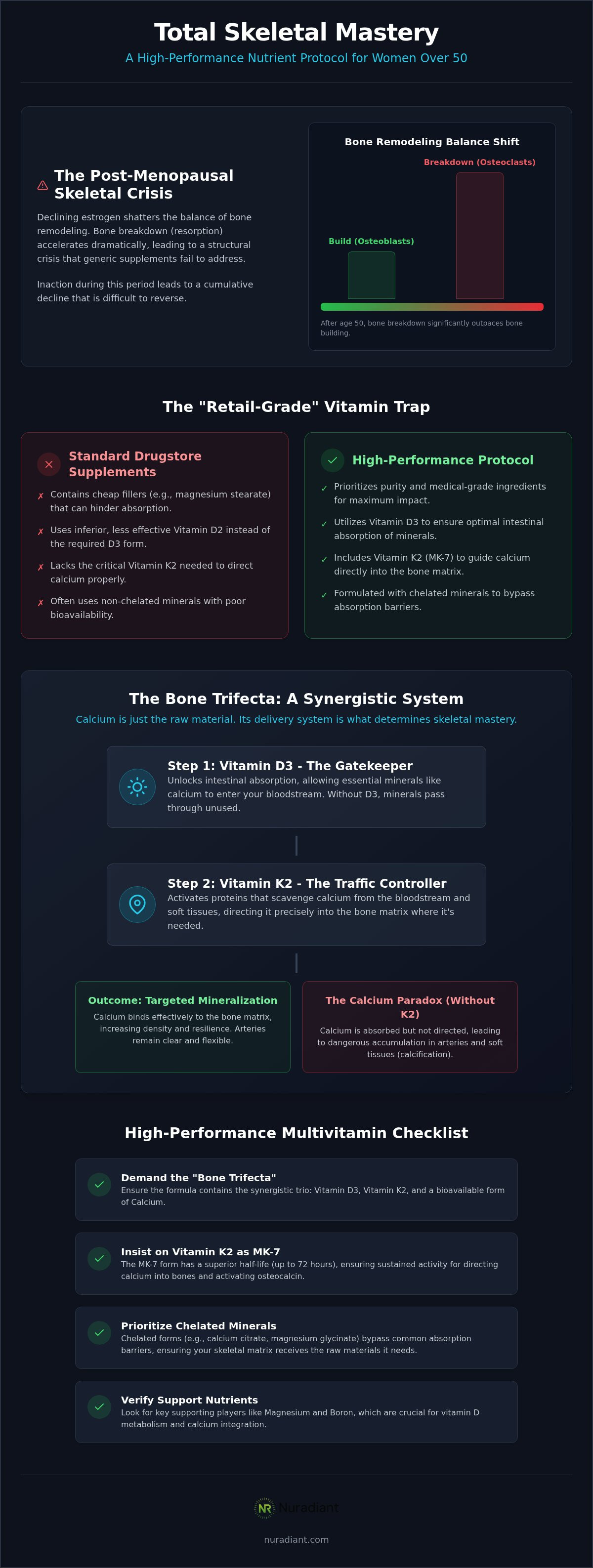
Estrogen is the primary regulator of your bone remodeling cycle. It maintains the delicate balance between osteoclasts, the cells that break down bone, and osteoblasts, the cells that build it. When estrogen levels drop during menopause, this balance shatters. Bone resorption accelerates rapidly, particularly in the first 10 years after age 50. Understanding Osteoporosis is vital because this isn't a slow, steady dip. It's a structural crisis. Inaction during this decade leads to cumulative decline that is difficult to reverse. You must provide your body with the exact signaling molecules it needs to keep osteoblasts active and productive.
The 'Retail Grade' Vitamin Trap
Drugstore supplements are built for the masses, which means they are built for the lowest common denominator. These products often contain "retail grade" ingredients that prioritize shelf life over biological efficiency. You'll frequently find fillers like magnesium stearate that can hinder the absorption of the very nutrients you're paying for. Even worse, many low-tier brands still utilize synthetic Vitamin D2. For anyone serious about high-performance aging, D2 is an inferior choice. You need Vitamin D3 to actually unlock intestinal absorption and ensure your mineral intake isn't just passing through your system. There is a massive difference between a multivitamin for bone health women over 50 that merely prevents deficiency and one that actively optimizes density. Choose the latter.
The Bone Trifecta: D3, K2, and the Calcium Signaling Mechanism
Stop treating calcium as a standalone solution. It isn't. Calcium is the raw material, but without a sophisticated delivery system, it's just debris in your bloodstream. To achieve total skeletal mastery, you must deploy the Bone Trifecta: Vitamin D3, Vitamin K2, and Calcium. This synergy is the foundation of any effective multivitamin for bone health women over 50. You don't just need minerals; you need a signaling network that works.
Vitamin D3 acts as the biological gatekeeper. Its primary mission is to unlock intestinal absorption, allowing calcium to enter your system. Without adequate D3, your body can't access the minerals you ingest. However, absorption is only half the battle. If you take calcium without direction, you risk the "Calcium Paradox." This occurs when calcium accumulates in soft tissues like arteries or kidneys instead of your bones. This isn't just a failure of absorption. It's a failure of biological routing.
This is where Vitamin K2 steps in as the traffic controller. It activates specific proteins that scavenge calcium from the blood and drive it directly into the skeletal matrix. The Bone Health & Osteoporosis Foundation emphasizes that women must be proactive about these nutrient interactions to prevent fractures. If you aren't using K2 to direct the traffic, you aren't building bone; you're just creating a potential cardiovascular liability.
Vitamin K2 (MK-7): The Missing Link
To harden the bone matrix, you need to activate osteocalcin. This protein acts like biological glue, binding calcium to the bone structure. Only Vitamin K2 can trigger this activation. For maximum performance, demand the MK-7 form. MK-7 has a superior half-life compared to MK-4, staying active in your system for up to 72 hours. Vitamin D3 absorbs the calcium while Vitamin K2 directs it, creating a biological force multiplier that hardens the skeletal matrix and prevents arterial calcification.
Magnesium and Boron: The Support Cast
High-performance aging requires precision support. Magnesium is the engine that converts Vitamin D3 into its active, usable form. If you're magnesium deficient, your D3 levels will remain functionally low regardless of your dosage. Boron serves as the stabilizer, extending the half-life of Vitamin D and preventing mineral competition in the gut. These trace elements ensure your mineral signaling remains clear and effective. They are the difference between a generic pill and a targeted protocol.
Don't settle for incomplete chemistry. Our Medical Grade Supplement Line provides the exact ratios needed to execute this protocol. It's time to demand more from your multivitamin for bone health women over 50 and start building a resilient future.
Evaluating Bioavailability: Medical Grade vs. Drugstore Supplements
A milligram on a label is not a milligram in your bone matrix. If you're buying a multivitamin for bone health women over 50 at a big-box retailer, you're likely paying for expensive waste. Bioavailability is the only metric that matters for high-performance aging. Most drugstore brands utilize calcium carbonate because it's cheap and shelf-stable. Carbonate requires massive amounts of stomach acid to break down. This often leads to bloating and poor uptake. Medical-grade protocols demand calcium citrate or malate. These forms bypass digestive hurdles and get straight to the structural hardware.
Chelated minerals are the only option for those refusing to accept decline. Chelation involves bonding a mineral to an amino acid. This process essentially "cloaks" the mineral for superior passage through the intestinal wall. It's part of the Purity Tax. Quality manufacturing costs more because it requires precision engineering and rigorous third-party testing. While the FDA doesn't approve supplements for effectiveness before they hit shelves, labels like NSF or USP are your guarantee. They prove the potency matches the promise on the bottle. You're paying for results, not just a pill.
The Absorption Audit
Look at your current label right now. If you see "magnesium oxide" or "zinc oxide," you're consuming low-tier industrial forms. These are notorious for causing digestive distress and offering minimal absorption. Performance-driven results require standardized extracts. These ensure every dose contains a precise concentration of active biological compounds. A tactical comparison shows that citrate, glycinate, and malate forms consistently outperform oxides in every clinical metric. Demand organic salts that your body can actually use to harden the skeletal frame.
Why Formulation Synergy Matters
Generic "kitchen sink" multivitamins are a mess of conflicting chemistry. You can't just throw every nutrient into one pill and expect a win. High doses of zinc can inhibit copper absorption. Calcium can compete with iron for transport. Nuradiant's medical grade supplement line prioritizes nutrient timing and synergistic pairing to ensure maximum biological efficiency. We don't guess. We optimize. Total resilience requires a data-driven approach to your internal environment. For a complete strategy, consider how your bone protocol interacts with your Supplements for Menopause Hormone Balance. Executing a professional-grade plan is the only way to secure your physical future. Don't settle for a sub-par multivitamin for bone health women over 50 when you can command peak performance.
The High-Performance Buying Checklist for Women Over 50
Stop settling for the 100% Daily Value (DV) trap. These baseline numbers are designed to prevent deficiency in a sedentary population, not to sustain an active, high-impact lifestyle after 50. High-performance aging requires therapeutic doses that actively intercept bone resorption. When selecting a multivitamin for bone health women over 50, you must audit the label with clinical precision. If the numbers don't meet the standard, the product doesn't belong in your system.
- Vitamin D3: Demand 2,000 to 5,000 IU. This range is essential for maintaining the serum levels required for structural hardware maintenance.
- Vitamin K2 (as MK-7): Look for 90 to 180mcg. As the traffic controller for calcium, this dosage ensures minerals reach the bone matrix rather than your arteries.
- Calcium: Focus on 500 to 700mg of citrate or malate forms. Do not aim for 100% DV in one dose. Your body absorbs smaller amounts more efficiently, and the rest should come from your optimized diet.
- Trace Minerals: Ensure the presence of Zinc, Manganese, and Copper. These are the critical co-factors that build the internal collagen scaffold your bones rely on for flexibility and strength.
Label Transparency and Purity
Proprietary blends are a massive red flag. They're a legal loophole used to hide under-dosed ingredients and cheap fillers behind a single milligram total. If a brand won't disclose the exact milligram count for every nutrient, they're hiding something. You need non-GMO and allergen-free certifications to ensure you aren't introducing systemic inflammation while trying to build bone. Identify and reject "performance killers" like artificial dyes, titanium dioxide, and talc. These serve the manufacturer's shelf-life, not your biological efficiency.
Form Factor: Capsules vs. Tablets vs. Gummies
Delivery systems dictate results. Cheap retail tablets are often compressed with industrial binders that make them nearly impossible to break down. It's common for these "rocks" to pass through the digestive tract completely undissolved. Gummies are even worse. They're sugar-laden candies with low nutrient stability and even lower bioavailability. High-purity capsules or liquid-filled options are the gold standard. They offer rapid disintegration and ensure the nutrients are available for uptake the moment they hit your small intestine.
Don't leave your skeletal resilience to chance. Audit your current cabinet and upgrade to our Medical Grade Supplement Line to execute a protocol that actually delivers. Your future capability depends on the standards you set today.
Reclaiming Your Strength: The Nuradiant Protocol for Bone Resilience
Stop viewing supplementation as a passive habit. It's a tactical execution. For women over 50, the hormonal shift isn't a suggestion to slow down; it's a demand for higher standards. A high-quality multivitamin for bone health women over 50 serves as the bridge across the post-menopausal gap. It provides the raw materials you need while your endocrine system recalibrates. You aren't just "taking vitamins." You're deploying a targeted women's health supplements protocol to ensure your skeletal hardware remains unbreakable. This is about reclaiming capability.
Bone remodeling is a marathon, not a sprint. The first 90 days of a medical-grade protocol are the most critical. This is the window where your body begins to shift from a state of resorption to a state of mineralization. You won't feel your bones hardening overnight, but you are setting the chemical foundation for total resilience. Consistency is the only variable you control. Execute the protocol daily to lock in your physical capability and protect your future mobility.
Beyond the Bottle: The Lifestyle Multiplier
Supplementation provides the materials, but resistance training provides the "on-switch." Mechanical loading is what signals your osteoblasts to actually use the minerals you've absorbed. Without load-bearing exercise, even the best multivitamin for bone health women over 50 is underutilized. Lift heavy. Push your limits. This mechanical stress works in tandem with Metabolism Boosting Supplements for Women Over 50 to ensure your body is in a prime anabolic state. Don't forget that gut health dictates mineral efficiency. If your microbiome is compromised, your ROI on supplements drops. Optimize your internal environment to maximize your results.
Your Next Step Toward Peak Functionality
Settling for retail-grade supplements is a gamble with your future mobility. You've seen the data. You know the "retail trap." Every day you spend using under-dosed, low-bioavailability pills is a day of lost density. Reclaiming your strength requires a no-excuses approach to your biological health. You have the checklist. You have the science. Now, you need the tools. Explore the Nuradiant Medical Grade Supplement Line to lock in your skeletal foundation and demand peak functionality from your body. Don't accept decline. Command resilience. Start today.
Command Your Physical Future
Fragility is a choice you no longer have to make. You've learned that standard retail pills are built for the average, not the high-performer. To maintain an active lifestyle, you must move beyond generic options and deploy a medical-grade multivitamin for bone health women over 50. This isn't just about avoiding a fracture. It's about hardening your skeletal matrix through the precise synergy of Vitamin D3, Vitamin K2, and chelated minerals. You now have the checklist to audit every label for purity, potency, and biological efficiency.
Don't let hormonal shifts dictate your mobility. You have the science-backed protocols to intercept decline and optimize your frame for high-impact activity. It's time to stop guessing and start executing with precision. Secure Your Skeletal Foundation with Nuradiant's Medical Grade Women's Supplements. Our formulations are third-party tested for purity and specifically designed for high-performance aging. We prioritize science-backed bioavailability so your body actually uses the nutrients you ingest. Take command of your health and build a resilient future today.
Frequently Asked Questions
How much calcium do women over 50 actually need daily?
Demand 1,200 mg of calcium every day to maintain skeletal hardware. This is the verified standard for women over 50 to counter the rapid resorption triggered by estrogen decline. Don't try to get it all from one pill. Your body can't process a massive calcium dump at once. Split your intake between a nutrient-dense diet and a high-bioavailability multivitamin for bone health women over 50 to ensure total absorption without digestive compromise.
Can a multivitamin really reverse bone density loss?
Precision supplementation is about optimization and resilience rather than a simple "reversal" of time. A medical-grade multivitamin for bone health women over 50 provides the essential signaling molecules needed to arrest decline. When you execute a consistent protocol of D3, K2, and chelated minerals, you provide the raw materials for new mineralization. Pair this with heavy resistance training to activate the biological "on-switch" for bone hardening and structural mastery.
What is the best time of day to take bone health supplements?
Split your doses between breakfast and dinner for maximum performance. Your intestines can only absorb roughly 500 mg of calcium in a single sitting. Taking your full daily requirement at once is a waste of resources. Since Vitamin D3 and K2 are fat-soluble, you must take them with a meal containing healthy fats. This ensures the nutrients actually enter your system instead of just passing through your digestive tract.
Why is Vitamin K2 so important for bone health after 50?
Vitamin K2 is the traffic controller for your skeletal system. It activates osteocalcin, the specific protein that binds calcium to the bone matrix. Without K2, calcium remains aimless in your bloodstream, failing to harden your frame. After age 50, your body's ability to direct minerals decreases. You need a medical-grade K2 (as MK-7) to ensure every milligram of calcium you ingest is funneled directly into your structural hardware.
Does Vitamin D3 cause calcification of the arteries without K2?
High-dose D3 increases calcium absorption, but it doesn't control the destination. This creates a risk where calcium accumulates in soft tissues like your arteries instead of your bones. Vitamin K2 protects your cardiovascular performance by activating Matrix GLA Protein, which prevents arterial calcification. Using D3 without K2 is a tactical error. You must use both to ensure calcium stays in your bones and out of your heart and kidneys.
Should I take my bone multivitamin with food or on an empty stomach?
Always take your supplements with food to maximize biological efficiency. Fat-soluble vitamins like D3 and K2 require dietary fats to trigger intestinal transport mechanisms. Taking minerals on an empty stomach often leads to nausea and poor uptake. High-performance aging requires you to synchronize your nutrient intake with your metabolic fuel. Don't leave your absorption to chance; execute your protocol during your largest meals for the best results.
How long does it take to see results in bone density scans?
Bone is slow-growing tissue that requires a 12 to 24-month window for measurable changes on a DXA scan. While the chemical foundation begins to shift in the first 90 days of a medical-grade protocol, structural resilience takes time. Consistency is the only variable you control. Maintain a no-excuses approach to your supplementation and loading schedule to ensure your next scan reflects the work you're putting in today.