

Blood Pressure Support Supplements Natural: The 2026 Optimization Guide
Your cardiovascular performance doesn’t have to fade quietly with age. If “blood pressure support supplements natural” is the phrase driving your search, you’re likely looking for more than another low-potency vitamin. You want evidence, clear quality standards, and support that fits a bigger goal: staying strong, active, and capable.
That instinct is sound. But supplement reviews can conflict, ingredient labels can obscure what you’re actually getting, and no supplement should replace prescribed medication or proven lifestyle strategies. The right approach is targeted, informed, and built around your health needs.
This guide breaks down which natural ingredients have research behind them, what to look for in potency and manufacturing quality, and how to assess a formula without falling for hype. You’ll also see where supplements fit alongside exercise, nutrition, and guidance from your healthcare provider. Heart health is the foundation for every other performance goal. Choose with precision, and take a more active role in protecting your cardiovascular resilience.
Key Takeaways
- See how cardiovascular resilience supports an active life and why blood pressure deserves a proactive place in your performance goals.
- Explore hibiscus, garlic, magnesium, and potassium, and learn how their potential roles in blood vessel function differ.
- Use a clear checklist to assess blood pressure support supplements natural, including ingredient transparency, potency, and quality standards.
- Learn how to think strategically about supplement timing and combining heart health support with broader vitality goals.
- Discover how Nuradiant’s science-backed heart health supplements are designed for adults over 40 and 50, and what to consider before adding any supplement to your routine.
Why Blood Pressure Optimization Matters for High-Performance Aging
Blood pressure isn’t just a number to chase downward. It’s one signal of how your cardiovascular system is handling the demands of everyday life, from climbing stairs to training and recovering. Natural support is best viewed as a proactive strategy: build heart-healthy habits, identify nutritional needs, and consider evidence-informed supplements as a complement to appropriate medical care. The goal is resilience, not self-treatment.
A reading in the normal range is useful, but it doesn’t capture every part of cardiovascular health or physical performance. For background on hypertension, its classifications, causes, and risk factors, see this comprehensive overview of hypertension. In 2026, “optimization” still doesn’t mean chasing an unverified ideal or replacing clinical guidance. It means paying attention to trends, risk factors, and how well your body supports the activities that matter to you.
The Cost of Cardiovascular Neglect
Your muscles rely on blood flow to deliver oxygen and nutrients during activity. Blood pressure alone doesn’t reveal how efficiently that system is working, but sustained vascular strain can affect cardiovascular function and deserves attention. The heart and blood vessels also help maintain blood flow to the brain, which supports thinking and focus. Protect the system that powers both effort and clear decision-making.
Cardiovascular optimization is the ongoing practice of supporting heart and blood-vessel function so your body can meet physical and cognitive demands over time.
Beyond “Normal”: Aiming for Peak Functionality
A single reassuring reading shouldn’t become a reason to ignore the bigger picture. Track measurements as advised by a healthcare professional, and consider them alongside factors such as activity, nutrition, sleep, and family history. If readings concern you, seek professional guidance rather than trying to force a change with supplements.
That’s the shift from reactive management to proactive cardiovascular care: make sustainable lifestyle choices, monitor your health, and address gaps with care. Blood pressure support supplements natural can be part of that conversation, but they aren’t a substitute for prescribed medication or a balanced diet. Talk with a healthcare provider before starting a supplement, especially if you take medication, because interactions are possible.
For adults over 40, medical-grade supplement formulations may offer a more deliberate option than generic retail vitamins, but “medical-grade” alone doesn’t prove a product’s effectiveness or guarantee a result. Check the ingredient amounts, form, and label transparency, then match the choice to your needs. For broader nutrient support, explore this guide to the best multivitamin for men over 40. Heart health is the foundation. Build from evidence, not hype.
Top Natural Ingredients for Precision Blood Pressure Support
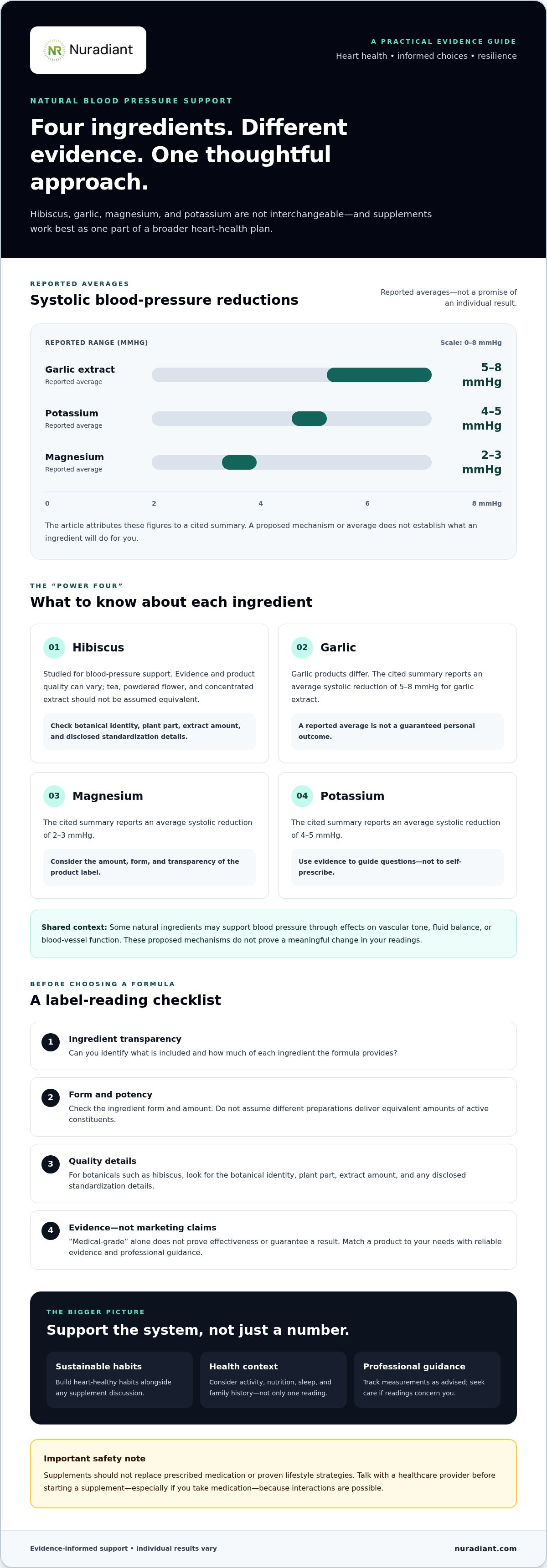
The “Power Four” are hibiscus, garlic, magnesium, and potassium. They aren’t interchangeable, and none is a guaranteed fix. Some may support blood pressure through effects on vascular tone, fluid balance, or blood-vessel function. The National Center for Complementary and Integrative Health offers a balanced review of natural products for high blood pressure, including the limits of current evidence. Use research to guide questions, not to self-prescribe.
Vasodilation is the widening of blood vessels. Endothelial function refers to how well the vessel lining helps regulate that response. Both are relevant to circulation, but a supplement’s proposed mechanism doesn’t prove it will meaningfully change your readings. YourHealthier’s May 2026 summary reports average systolic reductions of 5 to 8 mmHg for garlic extract, 4 to 5 mmHg for potassium, and 2 to 3 mmHg for magnesium. These are reported averages, not a promise of an individual result.
Hibiscus and Garlic: The Botanical Heavyweights
Hibiscus has been studied for blood-pressure support, but evidence and product quality can vary. Don’t assume a tea, powdered flower, and concentrated extract deliver equivalent amounts of active constituents. Look for the botanical identity, plant part, extract amount, and any disclosed standardization details. Specific clinical dosages should be verified against reliable evidence and discussed with a healthcare professional.
Garlic products also differ. Aged garlic extract and standard garlic powder are made differently, so their compound profiles aren’t automatically comparable. Check which form the label identifies and whether the manufacturer states a measurable marker compound. “Garlic” alone tells you too little. Standardization matters because a clearly specified extract makes its active-compound content easier to assess from batch to batch.
Magnesium and Potassium: The Mineral Foundation
Magnesium participates in muscle function, including the smooth muscle activity that helps regulate blood-vessel constriction and relaxation. Potassium supports fluid and electrolyte balance and helps counterbalance sodium’s effects on vascular tension. Food sources are important, and supplements aren’t appropriate for everyone, particularly when kidney function or medications affect mineral balance.
Don’t assume a multivitamin supplies amounts suited to targeted heart-health support. Compare the label’s actual mineral forms and quantities with your dietary needs, rather than choosing by front-label claims. More isn’t automatically better. Combining targeted nutrients may make sense when there’s a clear rationale, but the four ingredients haven’t been established as a universally effective stack. If you’re evaluating blood pressure support supplements natural, review each ingredient’s form, amount, and evidence, and ask a healthcare professional about interactions before starting. For an example of a dedicated category, explore Nuradiant heart health supplements.
How to Choose Medical-Grade Supplements Over Retail Fillers
A low price doesn’t prove a supplement is poor quality, and a premium label doesn’t prove it’s effective. The real test is what’s inside, how clearly it’s disclosed, and whether the formula matches a credible purpose. “Medical-grade” isn’t a guarantee of results or a substitute for regulatory approval. Treat it as a cue to examine the formulation, evidence, and quality information rather than accept the label at face value.
For blood pressure support supplements natural, compare more than the front of the bottle. Check the amount and form of each active ingredient, serving size, other ingredients, and any testing details the manufacturer makes available. Independent testing can add useful verification of identity or purity when the testing scope and results are clearly explained. In the United States, supplements are regulated as food, not drugs, and the FDA doesn’t approve them for safety or effectiveness before sale.
Bioavailability: Getting What You Pay For
Ingested isn’t the same as absorbed. A nutrient must be released and absorbed by the body to be available for use, and absorption can vary with the ingredient form, dose, and individual factors. Magnesium oxide and chelated forms such as magnesium bisglycinate differ in composition and characteristics, but don’t assume one form always outperforms another for blood pressure support. Assess the specific product and evidence, and ask a healthcare professional which form fits your needs.
Form matters for other ingredients, too. Coenzyme Q10 is sometimes discussed in connection with cardiovascular health, but evidence and possible medication interactions deserve careful review. See the Mayo Clinic’s information on Coenzyme Q10 and blood pressure before treating it as an automatic addition to a heart-health routine.
For another example of how a focused formulation is presented, review this medical grade supplement line. Compare its ingredient disclosures with the checklist you use for any supplement.
The Purity Standard: No Excuses Manufacturing
“Science-backed” should mean the formulation’s ingredients and amounts have a reason to be there, supported by relevant evidence. It shouldn’t mean that every ingredient has been proven to lower blood pressure, or that the finished product has demonstrated a clinical benefit. Nuradiant’s medical-grade supplement line and science-backed heart-health focus speak to its formulation approach; review each product label and available quality information to judge the specifics.
Scan the full label, not just the headline ingredients. Look for clearly named active compounds, amounts per serving, and a complete list of other ingredients. Binders, coatings, and flow agents may serve manufacturing purposes, so their presence alone doesn’t make a product harmful. The question is whether the label is transparent and the formula is appropriate for you. When details are missing, don’t guess. Ask the manufacturer or choose a product with clearer disclosures.
Strategic Implementation: Maximizing the Impact of Your Heart Stack
A supplement routine works best when it’s consistent, appropriate for your needs, and paired with habits that support cardiovascular health. Don’t build a complicated stack just to feel proactive. For adults over 50, changes in health, diet, and medication use can affect what’s suitable. Check with a healthcare professional before adding supplements, especially if you take medication or have a condition that affects mineral balance.
The 24-Hour Heart Support Cycle
There’s no universal clock time proven to make blood pressure supplements work better or align them with everyone’s circadian rhythm. Follow the product label and professional guidance. Some supplements are best taken with food, while others may have specific instructions. Consistency helps you follow the routine and assess it over time, but it doesn’t guarantee improved readings or arterial resilience.
Keep a simple schedule. Record what you take, when you take it, and any relevant changes in diet, activity, sleep, or medication. Avoid adding several new ingredients at once. That makes it harder to spot side effects or understand what may be influencing a change. If stress management is part of your wider recovery plan, read about CBD for stress and recovery; don’t treat CBD as a blood-pressure therapy, and check for potential interactions before use.
Monitoring and Adjusting for Peak Performance
Use reliable measurements, not guesses. Take blood pressure readings according to your healthcare professional’s instructions, using a validated monitor and consistent conditions where possible. Keep a log of readings and routine changes to discuss at appointments. Don’t judge a supplement by one number or by how you feel: high blood pressure may not cause noticeable symptoms, and feeling energetic doesn’t confirm that your readings have changed.
Track function separately. Note how you tolerate your usual walks, resistance-training sessions, and everyday activity, including recovery and fatigue. These observations can help you spot broader changes, but they don’t replace blood-pressure monitoring or medical evaluation. If readings shift, symptoms develop, or your medication changes, consult a healthcare professional before adjusting your stack. Age alone isn’t a reason to increase a dose or add another ingredient.
Make lifestyle the force multiplier. A DASH-style eating pattern, regular physical activity, weight management, and stress reduction have a stronger evidence base for blood-pressure management than any single supplement. Resistance training can support strength and function as you age; build it into a safe routine that matches your ability and professional advice. Supplements should complement those fundamentals, not compete with them.
Choose Nuradiant heart health supplements as a starting point for exploring the brand’s heart-health offerings, then review product labels and discuss fit with your healthcare professional. A disciplined plan beats an oversized stack.
Nuradiant Heart Health: Engineered for Resilience and Vitality
Heart health isn’t a side project. It supports the energy, mobility, and endurance you rely on to stay active as you age. Nuradiant focuses on science-backed heart health supplements and a medical-grade supplement line designed for adults over 40 and 50. The aim is proactive support for resilience and peak functionality, not a promise to diagnose, treat, or prevent high blood pressure.
That distinction matters. A supplement can support a health routine, but it can’t guarantee better readings or replace prescribed medication, appropriate care, or foundational habits such as a balanced diet and regular activity. Choose with evidence, check the label, and bring questions about ingredients and interactions to your healthcare provider.
The Nuradiant Advantage
Generic wellness formulas may not be designed around the needs and priorities of adults entering their 40s and 50s. Nuradiant’s focus is more targeted: science-backed ingredients and medical-grade formulations intended to support heart and immune health. Still, “medical-grade” isn’t proof that a product outperforms every retail alternative. Compare actual ingredient amounts, forms, and available quality information rather than relying on a label claim alone.
Potency only has value when it’s appropriate, clearly disclosed, and grounded in a sound formulation. Look for transparent serving information and named ingredients. If a label doesn’t provide the details you need to assess a formula, ask questions before making it part of your routine. Nuradiant’s performance-centered approach offers a starting point for that evaluation, not a reason to skip it.
Your Next Move in Cardiovascular Optimization
Don’t settle for guesswork, but don’t chase “peak” readings with an oversized supplement stack either. Build a deliberate plan:
- Review your baseline. Track blood pressure as advised by your healthcare provider and discuss readings that concern you.
- Check the formula. Read the full label, assess ingredient forms and amounts, and avoid assuming more is better.
- Check for interactions. Ask a healthcare professional before starting a supplement, especially if you take medication or manage a health condition.
- Keep the fundamentals in place. Pair any supplement with sustainable nutrition, physical activity, and other guidance that fits your health needs.
Use the same disciplined standard to assess blood pressure support supplements natural: evidence over hype, transparency over vague promises, and consistency over quick fixes. Nuradiant’s heart health supplements may be one option to consider as part of an informed routine. Protect your capability by making each choice deliberate, then keep measuring progress with your healthcare provider.
Make Your Next Move Count
Cardiovascular performance isn’t built on a single ingredient or one reassuring reading. It comes from informed choices, consistent habits, and a supplement strategy that earns its place in your routine. The key takeaways are simple: assess ingredients and quality instead of trusting bold label claims, treat supplements as support rather than a replacement for medical care, and keep your broader health goals in view.
Choosing blood pressure support supplements natural means demanding clarity and evidence, not chasing shortcuts. Nuradiant brings together science-backed heart health formulas for aging adults and a medical-grade supplement line focused on resilience and performance. Review the available formulations, check whether they fit your needs, and discuss your plan with a healthcare professional, especially if you take medication.
Your heart supports every move you want to keep making. Take the next step with purpose: Optimize Your Heart Health with Nuradiant's Medical-Grade Line. Stay informed, stay consistent, and keep building toward the active life you want.
Frequently Asked Questions
Can natural blood pressure support supplements replace my medication?
No. Supplements shouldn’t replace prescribed blood pressure medication or medical care. Stopping or changing a prescription without your clinician’s direction can put your health at risk, even if you feel well or see a different reading. Natural ingredients may have effects and can interact with medication. Before using blood pressure support supplements natural, discuss the specific product and your health history with a healthcare professional, and continue monitoring as advised.
How long does it take to see results from blood pressure supplements?
There’s no reliable timeline that applies to everyone. Research differs by ingredient, product form, dose, and study length, and an individual response can vary. Don’t use a supplement’s suggested timeframe as proof that it’s working. Follow your healthcare professional’s instructions for measuring blood pressure, keep a consistent record, and review changes with them. If readings remain concerning, seek medical guidance rather than increasing the dose or adding more products.
Are there side effects to taking natural heart health supplements?
Yes. “Natural” doesn’t mean risk-free. Supplements can cause unwanted effects, vary in quality, or interact with prescription and over-the-counter medicines. The risks depend on the ingredient, amount, and your health, including kidney function and other conditions. Read the complete label and consult a healthcare professional or pharmacist before starting a product, especially if you take medication. Stop and seek medical advice if you experience a concerning reaction.
What is the best form of magnesium for blood pressure support?
No magnesium form is established as the best choice specifically for blood pressure support. Forms differ in how they’re formulated and tolerated, and absorption can vary, but that doesn’t prove one form will improve your readings more than another. Check the label for the specific magnesium compound and amount, and ask a healthcare professional whether supplementation fits your needs. This is especially important if you have kidney problems or take medication.
Is it safe to stack blood pressure supplements with a multivitamin?
It depends on the ingredients, combined amounts, your health, and any medicines you take. A multivitamin may already contain minerals found in a separate heart-health supplement, so compare labels to avoid unintentionally doubling up. Potassium and magnesium supplements may be unsuitable for some people or interact with certain medicines. Show a healthcare professional or pharmacist every product label before combining supplements, and don’t assume that a larger stack offers greater benefit.
How do I know if a supplement is truly medical-grade?
“Medical-grade” isn’t, by itself, proof of FDA approval, clinical effectiveness, or a regulated quality tier. Assess the product, not just the wording: look for clearly identified ingredients, amounts per serving, complete labeling, and specific information about quality or independent testing. Check what testing covers, such as identity or purity, rather than relying on a vague testing claim. If key details are missing, ask the manufacturer before buying.
Does hibiscus extract really work as well as some clinical data suggests?
Hibiscus has been studied for blood pressure, but results from research don’t guarantee the same effect for every person or commercial product. Extract type, preparation, dose, and study design matter, and evidence for one formulation may not apply to another. Check whether a label identifies the extract and amount, and discuss it with a healthcare professional, particularly if you take medication. Don’t use hibiscus to replace prescribed treatment.
Should I take blood pressure support in the morning or at night?
There’s no universal morning or evening schedule proven to work best for every blood pressure supplement. Follow the product label and any guidance from your healthcare professional; some ingredients may have food or medication considerations. Choose a consistent routine that you can follow, and record when you take the product alongside your blood pressure readings. Don’t change medication timing or use supplements to manage a concerning reading without professional advice.